
In brief
✅ The borrower insurance share corresponds to the portion of the loan covered for each insured person. For two people, the total must generally reach at least 100%.
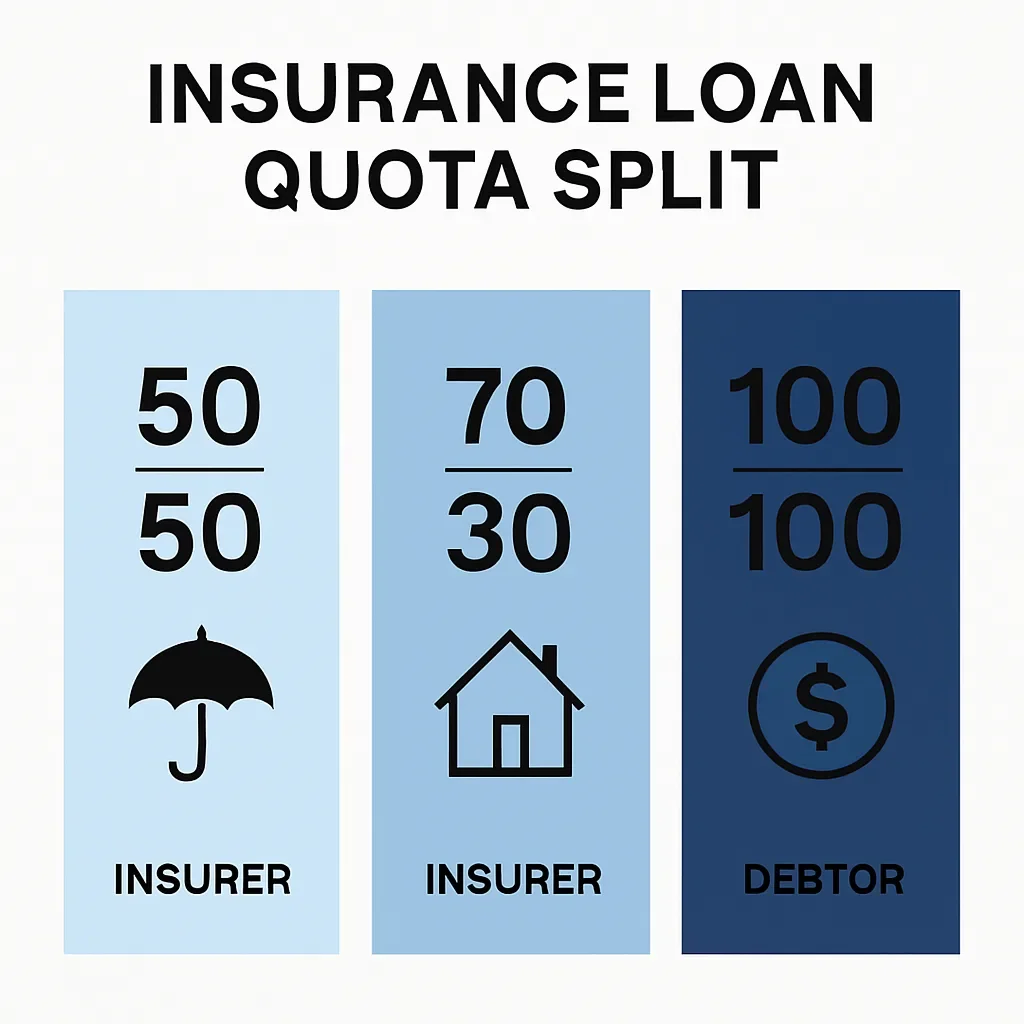
📌 The most common distributions are 50/50, 70/30, and 100/100. The stronger the protection, the higher the premium, but the less risk the household takes.
💡 The right choice mainly depends on your ability to continue repaying if one of the two disappears from the budget: death, disability, incapacity, or work stoppage.
How to divide borrower insurance shares when incomes differ?
When incomes are unbalanced, the share must protect the household’s actual ability to repay. The right reflex is to best cover the person who contributes the most to the budget, while keeping a simple logic: the total shares must reach at least 100% of the loan.
On paper, many couples think it’s enough to split “half and half.” In real life, this is not always the smartest. If a co-borrower contributes 70% of the household income, it may be coherent to assign them a higher share, especially if the other could not alone afford a monthly payment of several hundred euros.
The logic is quite down-to-earth: we look at who pays the most, who can handle the budget most easily, and who would have the hardest time absorbing a claim. This combination avoids false good ideas, like a 50/50 split that looks “nice” on paper but is a bit fragile as soon as one income drops.
According to the practical sheets of Service-Public.fr, borrower insurance is meant to secure loan repayment in case of hardship. In other words, the share is not chosen just to look nice: it is used to prevent a loss of income from turning the loan into a burden for the household.
- Step 1: identify the share of income brought by each person.
- Step 2: estimate who could pay the monthly payment alone for several months.
- Step 3: adjust the distribution according to the desired level of protection.
50/50, 70/30 or 100/100: which split for which couple?
There is no magic distribution. In practice, the right balance mainly depends on the income level, job stability, and each person’s ability to take over the monthly payment alone if the other is affected. The icing on the cake is that the right choice is not necessarily the most covered: it is the one that balances protection and budget.
| Distribution | Suitable profile | Main advantage | Limit |
|---|---|---|---|
| 50/50 | Similar incomes, balanced budget | Simple, clear, often cheaper | May be light if one earns much more than the other |
| 70/30 | Moderate to marked salary gap | Better matches household reality | Unequal protection if the more covered co-borrower disappears from the budget |
| 80/20 | One borrower carries the majority of the income | Strengthens the financial pillar’s coverage | May seem unbalanced if both repay equal shares of the monthly payments |
| 100/100 | Seeking maximum security | The loan can be fully covered for each | Often higher premium |
A bank agent often observes that couples with a large income gap avoid 50/50 reflexively, especially when the monthly payment exceeds a sensitive part of the budget. Conversely, a family that already has emergency savings may accept slightly less aggressive coverage to avoid unnecessarily increasing the premium.
The right trade-off is not “paying as little as possible” or “covering everything at all costs.” It is finding the ridge line where the couple remains protected without financing unnecessary overinsurance.
For couples whose incomes are fairly close, 50/50 remains logical. As soon as one of the two carries most of the budget, 70/30 or 80/20 often becomes more coherent. 100/100, meanwhile, is more for those who want very reassuring coverage, even if it means paying more.
Can the shares be changed after signing?
Yes, but it requires a contractual modification or a change of insurance, with the bank’s approval. If the new distribution reduces the overall protection or changes the guarantees, the lending institution may request adjustments or even refuse the endorsement if equivalence is not respected.
This is a point many discover too late: the share is not necessarily set in stone. If your situation changes — salary increase, birth, separation, career change, moving abroad — it may be relevant to review the allocation. Since the Lemoine law, changing insurance is more flexible than before, which opens the door to more frequent adjustments.
In practice, two things must be checked: first the equivalence of guarantees, then the bank’s approval if the original contract strictly governs the distribution. Again, it is better to compare before signing than to try to correct urgently afterward, when the file is already well advanced.
The INSEE portal reminds us how much couple and household situations vary from one household to another. It is not superfluous to recall this: a distribution valid at signing can become unstable if the household’s income or expenses change significantly a few years later.
Different shares according to guarantees: useful or gimmick?
In most contracts, the share applies identically to the main guarantees, such as death, PTIA (total and irreversible loss of autonomy), or disability. But some contracts or arrangements may provide for a finer interpretation, with protection designed differently according to the risk covered. And here, you need to be attentive, because not all risks play the same role.
For example, a couple may want very strong coverage on death and PTIA, but accept a slightly less ambitious level on temporary work incapacity, especially if one of them already has good salary protection. It is not automatic, but the idea is clear: you do not necessarily protect a permanent risk and a temporary work stoppage in the same way.
The ANIL website reminds us that real estate financing must be considered as a whole, not just from the interest rate perspective. This advice is valuable here: a share consistent with your real life is better than a theoretical formula that ticks the boxes but does not fit your daily life.
- Death / PTIA: strong protection is often sought because the financial impact is immediate and lasting.
- ITT / disability: the right level depends more on your profession, your savings, and the aids already available.
- Job loss: optional guarantee, often more expensive, so to be studied with caution.
Errors That Increase the Bill or Risk Taken
The number one trap is confusing monthly payment distribution with borrower insurance share. You can very well pay the loan 50/50 and have coverage at 70/30, or the opposite. It’s not the same mechanism, and banks mainly look at the level of security offered on the loan.
Second common mistake: under-insuring the co-borrower who already carries the household budget. If this person disappears from the financial scheme, the household may face a monthly payment that is too heavy to absorb. This is where the “nice” ratios become a bit brittle.
Third mistake: neglecting the impact of cost. A higher share protects better, yes, but it generally increases the premium. The right balance is therefore to aim for useful coverage, not maximum coverage out of reflex. Otherwise, you pay every month for peace of mind that does not necessarily correspond to your reality.
Finally, do not forget the context of the financed property. For a primary residence, the protection logic is often more cautious than for a rental investment where rents can offset part of the risk. The important thing is to align the share with the actual use of the loan, not with a standard formula from a too-quick simulator.
- Not checking if the sum of the shares reaches at least 100%.
- Taking a 100/100 without calculating its extra cost over the entire loan term.
- Choosing a 50/50 when the income gap is very marked.
- Forgetting to anticipate a separation, a birth, or a drop in activity.
FAQ
Can the sum of the shares exceed 100%?
Yes. For a loan with two borrowers, it can go up to 200% with a 100/100 distribution. This is a real overprotection logic, often chosen when the household wants to avoid any out-of-pocket expense in case of a serious claim.
Is it necessary to do 50/50 when borrowing as a pair?
No, and it would sometimes even be a bad idea. 50/50 is practical when incomes and expenses are close, but it becomes less relevant if one of the two carries a significant part of the budget. In short, fairness does not always equate to equality.
If one of the co-borrowers is self-employed, does the logic change?
Yes, often. A self-employed person may have more variable income, so a higher share on their head can secure the file, especially if the household depends heavily on their activity. Conversely, if their assets or emergency savings are solid, the balance can be more nuanced.
Does the share affect the loan monthly payment?
Not the loan monthly payment itself, but the insurance cost. The higher the insured share, the more the premium tends to rise. That’s why a 100/100 is very reassuring, but can increase the bill over the entire loan term.
Can shares be different if married or in a civil partnership?
Yes. The couple’s status does not lock the distribution; it’s mainly the incomes, financial stability, and desired level of protection that matter. Married, in a civil partnership, or cohabiting, the principle remains the same: coverage must match the household’s reality.
Is a lower share acceptable for a rental investment?
Often yes, but the setup must be looked at as a whole. Rents can offset part of the risk, which sometimes leads to reducing coverage. That said, if the loan relies on a limited personal contribution or if profitability is tight, it’s better to stay cautious.