
In Brief
🙂 Borrower’s insurance delegation involves choosing a contract outside the bank, often more finely priced according to your profile.
💡 Since the Lemoine law (2022), changes are possible at any time for the relevant mortgage loans, without waiting for an anniversary date.
🧾 The crux of the matter remains the equivalence of guarantees: if the new contract protects at least as much as the old one, the bank cannot refuse on principle.
How Does Borrower’s Insurance Delegation Work?
Borrower’s insurance delegation involves choosing a contract outside the bank, provided the required guarantees remain equivalent. On a mortgage loan, this can reduce the total cost, especially if your profile is young, non-smoker, or less exposed to certain risks.
In practice, the bank often offers its group insurance, pooled for all clients. Delegation, on the other hand, is based on an individual contract taken out with another insurer. This is not just jargon: the pricing method changes completely, and that’s where the differences appear.
The mechanism has been regulated since the Lagarde law of 2010, then strengthened by the Hamon law in 2014 and, above all, by the Lemoine law which came into effect in 2022. In short, the borrower has gained ground. According to the Ministry of Economy, changing borrower’s insurance is now possible at any time for the relevant contracts.
The key point is the standardized information sheet (FSI). This document lists the guarantees required by the bank, with their expected level. Your new contract must meet this specification point by point, otherwise the file may get stuck. This means that comparison should never be limited to price alone.
You also need to distinguish two words that are often confused: delegation, when you choose an external insurer, and substitution, when you replace an existing contract. In everyday language, people mix the two. Practically speaking, the idea remains the same: you no longer have to accept the bank’s insurance passively.
Why can delegating borrower insurance reduce the bill?
Because the bank’s group insurance pools risks, whereas an individual contract can be priced much more precisely. As a result: depending on your age, smoking habits, profession, or insured share, the cumulative difference over the loan term can quickly become very significant.
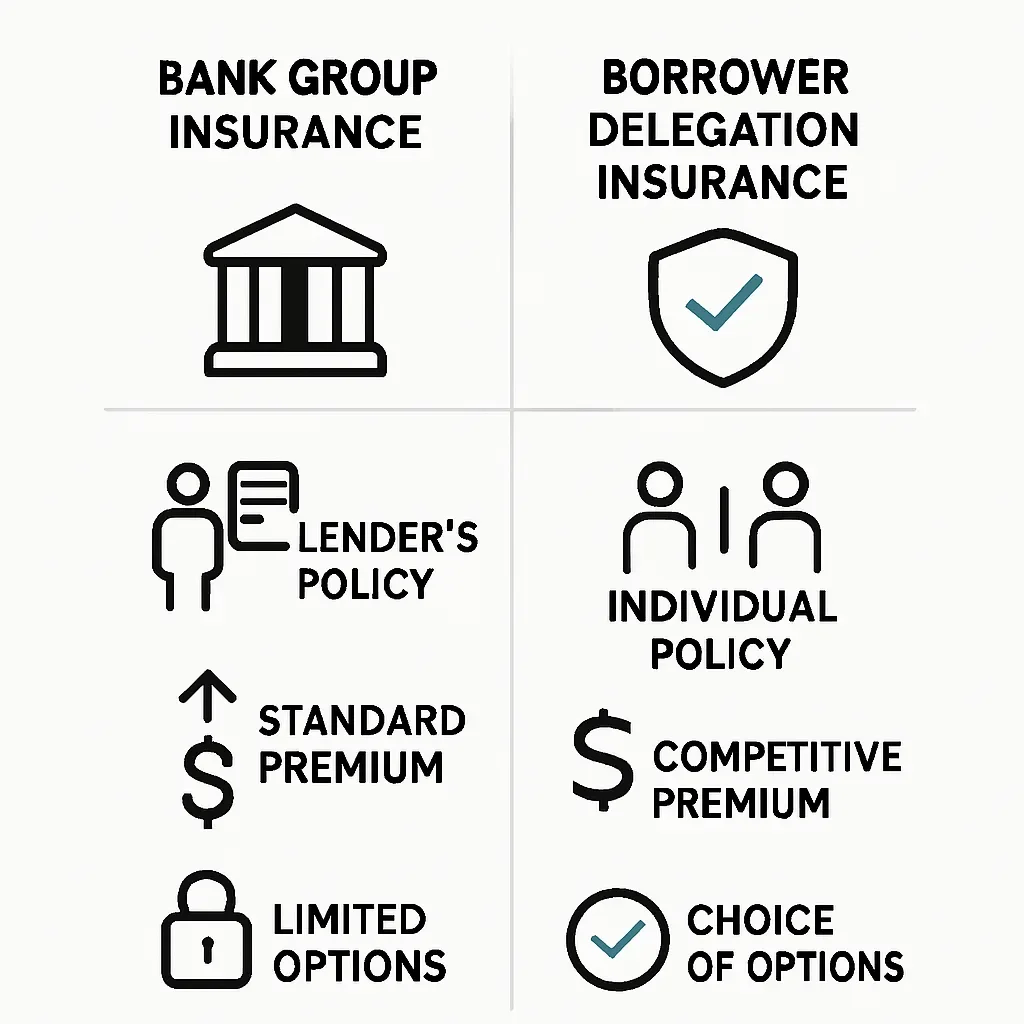
The right approach is to look at the TAEA rather than just the monthly price. The annual effective insurance rate better reflects the real cost over the entire credit period. A contribution of a few euros less each month may seem trivial, but it becomes significant over 15, 20, or 25 years.
| Criterion | Group Insurance | Delegation |
|---|---|---|
| Pricing | Mutualized, often smoother | Individualized, more tailored to the profile |
| Flexibility | Limited choice | Broader, subject to equivalence |
| Possible savings | Often low for favorable profiles | Sometimes very clear over time |
| Guarantees | Standardized | To be compared line by line |
| Target audience | Seeking simplicity | Seeking the best protection/price ratio |
In practice, three levers weigh the most: the insured share, the age at subscription, and the presence of exclusions. A cheaper but less protective contract is not a good deal. Conversely, a well-calibrated delegation can lighten the bill without weakening the loan.
How to set up borrower insurance delegation without blocking the loan?
The simplest way is to request the standardized information sheet, compare the guarantees point by point, then send the new contract to the bank before final signing. If equivalence is respected, validation is usually a formality. The real pitfalls are exclusions, the insured share, and administrative delays.
The Ministry of Economy reminds that the borrower can change insurance at any time since September 1, 2022 for the concerned contracts. In reality, it is better to proceed methodically, because a well-prepared file passes much better than a rushed submission.
Quick checklist before sending the file
- FSI from the bank, to compare exact requirements.
- Detailed quote from the new insurer, with guarantees and exclusions.
- Share of each co-borrower, especially if you borrow as a pair.
- General conditions of the contract, not just the commercial summary.
- Health questionnaire if still required depending on the situation.
In practice, files that pass on the first try are often those where the borrower has reviewed the FSI line by line. Conversely, a poorly worded ITT guarantee or a badly allocated share is enough to delay the exchange for weeks.
Once the contract is chosen, the process is usually done by mail, client portal, or through the bank advisor. The idea is not to “negotiate by feel,” but to produce a clean, readable, and comparable file. The more precise it is, the less the bank can nitpick.
Why can the bank refuse, and what to do?
A bank mainly refuses when the guarantees of the new contract are deemed insufficient or poorly documented. The refusal is not the end of the game: you must demand a written explanation, correct the weak points, then resubmit a clean file. In short, you don’t negotiate blindly.
The most frequent reason for refusal remains the absence of equivalence of guarantees. If the new contract covers ITT, PTIA, IPT, IPP, or death less well, the bank has a serious basis to say no. The problem is that a refusal can sometimes mask a simple reading misunderstanding.
It is therefore necessary to ask for a precise response, line by line. The proposed contract should not be compared “roughly,” but according to the bank’s criteria. This is where technical vocabulary matters: some guarantees seem identical while they do not trigger compensation under the same conditions.
The most useful approach is to review the file with a real sense of detail: waiting period, sports exclusions, qualifying periods, disability criteria, coverage in partial disability. If a point is blocking, adjust the contract, negotiate the share, or change insurer. The market is broad enough to avoid deadlock.
For a reminder of the basic principles, Service-Public.fr centralizes the rights and useful procedures around mortgage credit and borrower insurance. This is not luxury, because a misunderstood refusal wastes time… and sometimes significant savings.
Which profiles benefit the most from borrower insurance delegation?
The biggest gains often appear with young borrowers, non-smokers, in good health, or on a long loan. Conversely, risk profiles can also benefit, but only if exclusions and surcharges remain more competitive than the group contract.
The “winning” profile is therefore less a social category than a combination of parameters. A stable 32-year-old employee, a couple without medical history, or a first-time buyer borrowing over 25 years do not necessarily have the same interest, but they all have something to watch: the total cost over the duration.
Here are the cases where borrower insurance delegation really deserves your attention:
- Young borrower: the bank often pools too broadly, so the individual contract becomes more competitive.
- Non-smoker: the rate can drop significantly if the tobacco surcharge disappears.
- Co-borrower with solid income: a well-thought-out share can reduce the bill without cutting protection.
- Long-term loan: the further away the deadline, the more the cumulative gap can rise.
- Senior profile: you need to compare very carefully, as the rate increases with age and some guarantees become more expensive.
Conversely, a group contract can sometimes remain relevant for a person in a complex medical situation or with a difficult insurance history. It is not a failure to stay with the bank; it is just a sign that you need to compare equivalent guarantees, not just the listed price.
What mistakes should be avoided before signing?
The biggest mistake is to look only at the displayed price. A delegation that is too cheap may hide exclusions, an incorrect coverage percentage, or shaky compensation in ITT. The right choice is the one that truly protects your loan without unnecessary extra cost.
In other words, the cheapest contract is not necessarily the most cost-effective. It is better to pay a little more for real coverage than to end up with poorly adapted insurance at the first problem. Joking aside, this is often where unpleasant surprises occur.
- Comparing only the monthly payment instead of the total cost over the duration.
- Forgetting the coverage percentage, especially in joint loans.
- Ignoring exclusions related to the back, sports, or certain professions.
- Choosing a contract without checking the bank’s FSI.
- Rushing into a promotional offer without reading the compensation conditions.
A good borrower’s insurance is not just a falling price. It is a contract that protects you when life goes awry, without turning the promised savings into a false good deal.
If you have to remember one simple rule, take this one: borrower’s insurance delegation is judged on price, guarantees, and management flexibility. When these three factors move in the right direction, you often hold a real lever for savings.
FAQ: Everything you need to know about borrower’s insurance delegation
Can you change borrower’s insurance after several years of loan?
Yes, for the concerned real estate loans, changing is possible at any time since the Lemoine law. This is precisely what makes delegation interesting on an old loan, especially if your profile has improved or if your current contract has become too expensive.
Should each borrower insure 100% when borrowing together?
Not necessarily. The coverage percentage can be split 50/50, 70/30, 100/100, or other combinations, but it must remain consistent with the risk and the bank’s requirements. The higher the coverage percentage, the more expensive the contract.
Is borrower’s insurance delegation possible with a health risk?
Yes, but the contract must be compared with even more rigor. Depending on the profile, the AERAS system can help find a solution. The key is to check exclusions, waiting periods, and the level of compensation in case of incapacity or disability.
Does having a risky profession prevent making savings?
No, not automatically. Some exposed professions can obtain a more competitive rate than with group insurance, but exclusions and sports or professional guarantees must be monitored. Sometimes, the price difference exists, but it depends on the quality of coverage.
Can the bank change the loan rate if I modify the insurance?
In principle, no: the loan rate and borrower’s insurance are two separate matters. The bank must not condition the rate on accepting an insurance contract. If this happens, you should request a written justification and carefully check the file.
When is the right time to compare offers?
The best time is before signing the loan, but you should not stop there. If you have already signed, a comparison remains useful at any time. The higher the remaining capital, the more delegation can still generate a visible gain.