
Health insurance for job seekers: how to choose well?
Looking for health insurance for job seekers often comes at the worst time: income decreases, but health expenses do not take a break. Between the portability of the previous insurance, the Solidarity Health Supplement, and individual contracts, the real challenge is simple: avoid coverage gaps without blowing up the budget.
Sommaire
In brief
💡 If you have just lost your job, portability can extend your previous insurance for up to 12 months, without any contribution to pay out of pocket.
🧾 If your resources are modest, the CSS may be the most cost-effective option: the application is made through Health Insurance and the income of the last 12 months is reviewed.
📌 To compare intelligently, first look at hospitalization, dental, and optical coverage, not just the monthly premium displayed in large characters.
🎯 The right contract is not always the cheapest. It is mainly the one that fits your actual situation: end of rights, scheduled care, covered spouse, or imminent return to work.
Which health insurance to choose when you are unemployed?
The best choice mainly depends on your current situation: if you can keep the company insurance, portability is often the simplest solution; if your income is low, the CSS can do better; otherwise, an individual insurance or the spouse’s contract becomes the fallback option.
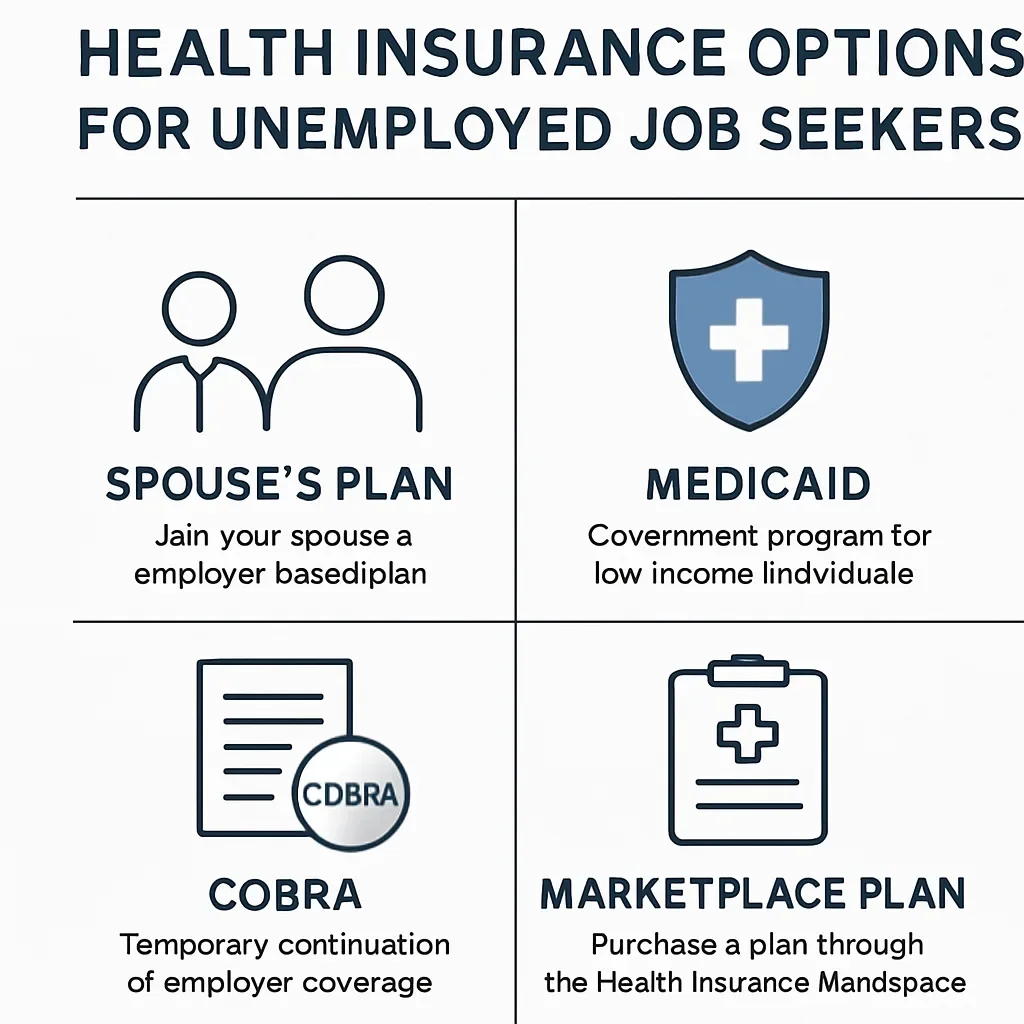
In other words, you should not choose “a health insurance” in absolute terms, but the right coverage solution at the right time. A single person without heavy care does not have the same priority as a parent with orthodontic treatment planned, nor as a person under medical follow-up. In Lille, Nantes or Marseille, the budget difference between a basic plan and a well-covered plan can quickly be felt.
| Solution | When it is useful | Strength | Main limitation |
|---|---|---|---|
| Portability of company insurance | After a contract termination giving entitlement to unemployment benefits | Simple maintenance, often no out-of-pocket expense | Limited duration |
| Solidarity Health Supplement (CSS) | Modest income or sudden drop in resources | Very protective coverage, often free or low cost | Conditioned on household income |
| Individual insurance | If portability no longer exists or if CSS is not accessible | Free choice of guarantees | Can quickly become more expensive |
| Spouse’s insurance | If the family contract allows it | Simple solution to reduce overall contribution | Depends on the contract and beneficiaries |
The real good reflex is to put these options in competition based on the same health need. A person who rarely consults can aim for a light contract, while another who already has dental care planned has every interest in favoring stronger coverage, even if the premium rises a bit.
How to keep your company insurance after job loss?
Portability often allows you to keep your company insurance after leaving the company, provided you were covered by the collective contract before termination and are eligible for unemployment insurance. Maintenance is free for the former employee, but it cannot exceed 12 months.
According to Service-Public.fr and practical information relayed by Health Insurance, this system works as an automatic extension of the collective contract. In short, you keep the same guarantees without having to urgently subscribe to an individual insurance the day after the contract ends.
For portability to start smoothly, several simple but non-negotiable conditions usually need to be met:
- the termination of the contract must not be due to gross misconduct;
- you must have been covered by the collective mutual insurance before the end of the contract;
- you must be entitled to unemployment benefits;
- the former employer and the insurer must be informed of the situation.
Good to know: portability often avoids the infamous “coverage gap” that happens when you think you have time, then end up paying full price for a consultation or glasses. In practice, this is exactly where people get caught out.
Is the Complementary Health Solidarity the best option?
Yes, if you are eligible. The Complementary Health Solidarity often becomes the most advantageous solution for a job seeker with modest income, as it can be free or require a small contribution, with very broad coverage of essential care.
The official website of the Complementary Health Solidarity for job seekers reminds that unemployment status facilitates access to the scheme when household resources remain below the thresholds. The application is made to the Health Insurance fund, with an examination of income over the last 12 months.
The CSS is particularly interesting if you have little financial leeway, as it covers reimbursable care within a very protective framework. It can include:
- routine medical consultations;
- hospitalization;
- basic dental care;
- optical and hearing care within the provided frameworks;
- third-party payment in covered situations.
It should be noted that the CSS is not a “big premium contract” with endless options. It is rather a very effective safety net, designed to prevent necessary care from being postponed due to financial reasons. The icing on the cake is that it fits well with transition periods, when the budget is tight and time is limited.
How much does an individual mutual insurance cost when unemployed?
An individual mutual insurance can start at a still reasonable price, but the bill quickly rises as soon as you seek real reimbursements in dental, optical, or hospitalization care. In practice, entry-level offers are often seen around €20 to €40 per month, then more comfortable plans between €50 and €90 for a single adult.
In practice, it is observed that a young profile, without planned care, readily accepts a basic plan. However, as soon as an orthodontist, a pair of glasses, or a private room comes into the equation, the price difference becomes much more noticeable, especially in cities like Rennes, Nantes, or Marseille.
The premium does not depend solely on age. Insurers also look at the level of coverage, any waiting periods, the presence of a care network, reimbursements as a % of the Social Security rate, and sometimes annual caps. In other words, a low-price plan can be costly when you actually use your benefits.
Here are the criteria that most affect the price:
- hospitalization: private room, extra fees, daily flat rate;
- dental: prosthetics, implants, orthodontics;
- optical: complex lenses, frames, renewal;
- waiting period: some coverages start later;
- age and area of residence: prices often rise in large cities.
At this stage, you need to think in terms of actual cost and not just the monthly payment. A mutual insurance at €28 that poorly reimburses glasses can end up being more expensive than a contract at €42 that is better calibrated. That is why the comparison must always start from your health needs, not the commercial slogan.
What criteria should you compare before signing?
The right contract is identified less by its introductory price than by its ability to reimburse the areas that really concern you. If you have planned care, prioritize comparing hospitalization, dental, optical, excess fees, and waiting periods; the rest comes after.
The cheapest mutual insurance is not necessarily the smartest. The one that reimburses the bad areas just makes you pay less… only to be disappointed the day you need it.
Here is a simple method to avoid unpleasant surprises:
- list your probable expenses over 6 to 12 months: glasses, dentist, specialist, hospitalization;
- check the reimbursement ceilings, not just the displayed percentage;
- look at the waiting periods if you need care quickly;
- control exclusions and annual limitations;
- compare the final out-of-pocket costs, especially on costly items.
Serious mutual insurers now display fairly clear guarantee tables. This is appreciated, because the jargon can quickly become dizzying: “300% BR”, “flat rate”, “care perimeter”, “partner networks”. In short, what you are looking for is a contract capable of absorbing the real expense, not a document that looks nice in a PDF.
What to do at the end of portability or unemployment rights?
As soon as portability ends, you must restart the process without delay: either you switch to a new mutual insurance, or you activate the CSS if you are eligible, or you join your spouse’s contract. The classic mistake is to wait until the last minute and find yourself without coverage for a few days.
To avoid this scenario, keep a very simple roadmap:
- note the end date of portability;
- take stock of your upcoming care;
- compare 2 or 3 quotes before the effective break;
- check if returning to work triggers a mandatory mutual insurance;
- if necessary, prepare the CSS file in advance.
Depending on your profile, the transition can be very quick. Returning to a position in Paris, Lyon or elsewhere can reactivate collective coverage in a few days, but that is no reason to remain in the dark. In case of doubt, the Health Insurance on ameli.fr remains a good entry point to check the right administrative reflexes.
FAQ — Health mutual insurance for job seekers
Can you have free mutual insurance when you are unemployed?
Yes, via portability if you came from a company mutual insurance, or via CSS if your resources are sufficiently modest. Portability is free for the former employee; CSS can be free or require a small contribution depending on the scale.
Can the spouse’s mutual insurance replace an unemployment mutual insurance?
Often yes, but it is not automatic. It all depends on the spouse’s contract, the notion of dependent, and the rules of the organization. In some households, it is the simplest solution to avoid double contributions.
Should you keep an individual mutual insurance if portability starts?
Not necessarily. If portability already covers your needs, keeping an individual mutual insurance in parallel often means paying twice for the same thing. It is better to check the exact dates and the quality of guarantees before stacking.
Does the CSS reimburse glasses and dentist well?
Yes, but within a specific framework. CSS properly covers essential care and strongly limits out-of-pocket expenses, provided the tariffs and provisions are respected. For high-end options, it is sometimes necessary to supplement otherwise.
What happens if I find a job quickly?
Portability ends when a new collective coverage is established, or when the conditions are no longer met. In practice, you must inform the insurer and your new employer, especially if the company mutual insurance becomes mandatory upon hiring.
Should I wait until my unemployment benefits end to change my mutual insurance?
No, on the contrary. The right time to compare is before the current coverage actually ends. This way, you avoid days without protection and gain time to prepare a CSS file or sign a new supplementary insurance.