
Map of French Academies: Associated Departments and Quick Guide to Find Your School Zone
| 📌 | Definition: a school academy is an administrative district of the National Education that groups one or more departments. |
| 🗺️ | Key reference: the map of academies in France allows you to identify the correct rectorate in seconds, based on a department or postal code. |
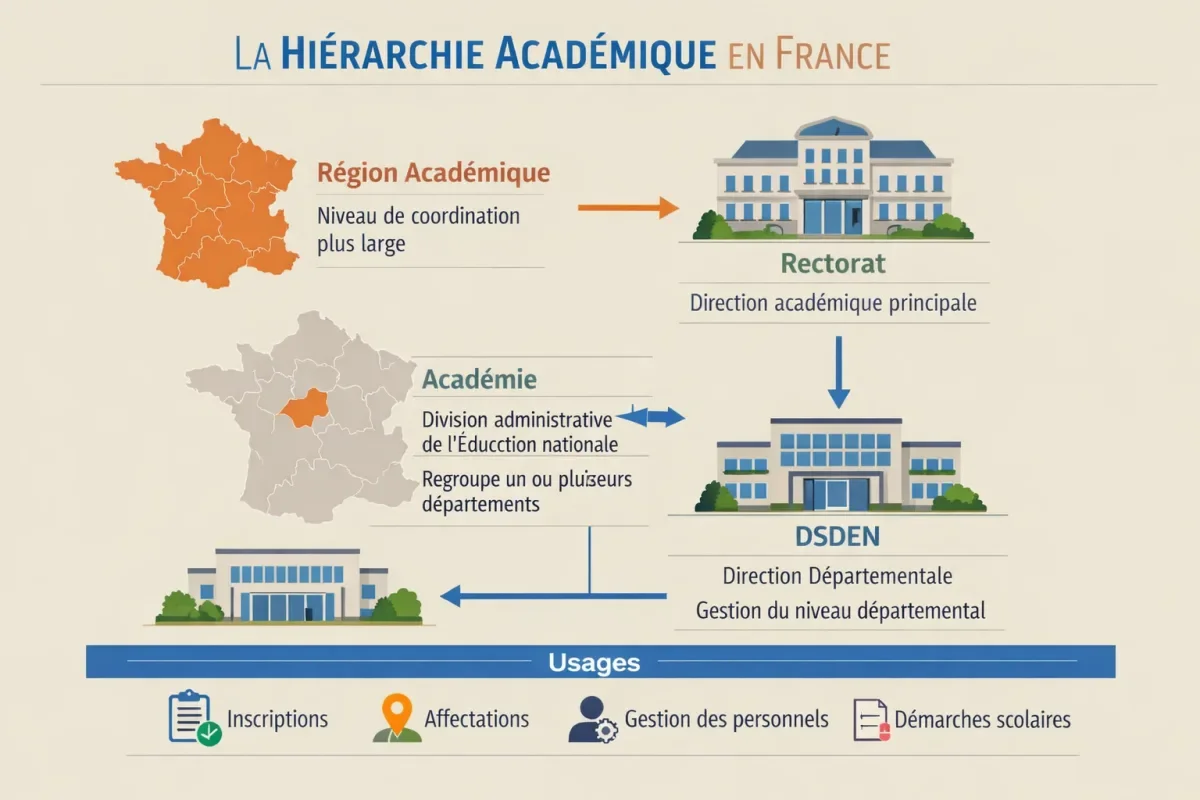
| 🏢 | Rectorate and DSDEN: the rectorate oversees the academy, while the DSDEN manages the departmental level. |
| 📍 | Practical use: useful for registration, assignment, file transfer, or local school procedures. |
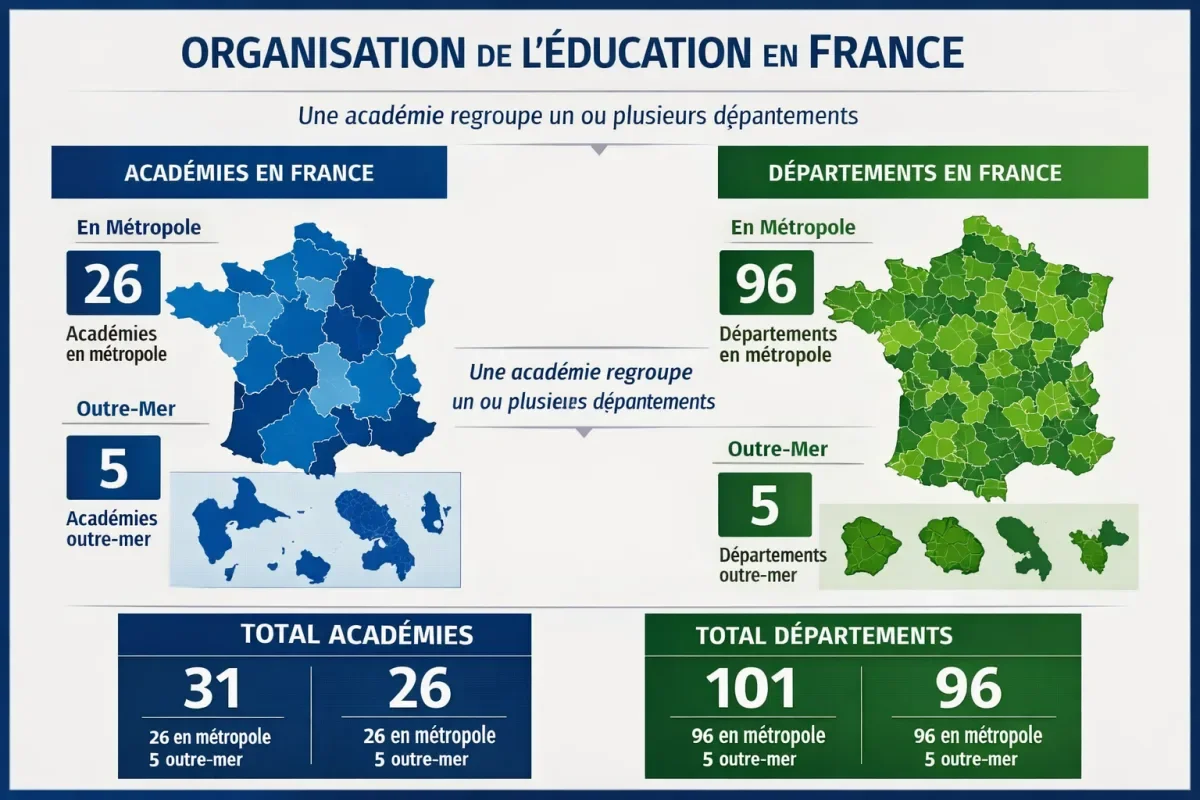
| 🌍 | Complete breakdown: France has a total of 31 academies, including 26 in metropolitan France and 5 overseas. |
| ✅ | Verification: in case of doubt, final confirmation must be made from the official sources of the ministry and the concerned rectorate. |
A map of French academies primarily serves to quickly find the competent school authority for a given territory. Updated in April 2026, this page gathers the list of French academies, the associated departments, the most common special cases, and a simple method to go from a postal code to the correct academy. The goal is practical: to avoid confusion between academy, academic region, department, and rectorate.
In the French educational system, the academy is not just a geographic area. It is an administrative framework that structures registrations, assignments, staff management, exams, and part of the school-related procedures. For a parent, a student, or a user, the most important thing remains knowing where to look for information and how to verify that a territory indeed depends on the correct rectorate.
Sommaire
What is a school academy and what is its purpose?
A school academy is an administrative division of the National Education that groups one or more departments. It serves to locally organize school, middle school, high school, exams, and administrative services. In practice, it is the right level to identify the competent rectorate and the associated departmental services.
Academy, academic region, rectorate, and DSDEN: key differences to remember
These concepts are similar, but they do not play the same role. The academy corresponds to the operational perimeter of the National Education; the academic region is a broader coordination level; the rectorate is the administration that manages the academy; the DSDEN acts at the departmental level. For the user, this hierarchy prevents contacting the wrong service.
- Academy: administrative territory of reference for the National Education.
- Rectorate: main academic direction, often located in the most important city of the perimeter.
- DSDEN: departmental direction, useful for local procedures.
- Academic region: management level grouping several academies in certain areas.
Why this division is useful daily
The division by academy serves to know where to send a file, where to look for an assignment, which service to contact, and which local regulation applies. It is particularly useful for the school map, registrations in public education, transfers, or preparing a change of institution. In case of doubt, one always starts from the department or postal code.
Complete map of academies and associated departments
The list below covers all metropolitan and overseas academies. For quick use, the most efficient reading consists of first finding the department, then the corresponding academy. This is the most reliable method to find your academy without getting lost in regional divisions.
| Academy | Associated Departments | Main Cities | Useful Particularities |
|---|---|---|---|
| Aix-Marseille | 04, 05, 13, 84 | Aix-en-Provence, Marseille | Academy covering four departments of Provence-Alpes-Côte d’Azur. |
| Amiens | 02, 60, 80 | Amiens | Three departments of Hauts-de-France. |
| Besançon | 25, 39, 70, 90 | Besançon | Academy of the northeast of Bourgogne-Franche-Comté and the Territoire de Belfort. |
| Bordeaux | 24, 33, 40, 47, 64 | Bordeaux | Wide coverage of the southwest. |
| Clermont-Ferrand | 03, 15, 43, 63 | Clermont-Ferrand | Academy centered on Auvergne. |
| Corse | 2A, 2B | Ajaccio, Bastia | One academy for the entire island. |
| Créteil | 77, 93, 94 | Créteil | With Paris and Versailles, one of the three academic centers of Île-de-France. |
| Dijon | 21, 58, 71, 89 | Dijon | Academy structured around Burgundy. |
| Grenoble | 01, 07, 26, 38, 73, 74 | Grenoble | Six departments, including Savoie and Haute-Savoie. |
| Lille | 59, 62 | Lille | Academy focused on two departments of Nord and Pas-de-Calais. |
| Limoges | 19, 23, 87 | Limoges | An academy with low departmental density. |
| Lyon | 01, 42, 69 | Lyon | Not to be confused with the larger Auvergne-Rhône-Alpes region. |
| Montpellier | 11, 30, 34, 48, 66 | Montpellier | Includes the departments of the historic Languedoc-Roussillon. |
| Nancy-Metz | 54, 55, 57, 88 | Nancy, Metz | Academy of Lorraine in the functional sense. |
| Nantes | 44, 49, 53, 72, 85 | Nantes | Covers all of Pays de la Loire. |
| Nice | 06, 83 | Nice | Two departments, with a strong coastal concentration. |
| Normandie | 14, 27, 50, 61, 76 | Caen, Rouen | Single academy for the whole of Normandy. |
| Orléans-Tours | 18, 28, 36, 37, 41, 45 | Orléans, Tours | Academy covering six departments of Centre-Val de Loire. |
| Paris | 75 | Paris | Academy with a single department, very easy to identify. |
| Poitiers | 16, 17, 79, 86 | Poitiers | Historic academy of Poitou-Charentes. |
| Reims | 08, 10, 51, 52 | Reims | Four departments of Grand Est. |
| Rennes | 22, 29, 35, 56 | Rennes | Reference academy for administrative Brittany. |
| Strasbourg | 67, 68 | Strasbourg | Only two departments, one of the clearest divisions. |
| Toulouse | 09, 12, 31, 32, 46, 65, 81, 82 | Toulouse | The largest metropolitan academy by number of departments. |
| Versailles | 78, 91, 92, 95 | Versailles | Second academic center in Île-de-France, with a high density of institutions. |
| Guadeloupe | 971 | Basse-Terre, Pointe-à-Pitre | Overseas academy with a single department. |
| Guyane | 973 | Cayenne | Specific overseas case, very large territory. |
| La Réunion | 974 | Saint-Denis | Single-department academy in the Indian Ocean. |
| Martinique | 972 | Fort-de-France | Overseas academy with a single department. |
| Mayotte | 976 | Mamoudzou | Special case with a single department and academy. |
For administrative purposes, this overview is sufficient in most cases. If you compare departments by academy or if you need to confirm an assignment, keep in mind that the same academy can cover several departments, while some overseas territories correspond to a single academy.
How to find your academy from a department or postal code?
The fastest method is to first identify the department, then match it to the academy. From a postal code, you trace back to the department, except in Paris, Lyon, Marseille, and in some local configurations where you need to pay attention to the name of the municipality. Once the department is found, the academy is immediate.
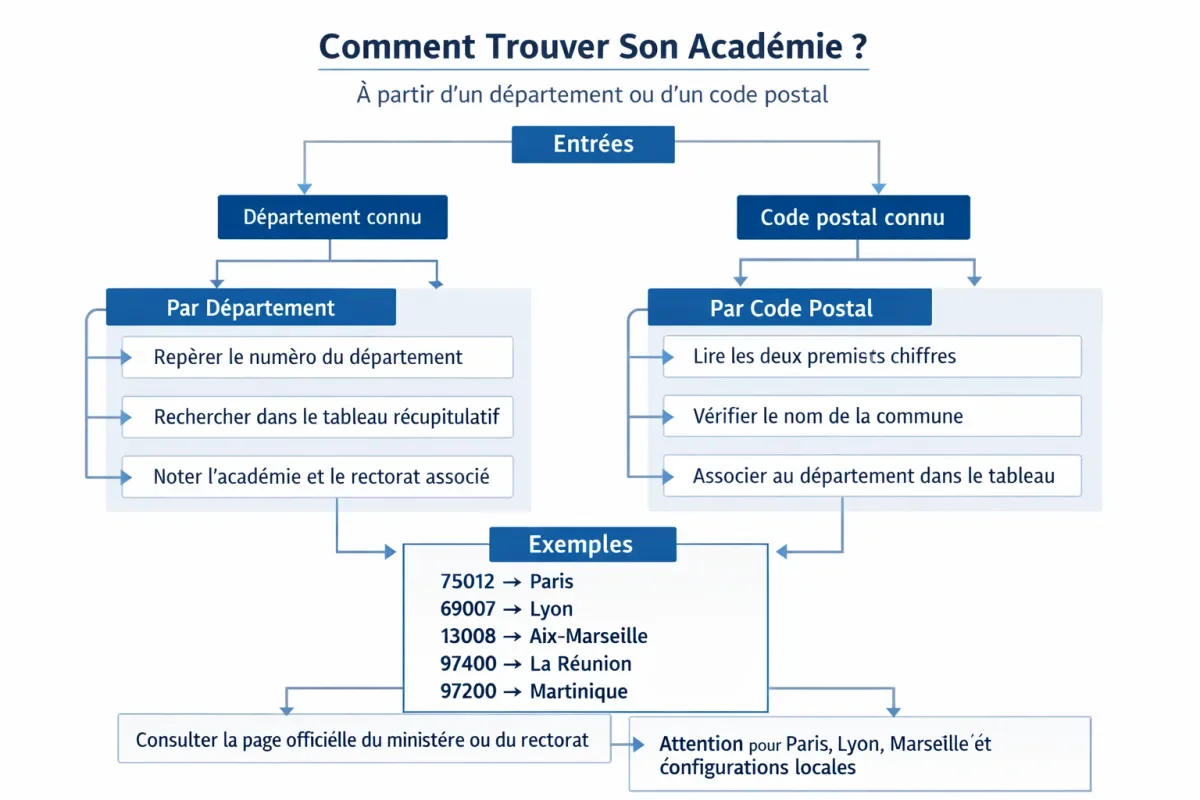
From a department
- Locate the department number on the address, a school document, or a form.
- Search for this number in the summary table above.
- Note the corresponding academy and, if needed, the associated rectorate.
From a postal code
- Read the first two digits of the postal code to obtain the department in most cases.
- Check the name of the municipality if the code could be confusing.
- Then associate the department with the academy in the table.
Some concrete examples help speed things up: 75012 refers to Paris, thus to the Paris academy; 69007 refers to Lyon, thus to the Lyon academy; 13008 corresponds to Marseille, thus to the Aix-Marseille academy; 97400 corresponds to La Réunion; 97200 to Martinique. This logic is often sufficient for routine administrative searches.
- Tip: if the form asks for the rectorate, take the name of the academy, then look for the corresponding rectorate.
- Tip: for registration, always keep the full address of the municipality, not just the postal code.
- Tip: in case of urgent verification, always compare the answer with the official page of the ministry or the rectorate.
Why do some academic boundaries seem counterintuitive?
Academies do not always follow the map of administrative regions in the strict sense, because they obey a logic specific to the National Education system. The result can be surprising: a region can be split between several academies, while an entire department can remain in a separate academy. This is common in Île-de-France and in overseas territories.
Île-de-France: Paris, Créteil, and Versailles
Île-de-France is the best-known case of division into three academies. Paris corresponds to its own perimeter, while the inner suburbs are attached to Créteil and the western outer suburbs to Versailles. This division is essential to manage a very dense area in terms of institutions, enrollments, and school procedures.
Overseas: academies often covering a single department
Overseas, the logic is easier to read on a map of academies in France. Guadeloupe, Guyane, Martinique, La Réunion, and Mayotte each have a distinct academy, generally aligned with the department. For the user, this reduces ambiguities, but it remains important to verify the exact titles of the rectorates.
Cases not to be confused
- Lyon Academy: it does not cover the entire Auvergne-Rhône-Alpes region.
- Normandy Academy: it groups several departments in a recent administrative merger logic.
- Toulouse Academy: it covers eight departments, which can be surprising if reasoning only by region.
What is the most reliable method to verify a school academy?
The most reliable answer remains to start from the department, then check the information on the official sources of the Ministry of National Education. In case of a sensitive procedure, such as registration, transfer, or change of institution, it is necessary to cross-check with the relevant rectorate. This final verification prevents zoning errors and administrative delays.
The official references provided by the French public administration, notably the pages of the ministry, Service-public, and Onisep, allow confirming the correct correspondence. This is particularly useful if a municipality has changed its boundaries, if you are consulting an old page, or if you are comparing several nearby territories.
Frequently asked questions about school academies
What is the difference between an academy and an academic region?
The academy is the operational perimeter of the Ministry of National Education for organizing school administration. The academic region is a broader coordination level, created to harmonize certain management aspects between academies. In daily practice, it is mainly the academy that is used to find the correct rectorate.
How to know to which academy a municipality belongs?
The simplest way is to start from the department of the municipality, then verify its correspondence in the list of academies. If the municipality is in Île-de-France or overseas, you need to be even more attentive, as the administrative division there is particularly structured.
Can my department change academy?
Yes, but this type of change remains exceptional and depends on administrative reorganizations. It is precisely for this reason that you should always check the update date of an academic map and, in case of an important file, confirm the information on the official pages.
Where to find the most reliable official information?
The most reliable references are the institutional websites of the Ministry of National Education, the relevant rectorate, and, for certain practical procedures, the public resources for guidance and administration. If information seems outdated or contradictory, prioritize the most recent official page.
Is the academic map the same as the school map?
No. The academic map is used to identify the administrative territory of the Ministry of National Education. The school map concerns more the assignment of institutions and recruitment sectors. The two concepts are related, but they do not exactly meet the same need.
In practice: how to quickly read the map of French academies?
To get straight to the point, remember a simple rule: one department leads to one academy, then to a rectorate. If you are looking for a school-related procedure, start with the postal code, convert it into a department, then compare it to the table. This method remains the fastest, most stable, and easiest to verify.
- Known department → academy found in a single step.
- Known postal code → department then academy.
- Île-de-France or overseas case → additional verification recommended.
- Sensitive procedure → confirmation on the official source before submission.