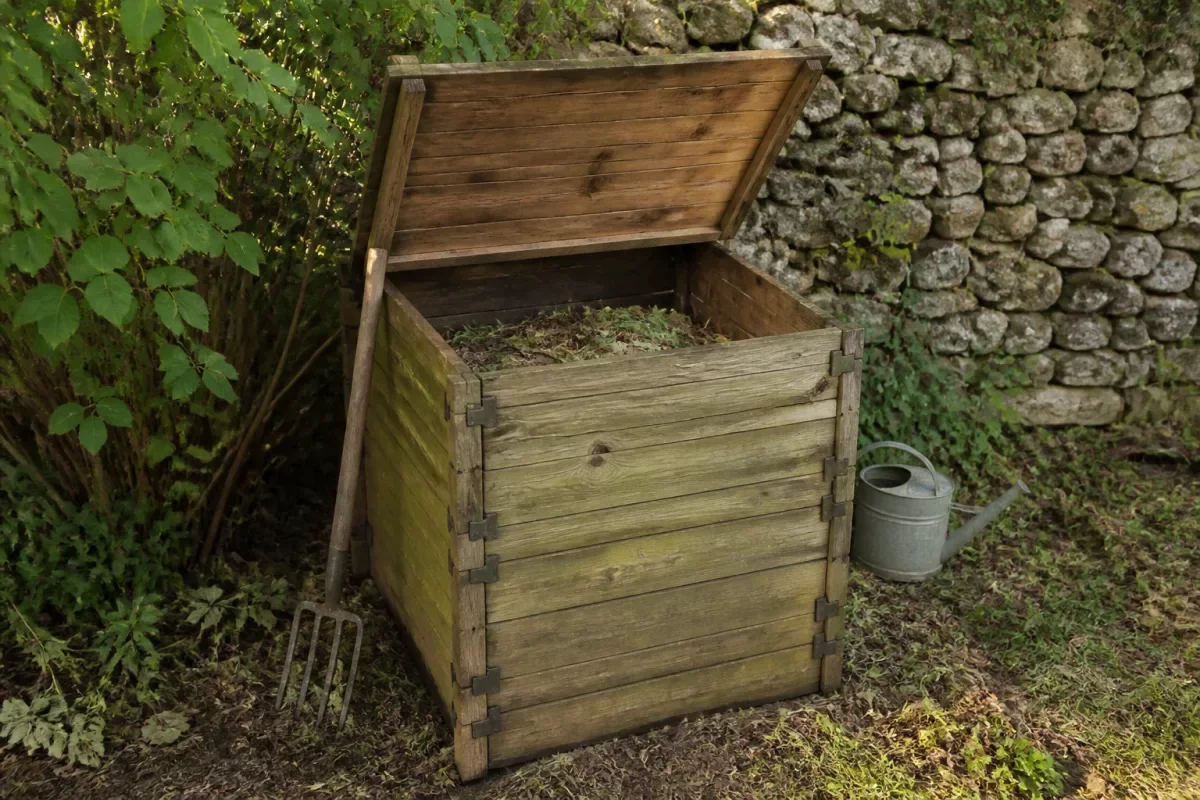
🪵 The wooden composter is mainly suitable for outdoor spaces and gardens.
🐛 The worm composter is designed for small spaces, including indoors.
⏱️ Mature compost is ready in about 4 months in a worm composter, compared to 6 to 9 months in a traditional garden bin.
💧 Wood requires maintenance against moisture, whereas the worm composter mainly demands good management of accepted waste.
Which composter to choose if you lack space?
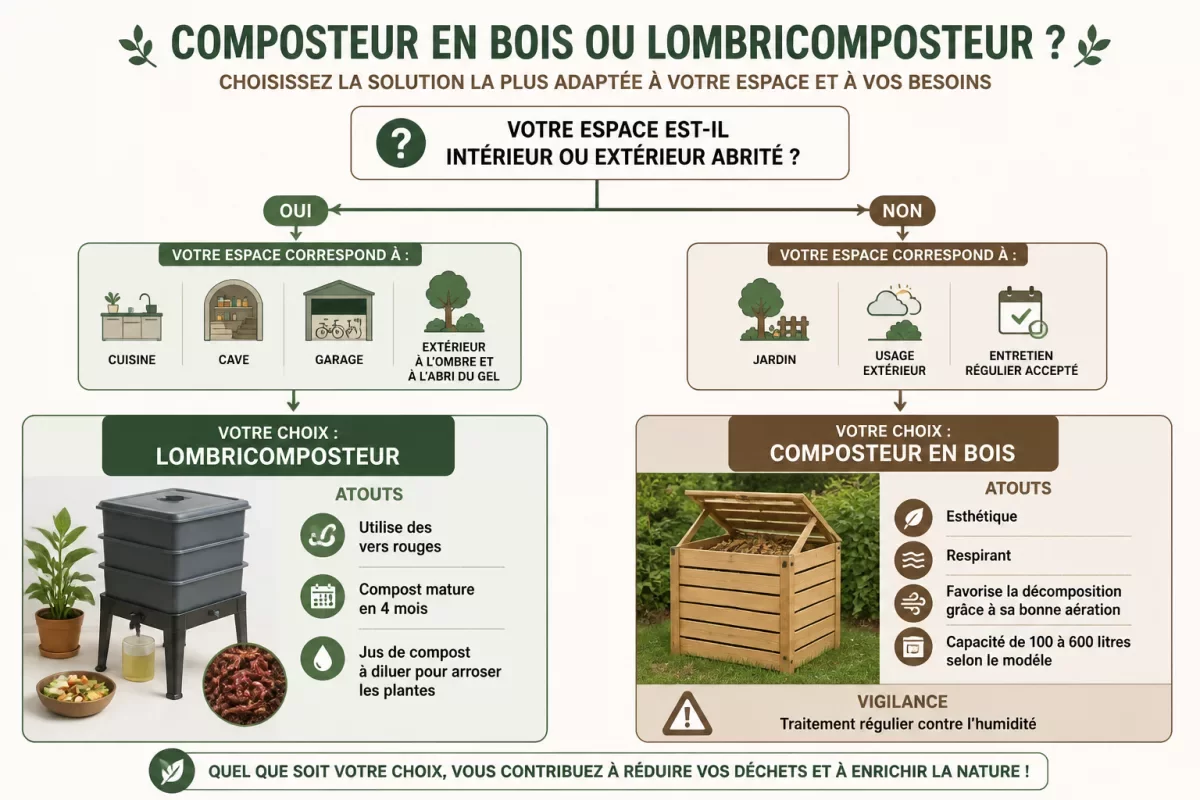
If your priority is available space, the worm composter almost always wins. It can be installed in a kitchen, cellar, or garage, or outside in the shade and protected from frost; the wooden composter makes sense as soon as a garden allows for its long-term installation.
The choice is first made based on space: indoor or sheltered outdoor for the worm composter, garden for the wooden composter. Mature compost arrives in about 4 months with a worm composter, compared to 6 to 9 months for a traditional bin.
The right reasoning is very concrete: the smaller your space, the more you need a compact and protected system; the more stable outdoor space you have, the more the wooden bin becomes relevant. It is also a matter of rhythm: the wooden composter works well for regular inputs, while the worm composter better supports a daily kitchen logic.
Choose the worm composter if you live in an apartment.
Choose the wooden composter if you have a garden and a sheltered location.
Choose a larger volume if several people produce biowaste.
Is the wooden composter made for a garden?
Yes, if you are looking for a more aesthetic, breathable system adapted to outdoor decomposition. The wooden composter is particularly suitable for those who want a stable, larger bin visually integrated into the garden, provided they accept regular maintenance against moisture.
A traditional bin can vary from 100 to 600 liters depending on the model. Wood remains interesting in a garden, but it must be regularly protected against moisture to last.
Wood has a real usage advantage: it allows air circulation, which promotes waste decomposition, and it blends better into a landscaped space than a technical bin. On the other hand, it must be considered as equipment to protect, not as a solution without monitoring; moisture will always eventually punish the lack of treatment.
The wooden composter is aesthetic, breathable, and promotes decomposition thanks to its good aeration.
You want a discreet and visually warmer composter.
You accept periodic checks of the wood’s condition.
In traditional models, capacity often ranges from 100 to 600 liters depending on the model. This range explains why the wooden composter remains a logical solution as soon as you want to process a regular volume of green waste and kitchen bio-waste.
Is the Worm Composter Really Suitable for an Apartment?
Yes, and it is often the simplest solution for housing without a garden. The worm composter uses red worms to digest organic waste, can live indoors, and produces mature compost in about four months; its juice can then be diluted in watering water.
The worm composter can be placed inside the home or outside sheltered from sun and frost.
The point of caution is not space, but the composition of inputs. Onions, leeks, and citrus fruits should not be added because they have vermifuge properties; in practice, a good worm composter mainly relies on suitable waste and well-managed humidity.
Keep compatible peelings and avoid overly aggressive waste.
Dilute the compost juice before watering plants.
Install it in a stable place, sheltered from strong temperature variations.
What Are the Real Differences in Cost, Maintenance, and Speed?
The differences are clear: the wooden composter generally costs more than a plastic model and requires maintenance against moisture, while the worm composter is mainly constrained by usage discipline and waste sorting. If you are looking for the least demanding solution to install, wood requires more space; if you want the most compact, the worm composter is more logical.
Criterion
Wooden Composter
Worm Composter
Space
Outside, ideally garden
Inside or outside in the shade, sheltered from frost
Volume
Traditional bin: 100 to 600 liters depending on model
Suitable for small household volumes
Time before mature compost
6 to 9 months in garden
About 4 months
Maintenance
Regular treatment against moisture
Sorting waste and respecting compatible inputs
Main advantage
Aesthetic, breathable, good aeration
Compact, usable indoors, compost juice usable diluted
Point of caution
More expensive than plastic and sensitive to water
Avoid onions, leeks, and citrus fruits
Composting prevents anaerobic degradation of waste in confined environments, which reduces methane production.
The best decision depends less on an aesthetic preference than on your lifestyle. If you are looking for a stable and large system for a garden, the wooden composter is the obvious choice; if you want to compost in an apartment, the worm composter is more coherent.
You live in an apartment: get a worm composter, as it works indoors and requires little floor space.
You have a garden: choose a wooden composter if you want a discreet, ventilated, and durable bin.
You produce a lot of biowaste: opt for a larger traditional bin, which can range from 100 to 600 liters depending on the model.
You want fast compost: the worm composter produces mature compost in about four months.
The right choice is therefore not the most “elegant” on paper, but the one that naturally fits into your space and routine. A useful composter is one that is properly fed and not abandoned after three weeks.
Key Takeaways
Key points to remember for choosing without hesitation.
🪴 The wooden composter is ideal if you have a garden and accept the maintenance.
🐛 The worm composter wins out whenever space is limited or the installation must remain indoors.
⏳ Four months for the worm composter, six to nine months for a traditional garden bin.
💧 Wood breathes better but must be regularly protected against moisture.
♻️ Composting valorizes biowaste and limits anaerobic degradation in confined environments.
FAQ
Does the wooden composter smell bad?
Not if it is well fed and well aerated. Wood promotes air circulation, but excessive moisture can unbalance the process and cause odors.
Can I put a worm composter in the kitchen?
Yes, it is even one of the intended uses. The important thing is to place it in a stable spot, away from direct sunlight, and to respect the inputs compatible with the worms.
How long does it take to get compost?
In a worm composter, mature compost arrives in about four months. In a traditional bin placed in the garden, it usually takes six to nine months.
What waste should be avoided in a worm composter?
Avoid onions, leeks, and citrus fruits, as they have vermifuge properties. It is better to stick to biowaste that is compatible and easy for the worms to digest.
What volume should I choose for a small family?
A traditional bin of 400 to 500 liters often suits a couple, while about 300 liters is enough for a single person. For a home without a garden, the worm composter remains more relevant than the question of volume.