
Rainwater harvesting: regulations, installation, and average cost in France
Rainwater harvesting is only worthwhile if it is considered as a complete system: collection, storage, authorized uses, and maintenance. In France, rainwater remains non-potable, but it can significantly reduce potable water consumption when properly sized.
The real issue is therefore not just the price of a tank: it is the overall cost, health regulations, and the choice between an above-ground or underground system. This is where real profitability is determined.
Sommaire
In brief
💧 Rainwater harvesting is mainly used for toilets, watering, floor cleaning, and laundry under certain conditions.
🏠 An above-ground tank is inexpensive, while an underground tank requires a significantly higher budget.
🛠️ The final price depends as much on installation, connection, and accessories as on the tank itself.
🦟 Poorly sealed storage promotes tiger mosquitoes and compromises system safety.
What really changes with rainwater harvesting?
Rainwater harvesting mainly changes the usage logic: potable water is not replaced; collected water is reserved for technical or non-food domestic needs. The roof of a house remains the main collection surface, but water quality directly depends on the roofing materials and the maintenance of the collection system.
A savings lever, not “free” water
Properly sized, rainwater harvesting can reduce the water bill and cover several common uses. Authorized uses include toilet flushing, garden watering, floor cleaning, car washing, and, under certain conditions, laundry. However, it should not be treated as drinking water.
Rainwater is not a substitute for potable water: it is a resource to be valued, not trivialized.
Why the roof matters so much
The roof is not just an entry point: it is the system’s first filter. According to available data, the quality of recovered water varies depending on the roofing materials. Roofs made of fibrocement or tar-based materials are often excluded due to health risks, which reminds us that an efficient collector starts with a compatible roof.
What rules must be followed to collect rainwater?
The basic rule is simple: in France, rainwater is unfit for human consumption because it can contain chemical pollutants. Law No. 2006-1772 of December 30, 2006 on water and aquatic environments prohibits its use for food or hygiene purposes, which imposes strict regulation of installations and uses.
What the regulations specifically govern
The framework distinguishes two main types of systems: collectors connected to the internal network and those without connection. In both cases, withdrawal points and toilets supplied with this water must be marked with a “Non-potable water” sign. Faucets must also be clearly identified and designed to be lockable, with an opening requiring a specific tool.
- Authorized uses: toilets, watering, floor cleaning, car washing, laundry under conditions.
- Prohibited uses: drinking, food preparation, and hygiene uses.
- Mandatory signage: “Non-potable water” sign on relevant points.
- Access safety: lockable faucets to prevent accidental use.
- Health vigilance: closed tank to limit tiger mosquitoes.
A compliant installation is not one that “works,” but one that avoids any confusion between useful water and potable water.
The often underestimated point: health risks
Rainwater storage can promote the proliferation of tiger mosquitoes, carriers of diseases such as dengue, chikungunya, and zika. This risk is not theoretical: it depends on the quality of the tank’s closure, the absence of stagnant water, and the regular maintenance of accessories.
How to choose between an above-ground tank and a buried tank?
The right choice first depends on the available space, budget, and required volume. An above-ground tank suits modest needs and quick installation, while a buried tank generally offers a larger storage capacity but involves heavier work and a higher budget.
The criteria that really matter
- Usable volume: the more the roof collects water, the more the tank must be adapted.
- Footprint: a small garden often favors above-ground tanks.
- Overall budget: purchase, installation, connection, and maintenance must be included.
- Intended use: watering only or supplying several domestic points.
- Site context: a buried tank requires proper site preparation.
| System type | Indicative price | Capacity / context | Practical reading |
|---|---|---|---|
| Above-ground polyethylene tank | €50 to €500 | From 200 L to 5,000 L depending on models | The most accessible solution to start |
| Buried polyethylene tank | €5,000 to €8,000 | 5,000 to 10,000 L, installation and connection included | Suitable for large needs and lack of space |
| Buried concrete tank | Up to €7,000 | 10,000 L, installation included | Interesting for large storage volume |
How much does a rainwater collector cost in France?
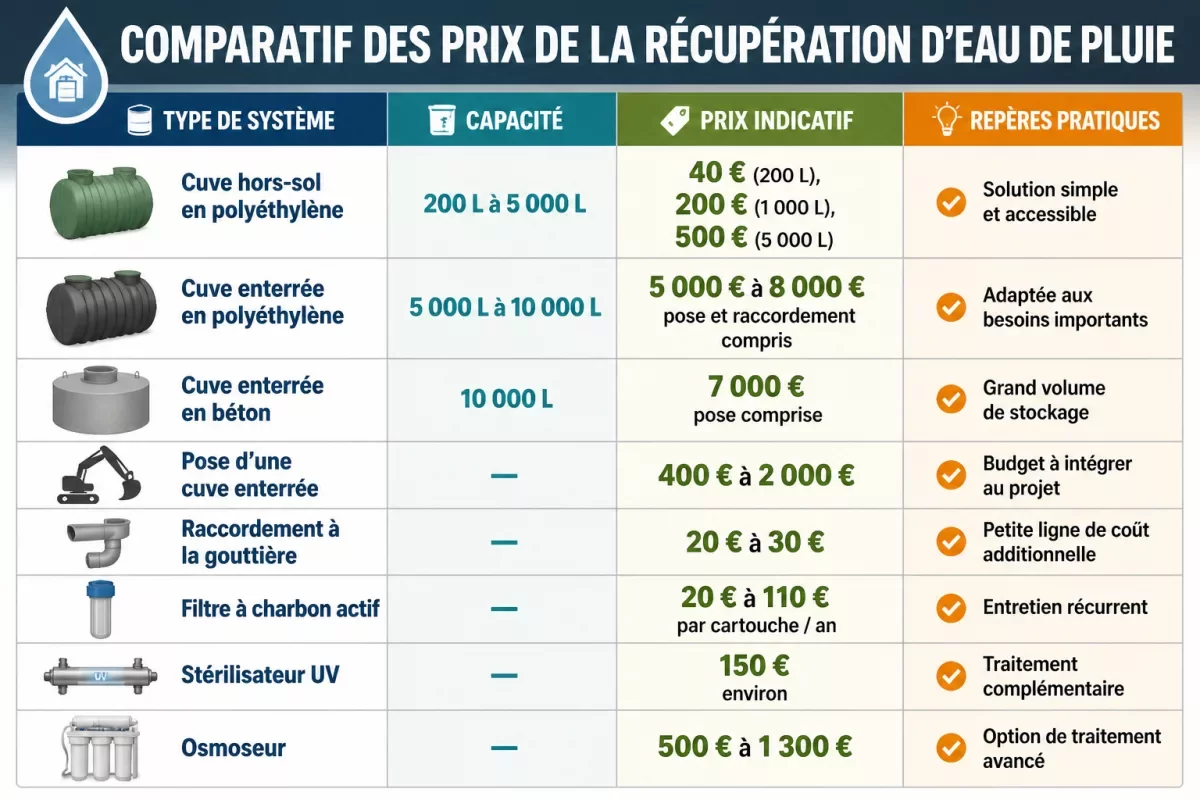
The average cost of a rainwater harvesting system is estimated at around 2,500 euros, but this average masks large differences depending on the type of tank, capacity, and accessories. In practice, the market ranges from about €100 to €7,000, with significant gaps between a simple solution and a complete buried installation.
The figures that really help budget
Detailed costs provide a more precise market reading. A 200-liter above-ground polyethylene tank costs about €40, a 1,000-liter around €200, and a 5,000-liter about €500. At the other end, a 5,000-liter buried polyethylene tank, with installation and connection, costs about €5,000, and a 10,000-liter reaches €8,000.
What increases the budget
The tank represents only part of the cost. You must add the installation of a buried tank, estimated between €400 and €2,000, the connection to the gutter between €20 and €30, and sometimes treatment equipment. An activated carbon filter costs between €20 and €110 per cartridge and must be replaced each year; a UV sterilizer starts around €150; a reverse osmosis unit ranges between €500 and €1,300.
The real budget is not the tank: it is the complete installation, maintenance, and accessories that make the difference.
How to read the price according to usage
For simple watering, an above-ground tank may suffice. For a house that wants to supply several points, the cost rises quickly, but the storage capacity becomes decisive. That is why rainwater harvesting should be considered a functional investment: the broader the usage, the more important the sizing and quality of installation are.
How to install and maintain a system safely?
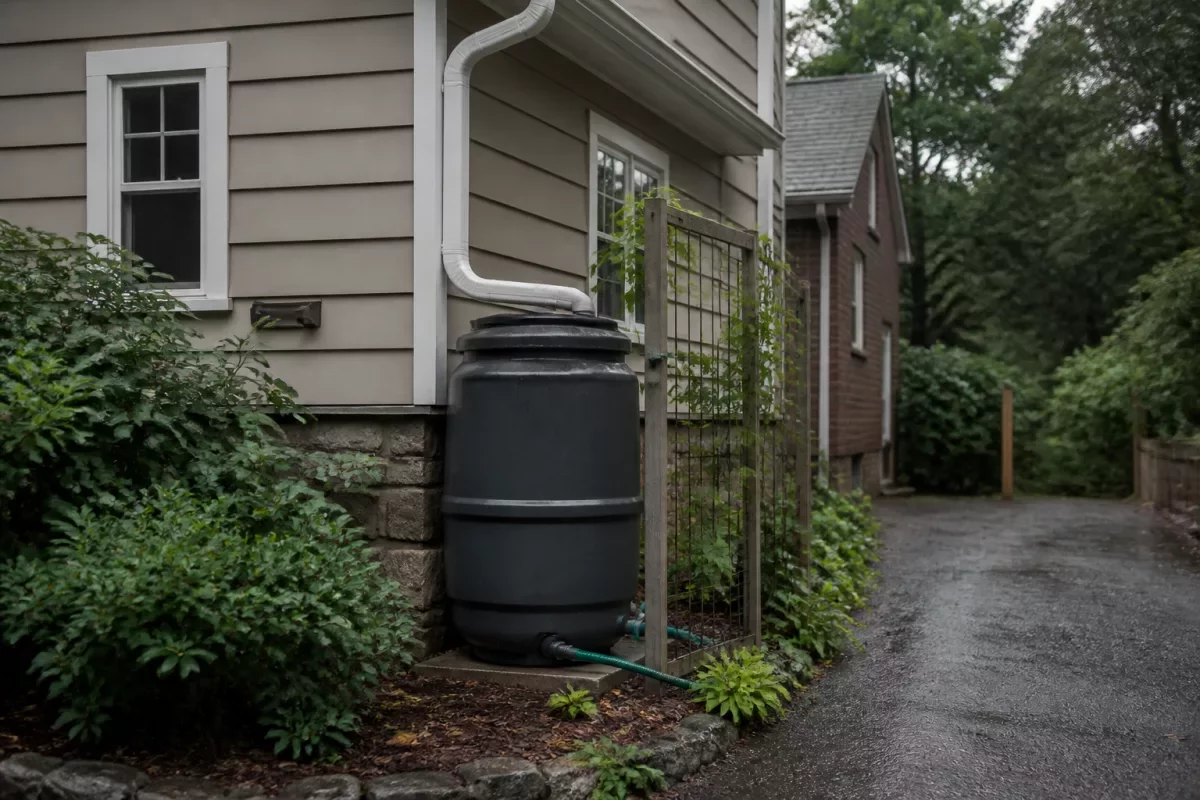
A safe installation is based on three principles: collect cleanly, store without contamination, and prevent any confusion with drinking water. According to available data, the roof is the main catchment surface, but success mainly depends on the fittings, the sealing of the tank, and regular system maintenance.
Steps for a coherent installation
- Check that the roof is compatible with harvesting.
- Choose the tank according to the available space and desired useful volume.
- Plan the connection to the gutter and the necessary filtration devices.
- Install clear signage for non-potable water.
- Properly close the tank to limit tiger mosquitoes.
Maintenance to avoid unpleasant surprises
Maintenance should not be treated as an option. It is necessary to check the condition of the filters, verify the absence of stagnation, clean elements exposed to deposits, and ensure that taps and withdrawal points remain well identified. A neglected system quickly loses its economic interest and sanitary reliability.
Why does profitability depend as much on context as on price?
The profitability of a rainwater harvesting system is not measured solely by the purchase price. It depends on the volume actually used, the local climate, the available roof surface, and the type of tank chosen. In some cases, a simple solution is enough; in others, the buried investment is justified by the storage capacity and duration of use.
The simplest models allow entry into the approach at a lower cost, while more complete installations are mainly justified when they replace a significant portion of drinking water consumption. The right question is therefore not “how much does a tank cost?”, but “how many useful uses can this tank cover over several years?”
Key points to remember
- Rainwater harvesting is useful, but the water remains non-potable.
- Authorized uses are limited and must remain clearly indicated.
- An above-ground tank costs little, a buried tank costs much more.
- Installation, connection, and accessories weigh heavily in the final budget.
- The risk of tiger mosquitoes requires a closed and well-maintained tank.
- The roofing material directly influences the quality of the recovered water.
Ultimately, rainwater harvesting is not just a savings solution: it is a trade-off between regulation, safety, capacity, and total cost. The more precise the project is from the start, the more useful, durable, and truly profitable it becomes.
To remember
- 💧 Rainwater remains non-potable and must be reserved for authorized uses.
- 🏗️ The real budget includes the tank, installation, fittings, and annual maintenance.
- 🛡️ “Non-potable water” signage is essential to avoid any mistakes.
- 🦟 A closed tank limits tiger mosquitoes and secures storage.
- 📏 The choice between above-ground or buried mainly depends on space, volume, and budget.
FAQ
Can rainwater be drunk?
No. In France, rainwater is considered non-potable due to its possible contamination by chemical pollutants. It must not be used for drinking or hygienic purposes.
What uses are allowed with rainwater?
The allowed uses mainly concern toilet flushing, watering, floor cleaning, car washing, and, under certain conditions, laundry. The main point is to maintain separation from drinking water.
Is an underground tank always better than an above-ground tank?
Not necessarily. The underground tank generally offers greater capacity, but it is much more expensive and requires heavier work. For limited needs, an above-ground tank often remains the most rational solution.
How to limit mosquitoes in a rainwater tank?
The tank must be well sealed, without stagnant water or free access for insects. Regular maintenance greatly reduces the risk of tiger mosquito proliferation and protects the quality of storage.
Why is the type of roof important?
Because the roof is the first catchment surface. The quality of the collected water depends on its materials, and some roofs, such as those made of fibrocement or tar-based, are often to be avoided for health reasons.