How to tell if it’s a rat or a mouse?
Look at the size of the droppings, the shape of the body, the tail, and the intensity of the damage. A mouse leaves small black droppings a few millimeters long and passes through tiny openings. The rat is bulkier, its traces are more visible, and its gnawing is often more pronounced.
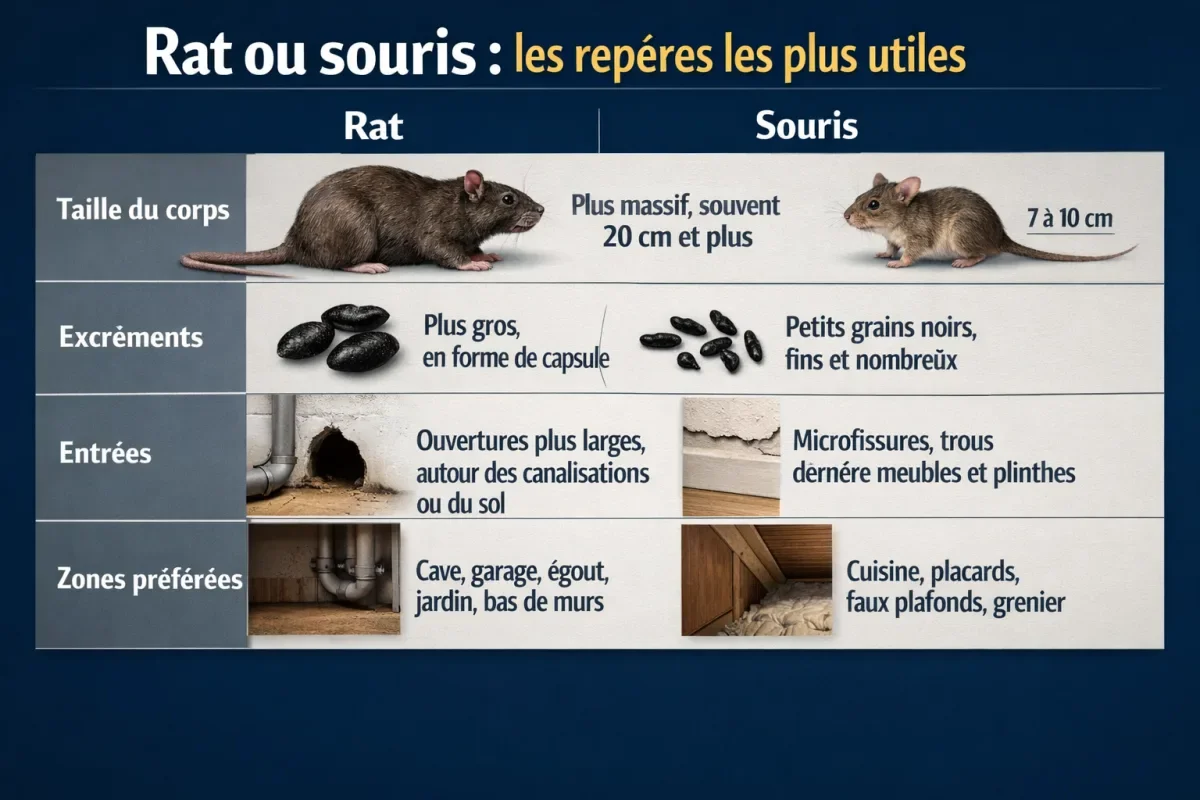
Brown rat, black rat, house mouse: the most useful markers
In houses, the most common is the brown rat or Norway rat, very adaptable, and the house mouse, smaller and more agile. The black rat is rarer in closed urban habitats but can be found in some attics or outbuildings. This distinction helps choose the right rat trap or the right mouse trap.
| Criterion | Rat | Mouse |
|---|---|---|
| Body size | Bulkier, often 20 cm and more | Small body, often 7 to 10 cm |
| Droppings | Larger, capsule-shaped | Small black grains, thin and numerous |
| Entries | Wider openings, around pipes or the floor | Microcracks, holes behind furniture and baseboards |
| Preferred areas | Cellar, garage, sewer, garden, bottom of walls | Kitchen, cupboards, false ceilings, attic |
Signs of presence to check immediately
- Droppings: the fresher they are, the more recent the activity.
- Grease marks: rodents rub their fur along walls.
- Noises: scratching at night in partitions, ceilings, or attics.
- Nests: shredded paper, fabric, insulation, or cardboard in a dark corner.
- Damage: pierced packaging, gnawed seeds, chewed wires, strong urine odor.
How to get rid of rats and mice quickly?
Start by removing access to food, then set traps along active routes and seal openings. Repellents alone are rarely sufficient. If noises continue, if bait disappears, or if several rooms are affected, professional pest control is often the fastest solution.
- Isolate the area: close food containers, store food in airtight boxes, and clean up crumbs.
- Spot the traces: look for droppings, grease marks, holes, and noises in the same place each night.
- Set traps: use a mouse trap or a rat trap suitable for the suspected species, along walls and never in the middle of a room.
- Check every morning: verify catches and reload bait if necessary.
- Clean without dispersing particles: ventilate, moisten soiled areas before collection, wear gloves and a mask.
- Start sealing: plug visible holes from day one to limit back-and-forth movement.
“As long as there is food, access, and shelter, rats and mice will return.”
Field principle used in pest control
What solutions are really effective against rats and mice?
The most reliable methods are mechanical traps, sealing access points, and, in case of heavy infestation, professional pest control. Natural solutions can help repel mice and occasionally repel rats, but they are rarely sufficient alone in an already affected home.
| Solution | Effectiveness | Safety | Cost | Duration |
|---|---|---|---|---|
| Mechanical traps | High if the route is correct | Good if out of reach | Low to medium | Fast |
| Mouse repellent / rat repellent | Low to variable | Good with moderate use | Low | Short term |
| Rodent ultrasonic devices | Variable, often insufficient | Good | Medium | Temporary |
| Rodenticides / secured baits | High in heavy infestation | Must be strictly controlled | Medium | Several days |
| Professional pest control | Very high | Very good if protocol respected | Higher | Fast and lasting |
Traps, bait, and capture: the most concrete basis
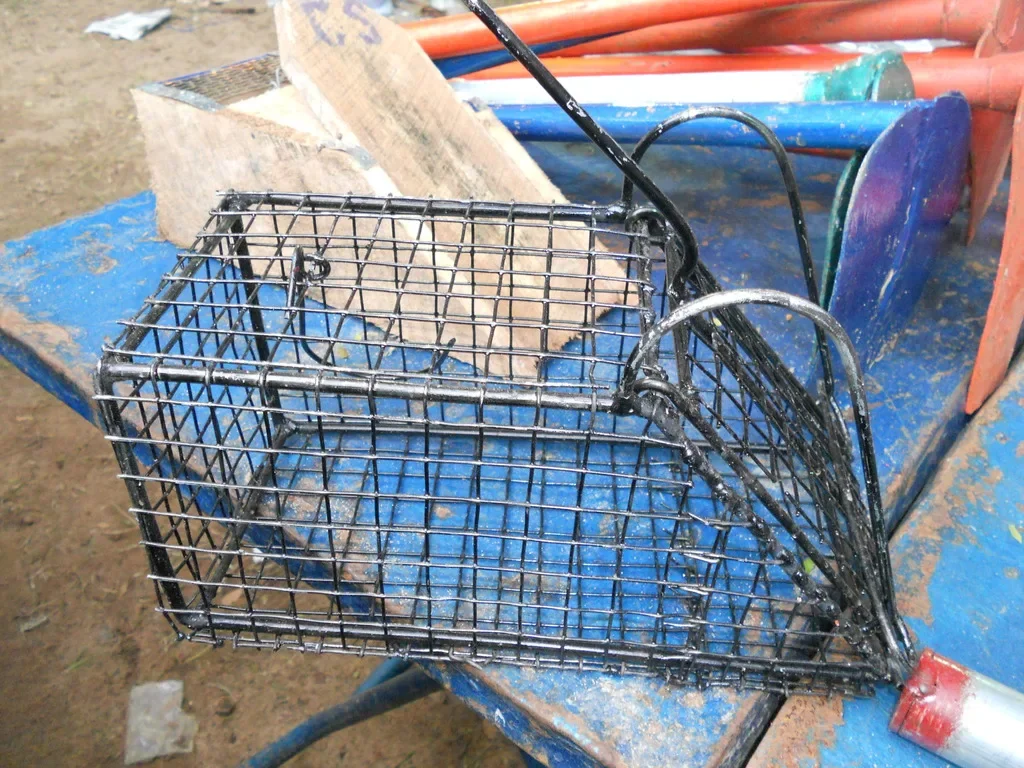
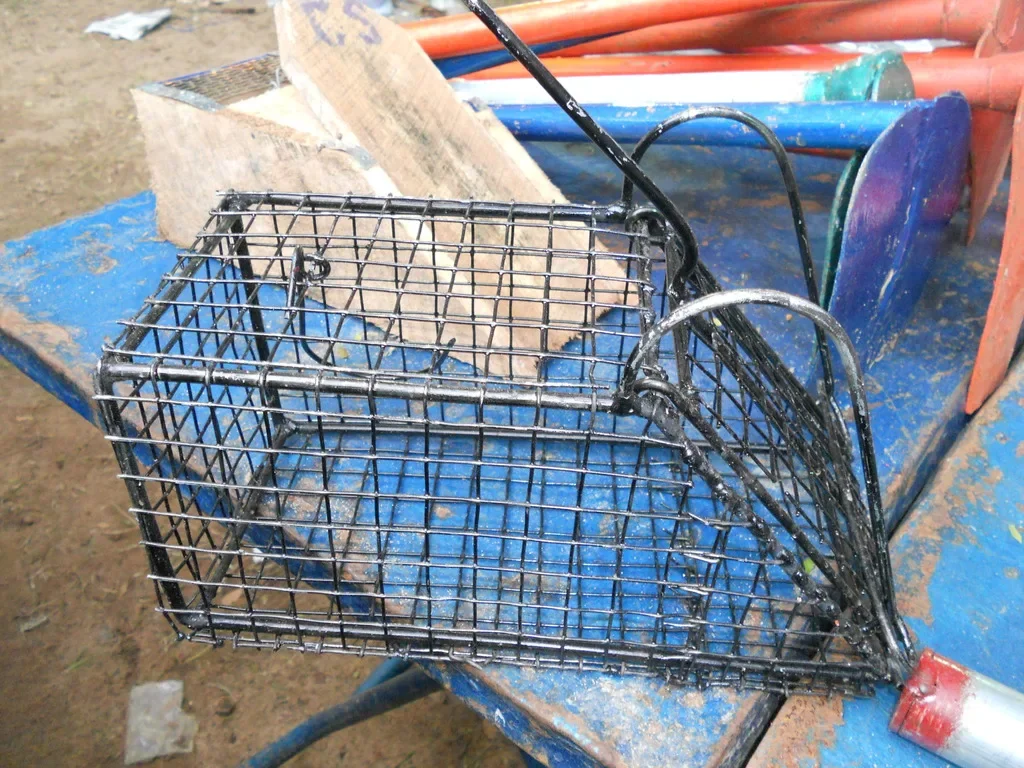
The mouse trap is suitable for narrow passages and small tunnels. The rat trap must be more robust and placed near walls, furniture, or pipes. Baits must be attractive but minimally dispersing: peanut butter, fatty paste, or strongly scented food, in minimal quantity.
Mouse repellent, rat repellent: useful or just a supplement?
Essential oils, strong odors, or certain sprays can temporarily bother rodents, but they do not solve an infestation. A mouse repellent or a rat repellent can be used as a complement, especially in a secondary passage area, never instead of a fundamental treatment. If food and shelter remain accessible, the effect fades quickly.
Rodent Ultrasound: Why the Effect is Often Limited
Rodent ultrasounds can disturb the animal for a while, but their effectiveness decreases when the space is compartmentalized, cluttered, or already colonized. Rats and mice sometimes get used to the device. In practice, ultrasounds are mainly used as a supplement, not a sole solution.
“Ultrasounds never replace sealing or sanitizing the area.”
Pest control professionals
When Home Pest Control is No Longer Enough
If you have repeated captures, fresh droppings every day, noises in several rooms, damage to insulation, or a persistent odor, a professional intervention should be considered. Home pest control quickly reaches its limits when a nest is established in a partition, cellar, attic, or crawl space.
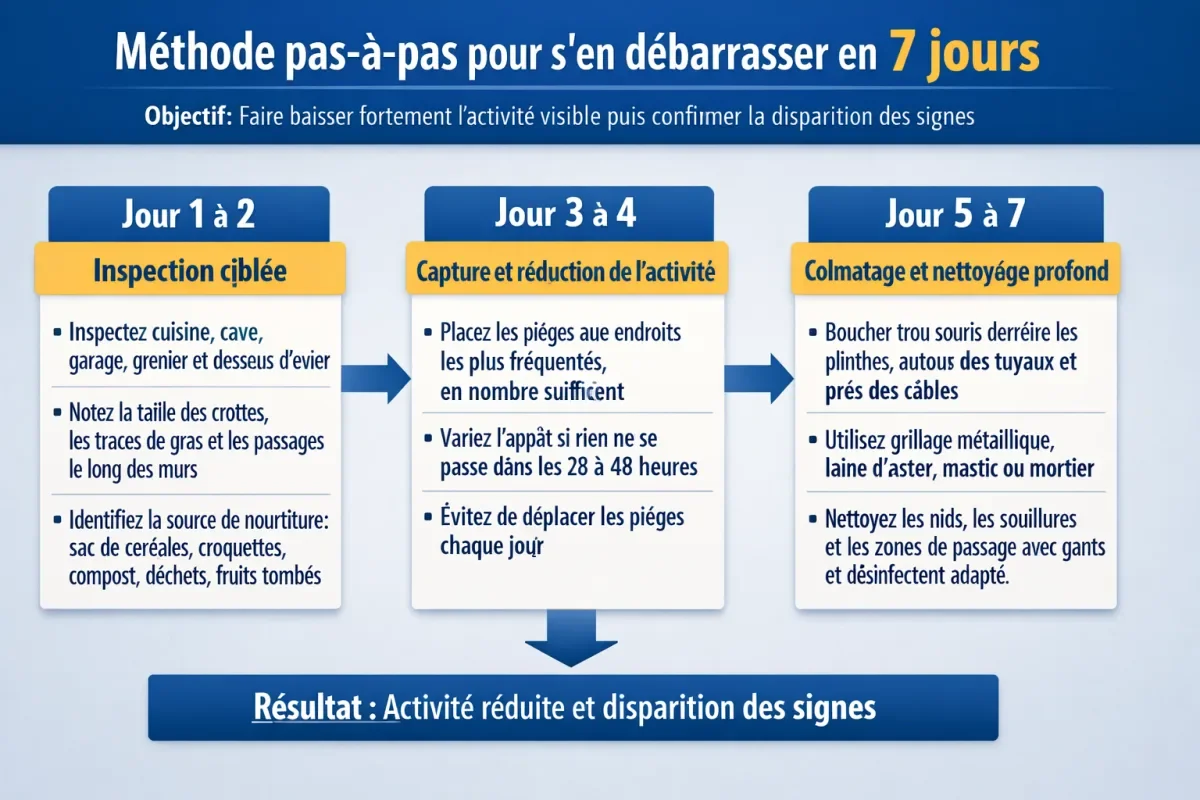
Step-by-Step Method to Get Rid of Them in 7 Days
The right method is not to do everything randomly, but to follow diagnosis, capture, sealing, and monitoring. In seven days, visible activity can be significantly reduced, then disappearance of signs can be confirmed: fewer droppings, fewer noises, baits initially consumed then later ignored.
Day 1 to 2: Targeted Inspection
- Inspect the kitchen, cellar, garage, attic, and under the sink.
- Note the size of droppings, grease marks, and passages along walls.
- Identify the food source: cereal bags, pet food, compost, waste, fallen fruit.
Day 3 to 4: Capture and Activity Reduction
- Place traps in the most frequented spots, in sufficient numbers.
- Slightly vary the bait if nothing happens within 24 to 48 hours.
- Avoid moving traps every day: rats and mice prefer stable routes.
Day 5 to 7: Sealing and Deep Cleaning
- Seal mouse holes behind baseboards, around pipes, and near cables.
- Use metal mesh, steel wool, sealant, or mortar depending on the area.
- Clean nests, soiling, and passage areas with gloves and appropriate disinfectant.
“The right reflex is not to multiply baits, but to eliminate what attracts rats and mice.”
Housing prevention principle
How to Prevent Rats and Mice from Returning?
To prevent rats and mice from returning, the dwelling must be made unappealing: food sealed, waste taken out daily, access points sealed, clutter reduced, and regular monitoring. Without sealing and hygiene, even good capture remains temporary. Prevention is what turns a temporary victory into a lasting result.
Seal Mouse Holes, Cracks, and Technical Passages
- Seal holes around pipes, cables, and vents with a resistant material.
- Check baseboards, door seals, grilles, and under furniture.
- In the garage or cellar, also monitor thresholds, air bricks, and drains.
Manage Food, Waste, and Humidity
- Store dry food in airtight containers.
- Never leave pet food out overnight.
- Take out trash often and close lids.
- Fix water leaks: rats and mice also seek moisture.
Garden, cellar, garage: the forgotten areas that reignite infestation
The garden offers hiding places, the cellar provides quiet, and the garage often gives access to food or boxes. Trim plants near walls, avoid stacks of wood against the facade, and elevate anything that could serve as a nest. A clean house but a neglected outbuilding remains vulnerable.
“Prevention is not an option: it is the only way to sustainably break the cycle of rats and mice.”
Field approach in domestic hygiene
Safety and hygiene: what you need to know
Rats and mice can contaminate surfaces and foodstuffs. The priority is therefore to protect people, especially children and pets, then to properly clean the soiled areas. If you use baits or toxic products, strictly follow the manufacturer’s instructions and avoid any unnecessary exposure.
Children, pets, and rodent control products
- Prefer secured bait boxes if a rodenticide is necessary.
- Place traps out of reach of children and animals.
- Never leave bait uncovered in a kitchen or living room.
- If in doubt, seek advice from a professional before any chemical treatment.
Cleaning and disinfection after rodent activity
- Ventilate the room before starting.
- Wear gloves and, if necessary, a protective mask.
- Moisten droppings before picking them up to avoid dust resuspension.
- Then disinfect the affected surfaces.
- Never mix household products together.
When to call a professional?
Call a pest control company if the infestation is extensive, if you cannot locate entry points, if captures continue despite traps, or if the situation concerns a sensitive location: professional kitchen, food business, school, housing with infants or fragile animals. A professional provides a more precise diagnosis, a safer protocol, and follow-up.
For further information, consult reliable references such as ANSES, Santé publique France, and INRS, especially regarding biological risks, hygiene, and contamination prevention.
- Quickly identify the rodent: rat or mouse, the strategy is not the same.
- The most effective solutions combine traps, sealing, and hygiene.
- Natural repellents and ultrasonic rodent devices are mainly temporary aids.
- A tiny hole can be enough for a mouse: therefore, mouse holes must be sealed precisely.
- Risks to children and animals require strict safety measures.
- If activity persists, professional pest control is often the fastest and most reliable solution.
Conclusion
Getting rid of rats and mice requires a simple but rigorous method: observe, trap, seal, clean, and prevent. By acting quickly and addressing the cause, you greatly reduce the risk of recurrence. If the infestation overwhelms you, call in a professional to save time and secure the home sustainably.
FAQ
How to get rid of rats and mice?
Remove accessible food, set appropriate traps along their paths, seal openings, and clean soiled areas. Natural solutions and ultrasonic rodent devices can help, but an established infestation often requires more comprehensive pest control.
How to prevent them from coming back?
You need to block access to water, food, and shelter. Close the trash bins, store food properly, seal holes, reduce clutter, and regularly check the basement, attic, kitchen, and garage. Without prevention, rats and mice often return.
What is the difference between a rat and a mouse?
The rat is larger, more robust, and leaves bigger droppings. The mouse is smaller, can pass through very narrow cracks, and leaves tiny droppings. The location also helps: kitchen and cupboards for the mouse, basement and garage for the rat.
Are ultrasonic rodent repellents effective?
They can temporarily disturb rodents, but their effect is often limited and variable. They do not replace traps, sealing, or cleaning. In case of a real infestation, they should be considered as a supplement, not the main solution.
When should you call a professional pest control service?
When traps fail, signs persist, the infestation affects multiple rooms, or a nest is hidden in a wall, attic, or crawl space. A professional provides a safer, faster, and often more lasting strategy.