In brief
- MaPrimeRénov’ remains the backbone, but the ceilings tighten.
- CEE, eco-PTZ, and 5.5% VAT complement the financing.
- Local aids can cover part of the remaining costs.
- The correct order of procedures matters as much as the amount of aids.
- France Rénov’ and an RGE professional secure the file and the worksite.
Overview of national aids: the foundation of 2026
In 2026, the public logic is no longer to multiply incoherent counters, but to coordinate aids to promote works that truly improve a dwelling’s energy performance. As highlighted by I4CE, the budgetary challenge is not limited to the amount of money distributed: it mainly depends on how the schemes complement, replace, or reinforce each other.
The core of the system still relies on the same pillars: MaPrimeRénov’, energy savings certificates, zero-interest eco-loan, 5.5% VAT, and, in addition, local aids. Overall, the analysis of energy renovation aids in 2026 shows that aids only work well if they are thought of as a whole and not as a random list to pick from.
| Aid | What it provides | Strength | Caution |
|---|---|---|---|
| MaPrimeRénov’ | Central grant for large-scale renovations | Remains the most structuring aid | More targeted conditions and revised ceilings in 2026 |
| CEE / energy bonus | Bonus linked to achieved energy savings | Can reach 7,522 euros depending on works, location, area, and income | Variable amount and application must be properly prepared |
| Eco-PTZ | Zero-interest loan to finance remaining costs | Up to 50,000 euros until December 31, 2027 | Repayment must be anticipated in the financing plan |
| 5.5% VAT | Tax relief on eligible works | Immediately reduces overall cost | Does not replace direct cash aid |
In 2026, the real issue is not the existence of aids, but their hierarchy.
The 2026 finance bill announces an overall budget of 4.6 billion euros for Anah, including 3.6 billion for MaPrimeRénov’. This figure says a lot at once: the State is not shutting off the tap, but it is calibrating it more precisely. And this changes the strategy of households, who must aim for the most coherent renovation rather than simply adding up individual actions.
How is MaPrimeRénov’ changing in 2026?
MaPrimeRénov’ remains the key aid, but 2026 makes it more selective: access is open to all households for large-scale renovations, provided there is a prior appointment with a France Rénov’ advisor, while the per-action pathway sees its scope reduced on several items. In short, the aid is still there, but it pushes more towards structured projects.
The most striking point is the reduction of eligible spending ceilings. For large-scale renovations, the ceiling, for example, drops from 40,000 to 30,000 euros excluding tax for a jump of 2 or 3 classes. Subsidy rates are also standardized at 45% for MaPrimeRénov’ Violet households and 10% for MaPrimeRénov’ Rose households. At the same time, the ceiling of 70,000 euros excluding tax for a jump of 4 classes or more, as well as the 10% bonus for exiting energy-poor housing, have been removed.
In the per-action pathway, the removal of aid for interior and exterior wall insulation, as well as for biomass boilers, further narrows the landscape. This does not mean these works should be abandoned, but that they must be placed within a global plan. The icing on the cake is that this evolution encourages viewing renovation as a whole: insulation, heating, ventilation, and energy management must progress together.
MaPrimeRénov’ is not disappearing; it is becoming a management tool.
- Large-scale renovation remains accessible to all households.
- The appointment with a France Rénov’ advisor becomes mandatory before applying.
- The per-action pathway loses several eligible work items.
- Ceilings are lowered, so the application must be more finely thought out.
The result is quite straightforward to read: 2026 favors solid, well-structured projects, with a real energy leap at the key. Small isolated works do not necessarily disappear from the household’s radar, but they cease to be the center of gravity of public funding.
CEE, eco-PTZ and 5.5% VAT: what should we really expect?
These three levers do not replace MaPrimeRénov’; they complement it. Their role is very concrete: to reduce the remaining cost, smooth cash flow, and prevent a good project from being blocked due to cash issues. In practice, it is often they who transform a “conceivable” renovation into a truly launchable renovation.
Energy savings certificates enter the 6th period from 2026 to 2030, with strengthened obligations for suppliers and a stronger focus on energy poverty. I4CE emphasizes the importance of this shift because it conditions part of the volume of mobilizable aids. To be confirmed: a range of obligation between 825 TWhc and 1,750 TWhc has been mentioned, but the final decision has not been made.
In the reality of households, CEEs often materialize as an energy bonus. This can reach up to 7,522 euros depending on the works, location, surface area, and resources. The interest is obvious: we are not talking about a symbolic “bonus,” but a real budgetary lever. Since 2024, Anah also directly values CEEs for certain global renovations, which simplifies part of the process.
The zero-interest eco-loan remains an excellent relief valve. It is maintained and extended until December 31, 2027, with a ceiling still set at 50,000 euros. It is obviously not a subsidy, but it is a precious buffer when the project is significant. As for the 5.5% VAT, it remains in 2026 for energy renovation works, which lightens the bill without adding paperwork.
CEEs are not a bonus: they are a silent pillar of financing.
What these aids change, very concretely
To use them well, one must remember a simple idea: each plays a different role. CEEs improve the immediate subsidy, the eco-PTZ absorbs the uncovered part, and the 5.5% VAT reduces the base cost. In other words, a well-constructed file does not seek the most attractive aid, it seeks the right stacking.
- CEE: a good reflex to quickly reduce the remaining out-of-pocket expenses.
- Eco-PTZ: useful when the project is more substantial than a simple isolated action.
- 5.5% VAT: a discreet fiscal advantage, but very tangible on the final invoice.
- MaPrimeRénov’: the main foundation to organize before discussing additional financing.
Which local aids should be sought first?
Local aids never make as much noise as MaPrimeRénov’, yet they can make a difference on the remaining out-of-pocket expenses. Regions, departments, metropolises, agglomeration communities, and sometimes municipalities add their own boosts. The right reflex is to look for them very early, even before finalizing the quote, because they have their own rules and schedules.
In practice, you have to think like a financing detective. Local aids often play the role of the final layer, the one that prevents leaving a project halfway. They are all the more useful as national schemes become more targeted: the more the central aid tightens, the more important the local supplement becomes.
- Check the aids from the region and department.
- Look at the schemes from the metropolis or intercommunality.
- Consult the France Rénov’ advisor in your area.
- Compare local aids with MaPrimeRénov’ and the CEE.
The essential point is the combination. A local aid can be very interesting on its own, but even more so if it complements an already well-prepared framework. It should not be set aside just because it seems modest: on a project costing several thousand euros, a few hundred or a few thousand euros can really tip the decision.
How to maximize your financing without making mistakes?
The right method is to think of financing as a journey, not a treasure hunt. Start by checking the eligibility of the housing and the project, then test the combinable aids before signing anything. Cherry on the cake, the official France Rénov’ simulator saves precious time by avoiding combinations that don’t hold up.
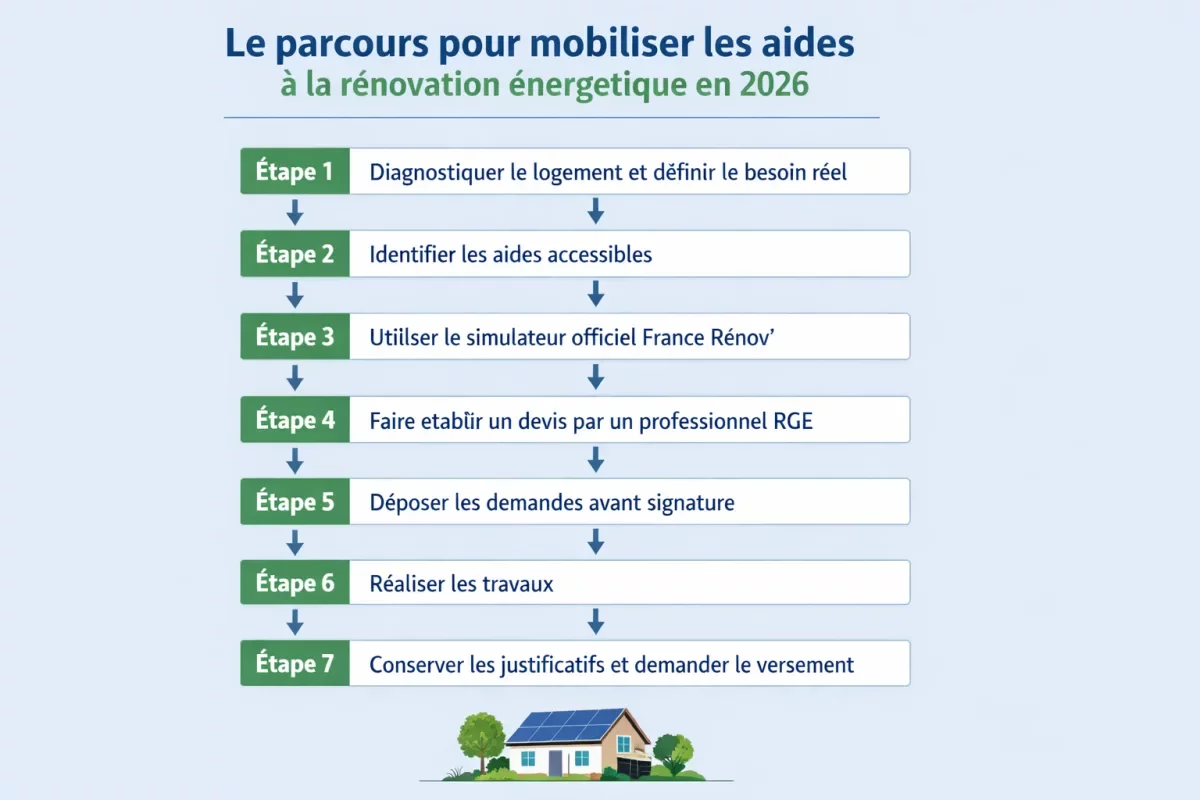
The real trap is the order of operations. A quote signed too early, a file submitted in the wrong order, or a forgotten local aid can be costly. Conversely, a well-ordered plan smooths everything out: you know which aids to mobilize, when, and under what conditions. It cannot be repeated enough, but in energy renovation, administrative discipline pays almost as much as technical choice.
- Define the real needs of the housing: heat, humidity, bill, comfort, ventilation.
- Identify the right path: isolated action or large-scale renovation.
- Simulate the aids before any commitment.
- Have the work priced by an RGE renovation professional.
- Submit the applications in the correct order.
- Keep all receipts until the final payment.
A well-prepared file often counts more than a theoretically poorly mobilized amount.
Why does the RGE professional change the game?
The RGE renovation professional is not an administrative detail, it is a safety lock. Without a certified company, you take a risk on the eligibility of aids, on the quality of the worksite, and on the technical coherence of the project. In short, it’s not just a box to check: it’s the backbone of the file.
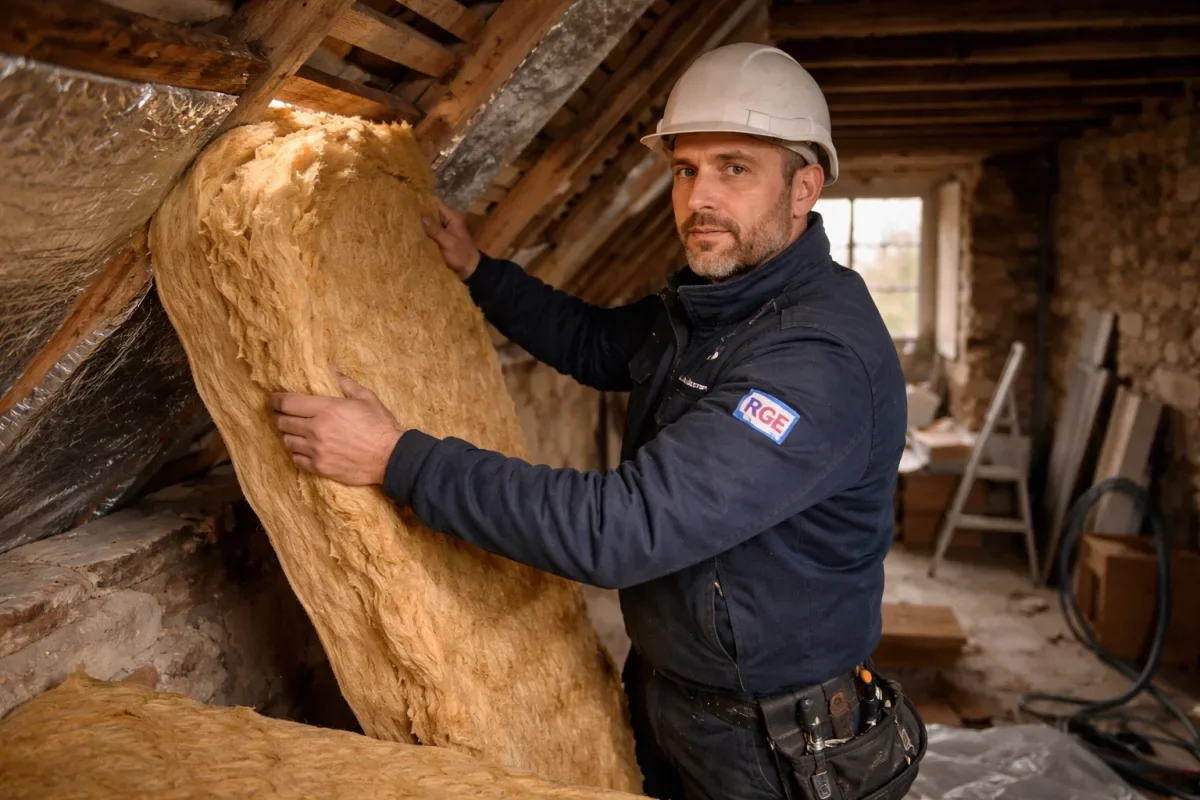
This point is all the more important because the 2026 aids favor large-scale renovations. The more ambitious the project, the higher the technical requirements. Therefore, a contact person capable of linking the building envelope, heating, ventilation, and the aid file is necessary. Successful projects are not those that “cost less” initially, but those that avoid costly mistakes in the end.
- The RGE secures access to aids.
- It helps structure a coherent project.
- It limits unpleasant surprises at the time of payment.
- It becomes essential as soon as a large-scale renovation is targeted.
Co-ownership, low-income households, large-scale renovation: what should you know?
The short answer is that not everyone is playing the same game. Low-income households benefit from stacking aids to minimize out-of-pocket costs. Co-ownerships must deal with a collective schedule, votes, and technical arbitrations. As for large-scale renovation, in 2026 it becomes the most coherent field to obtain clear and useful aid.
For a co-ownership, the issue is not only financial: it is also organizational. The association, votes, allocation of common and private parts, choice of works, and sequencing of requests add a layer of complexity. However, when the project is well framed, the co-ownership can mobilize interesting funding and sustainably reduce the building’s consumption.
The right reflex according to your profile
- Low-income household: prioritize MaPrimeRénov’, CEE, and local aids.
- Intermediate household: work on the combination between direct aid and eco-PTZ.
- Co-ownership: structure the project collectively before starting procedures.
- Large-scale renovation: favor a global strategy rather than a succession of small actions.
The signal sent by 2026 is clear: public authorities want to finance sustainable energy savings, not just one-off works. This does not penalize households, but it forces them to think more carefully. Those who take the time to build a coherent project will have much better chances to maximize their funding.
Key points to remember
- MaPrimeRénov’ remains central, but becomes more selective.
- CEE, eco-PTZ, and 5.5% VAT form the complementary base.
- Local aids often serve to reduce the last portion of out-of-pocket costs.
- The correct order of procedures avoids refusals and unnecessary delays.
- The RGE professional remains a mandatory step to secure the file.
To remember
- 📌 MaPrimeRénov’ refocuses on large-scale renovation and tightens certain actions.
- 💶 CEE, eco-PTZ, and 5.5% VAT reduce out-of-pocket costs without replacing the main aid.
- 🧭 The correct order of procedures avoids refusals and unnecessary delays.
- 🏠 Local aids and the project status can tip the project’s profitability.
FAQ
Can MaPrimeRénov’ and CEE be combined?
Yes, in many cases, combining them is possible and even strategic. It is often this duo that significantly lowers the real cost of the project. The key point is to check the rules of your work process before submitting anything.
Does the eco-PTZ finance the entire project?
Not necessarily. The eco-PTZ mainly finances the remaining costs after direct aids. It is particularly useful when the project is heavy, as it avoids mobilizing all your cash at once. Its interest therefore depends on the total amount of the project and the level of aid already obtained.
Are local aids automatic?
No, and this is one of the most frequent pitfalls. Each territory has its own criteria, deadlines, and sometimes priorities. They must therefore be checked very early to avoid missing out on useful supplements or favorable stacking rules.
Is an RGE professional required for all works?
For works entitling to the main aids, yes, it is generally essential. The RGE label secures the eligibility of the file and reduces the risk of poor execution. It is also a good indicator of seriousness when you want to avoid costly DIY in the long term.
Does MaPrimeRénov’ remain attractive in 2026?
Yes, but only if you choose the right path. It remains the most significant aid, especially for large-scale renovations. However, households opting for isolated actions will need to be much more attentive to the conditions and the actions that are actually subsidized.