
Quick summary of the situation
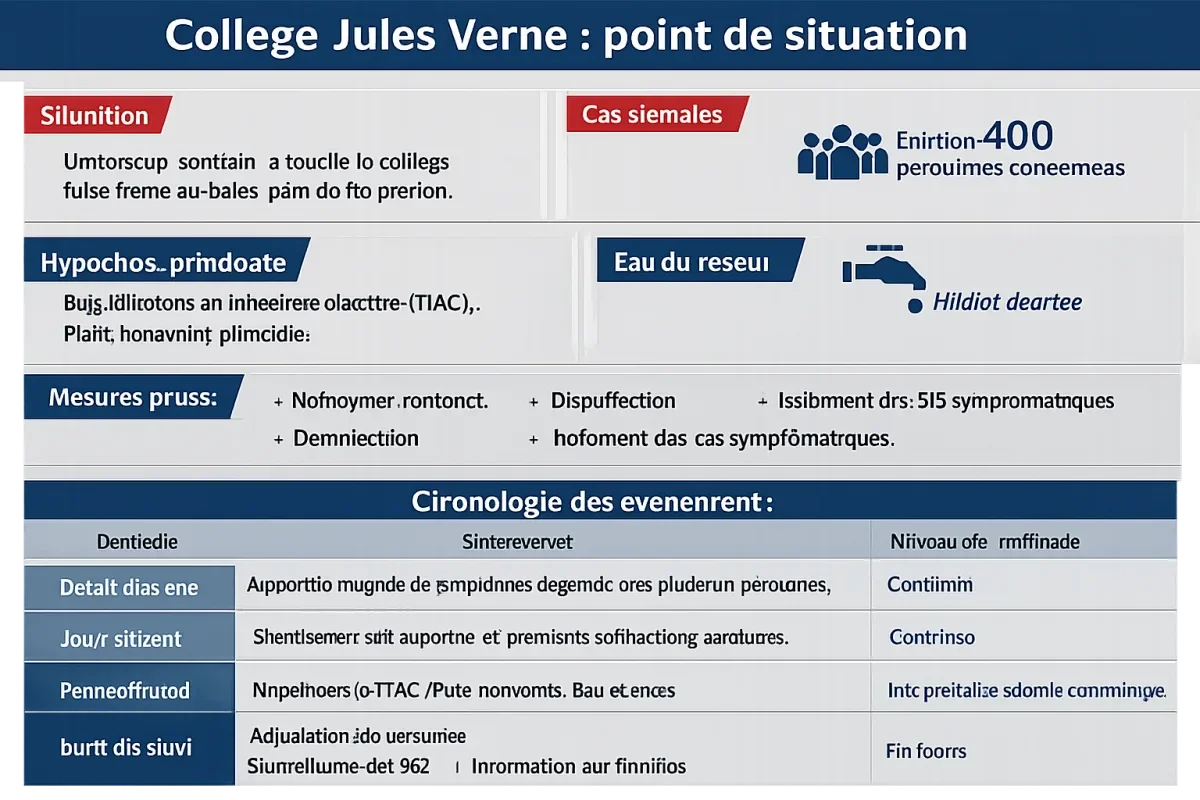
The essential point is simple: a wave of digestive symptoms was reported at Jules Verne Middle School in Le Soler, with health monitoring involving the prefecture, the ARS, and the institution. The most serious hypothesis remains a TIAC, while water has been ruled out as a probable cause. Families must refer to official instructions, as the situation can evolve rapidly.
| Element | Status | What to understand |
|---|---|---|
| Origin | Under analysis | The foodborne hypothesis is favored, but the health investigation remains open. |
| Reported cases | Confirmed by official monitoring | About 400 people have been affected, mainly with digestive symptoms. |
| Network water | Rather ruled out | Public communications do not point to a drinking water problem. |
| Severity | Ongoing monitoring | Severe cases appear limited according to the latest reports. |
What is the outbreak reported at Jules Verne Middle School?
According to authorities, it is an episode compatible with a collective foodborne illness, meaning contamination affecting several people who shared the same exposure context. Norovirus is the most often mentioned hypothesis. In short, this is not a “simple stomach flu” casually reported, but a public health situation closely studied.
Nature of the health problem
The difference between “symptoms,” “diagnosis,” and “official confirmation” matters greatly. Students may present similar symptoms without the cause yet established. Here, health authorities communicated a structured hypothesis, which is more solid than a hallway rumor. That is why it is necessary to rely on elements validated by the ARS and the prefecture.
Period and context
The first cases were reported over a short period, which points precisely to a common exposure rather than a widely spread circulation over time. The local context, with several people affected in the same institution, is typical of field investigations conducted in school settings. This kind of scenario requires checking meals, environment, and direct contacts.
How many people are affected?
The publicly communicated tally is around 400 people affected, including students but also parents and some staff members. This figure should be read as an order of magnitude from official monitoring, not as a fixed snapshot: in such a situation, numbers can be reassessed as feedback and care proceed.
Available Numerical Report
- Students concerned: the majority of affected individuals appear to belong to the middle school.
- Staff concerned: a few cases have also been mentioned within the school’s circle.
- Impacted levels: public feedback speaks of a widespread phenomenon, with no single isolated level.
- Hospitalizations: some care has taken place, but severe cases seem limited according to the latest official updates.
What remains to be confirmed
It remains essential to distinguish what is established from what is not yet. The exact number of confirmed cases, the precise timeline of initial symptoms, and the exact proportion of hospitalized individuals may evolve after data consolidation. In other words, we avoid panic headlines: only health authorities can finalize the report.
| Point | What we know | What we are still waiting for |
|---|---|---|
| Cause | TIAC / norovirus considered | Complete results of investigations |
| Transmission | Possibly human-to-human | Confirmation of the main mode of spread |
| Food source | Hypothesis under study | Detailed analysis of meals and samples |
What measures have been taken by the establishment?
The response was swift: informing families, adapting internal guidelines, enhanced disinfection, and monitoring symptomatic students. In this type of context, the goal is twofold: to prevent spread and maintain minimal school organization. These are very concrete health measures, not cosmetic communication for appearances.
Immediate actions
- Enhanced cleaning of classrooms, restrooms, and passage areas.
- Isolation of symptomatic cases to avoid unnecessary contacts.
- Instructions to families to monitor the appearance of digestive symptoms.
- Coordination with the ARS and state services for outbreak monitoring.
Administrative decisions
Depending on the evolution of the situation, adjustments may include partial class closures or temporary reorganization of activities. This is not automatic but is a common option when symptom circulation is too high. Returning to class then depends on public health guidelines and the clinical condition of students.
Should you consult a doctor if a child has symptoms?
Yes, especially if symptoms are marked, repeated, or accompanied by fever, intense fatigue, or signs of dehydration. Medical advice helps distinguish a simple transient discomfort from a condition requiring care. For a child, the best reflex remains to seek professional advice rather than playing doctor at home.
Signs to watch for
In a context like this, the most frequent symptoms are vomiting, nausea, abdominal pain, sometimes diarrhea, headaches, and severe fatigue. If the norovirus hypothesis is confirmed, transmission can be rapid in a community. This is precisely why isolating cases and hand hygiene are so important.
When to keep your child at home?
The safest rule is simple: if the child vomits, has a fever, or is not able to follow a normal day, they stay home. School is not the place to “test if it passes.” In case of doubt, a health professional or the official message from the school should decide, not momentary intuition.
What do health authorities say?
Local and health authorities focus on three things: identifying the cause, limiting spread, and informing without dramatizing. The ARS, prefecture, rectorate, and school management each play their role. This institutional coordination allows turning an anxiety-provoking episode into clear health monitoring.
Official communication
The vocabulary used by authorities is useful: terms like “suspected cases,” “outbreak,” “transmission,” and “exclusion” when a sick person must temporarily stay away from the group. This precision is not jargon to sound smart; it helps avoid misunderstandings and provide the right instructions at the right time.
Prevention Recommendations
- Systematic hand washing before eating and after using the restroom.
- Ventilation of premises to reduce the concentration of infectious particles.
- Cleaning of frequently touched surfaces.
- Limiting contacts in case of symptoms.
- Return to class only according to communicated health guidelines.
Impact on Classes and School Life
When a health cluster affects a middle school, the educational organization inevitably becomes more flexible. Classes can be maintained, lightened, or rearranged depending on absences and official recommendations. For families, the concrete issue is often absences and returning to class, much more than the exact name of the virus itself.
Educational Organization
Continuity of education remains the priority as soon as some students are absent. This can involve deferred assignments, instructions sent to families, or a gradual resumption of sessions. The idea is to avoid chaos while allowing symptomatic children time to properly recover.
Consequences for Families
The most useful thing for parents is to monitor messages from the school and keep contact details handy. In case of symptoms, the school must be notified quickly, exclusion respected if requested, and health status monitored. Good parental information reduces unnecessary calls and worries that arise for no reason.
Timeline of Events
To understand this case without getting lost, a simple timeline is better than a flood of scattered information. Here are the main steps to remember, with varying levels of certainty depending on the stage of the investigation.
| Period | Event | Level of Certainty |
|---|---|---|
| Start of cases | Rapid onset of digestive symptoms in several people | Confirmed |
| Following day | Report to authorities and initial health checks | Confirmed |
| Official update | Hypothesis of foodborne illness outbreak (TIAC), norovirus suspected, water ruled out | Very likely according to the statement |
| Follow-up | Adjustment of measures, case monitoring, and information to families | Ongoing |
Frequently Asked Questions about the Epidemic at Jules Verne Middle School
Is the school closed?
Not necessarily. Depending on the evolution of the cluster and health guidelines, the institution may remain open with adaptations, close certain classes, or temporarily reorganize classes. The best practice is to check the latest official message from the administration or prefecture before going.
Is it a stomach flu or a foodborne illness outbreak (TIAC)?
The symptoms resemble gastroenteritis, but the stakes are different. A TIAC refers to a collective episode linked to a common exposure, often food-related. This is the hypothesis being investigated here. The distinction matters because it guides the search for the source and prevention measures.
How long does the exclusion last?
The duration depends on health status and official instructions. In practice, an excluded student does not return until major symptoms have subsided and the school has approved the return, if specific instructions are in place. The doctor remains the reference contact for individual situations.
How to know if the situation is evolving?
You must follow messages from the school administration, prefecture statements, ARS information, and, if applicable, those from the rectorate. Social media moves fast but often mixes truth, falsehood, and very approximate information. For this type of subject, the institutional source remains the best gauge.
Where to find reliable and up-to-date information?
The most reliable information is published by competent health and educational authorities: ARS, prefecture, rectorate, and the institution. In case of doubt about a symptom, a doctor or pharmacist can also confirm the appropriate action. This is more solid than a message shared ten times in a parents’ group.
Key Takeaways
- The Jules Verne middle school in Le Soler was affected by a collective-type health episode.
- The main hypothesis put forward by the authorities is a foodborne illness outbreak (TIAC), with a norovirus lead.
- The measures taken are based on information, disinfection, isolation, and monitoring.
- Families should rely on official instructions, not on rumors or extrapolations.
- In case of pronounced digestive symptoms, the advice of a healthcare professional remains the best guide.
FAQ
Is the Jules Verne middle school epidemic officially confirmed?
Yes, a health episode has indeed been publicly acknowledged, with monitoring by the authorities. However, the exact label depends on the stage of the investigation: initial suspicion, hypothesis of TIAC, then progressive confirmation according to analyses.
Should parents keep their children at home?
Yes, if the child shows digestive symptoms or does not feel well. The goal is to prevent spread and allow a return to class under good conditions. In case of doubt, medical advice should be sought.
Is the problem coming from the school’s water?
At this stage, the water hypothesis is not considered the main explanation. Authorities rather favor food contamination or human-to-human transmission associated with a viral agent like norovirus.
Can a student who is just a little tired be sent to school?
If the fatigue is accompanied by nausea, vomiting, or a general poor condition, it is better to avoid attendance at school. When a health cluster is under investigation, caution protects both the child and the community.
When can the official information change?
As soon as a new report is consolidated: analysis results, evolution in the number of cases, clarification on the origin, or adaptation of school measures. For this type of case, updates can come quickly, sometimes from one day to the next.