
Zero Out-of-Pocket Cost: How It Works, Covered Care, and Reimbursement
A dental crown, a pair of glasses, or a hearing aid, and the bill can quickly add up. The zero out-of-pocket cost was specifically designed to nip the heaviest expenses in the bud, provided you stay within the framework of 100% Health. The catch is that many patients confuse full reimbursement with complete freedom of choice.
In practice, the system is simple on paper, but it deserves close scrutiny: which care is included, who is eligible, how to read an estimate, and what you actually have to pay. That’s what we’re going to break down, without unnecessary jargon, with concrete benchmarks to avoid unpleasant surprises at the dentist’s, optician’s, or hearing aid specialist’s counter.
Sommaire
In Brief
🧾 The zero out-of-pocket cost does not mean everything is free: it applies to regulated packages in optics, dental, and hearing, not to all care.
👓 In optics, the frame of the 100% Health package is capped at €30; in hearing, the Class I package is capped at €950 per ear.
🦷 The game-changing habit is to ask for a detailed estimate before agreeing to anything: that’s where the real amount to pay is revealed.
How Does Zero Out-of-Pocket Cost Work?
Zero out-of-pocket cost applies when the procedure or equipment falls within a 100% Health package and your responsible supplementary health insurance, or the CSS, covers the portion from the Health Insurance. Based on the eligible amount, nothing remains to be paid.
In concrete terms, the bill doesn’t magically disappear: it is split between Health Insurance and supplementary health insurance, according to regulated tariffs and packages. The Ministry of Health reminds that the 100% Health reform was gradually rolled out between 2019 and 2021, to provide easier access to essential equipment in optics, dental, and hearing.
The right reflex is to check three things: the chosen package, the presence of a responsible contract, and the details of the options. A more stylish frame, a more technical lens, or a device with premium features may fall outside the framework and create an out-of-pocket cost again.
For official rules, the dedicated page of the Ministry of Health on 100% Health and the Health Insurance file are the two simplest references to keep handy.
Which Care Is Covered by Zero Out-of-Pocket Cost?
The system targets three very specific areas. In optics, it concerns glasses from the 100% Health package; in dental, certain crowns, bridges, and removable prostheses; in hearing, Class I hearing aids. The principle remains the same: useful, regulated equipment clearly shown on the estimate.
The three fields are not alike. In optics, it mainly concerns frames and lenses; in dental, crowns, bridges, and dentures; in hearing, hearing aids and technical options. But the logic remains the same: a defined package, capped prices, and reimbursement that becomes total only if you stay within the limits.
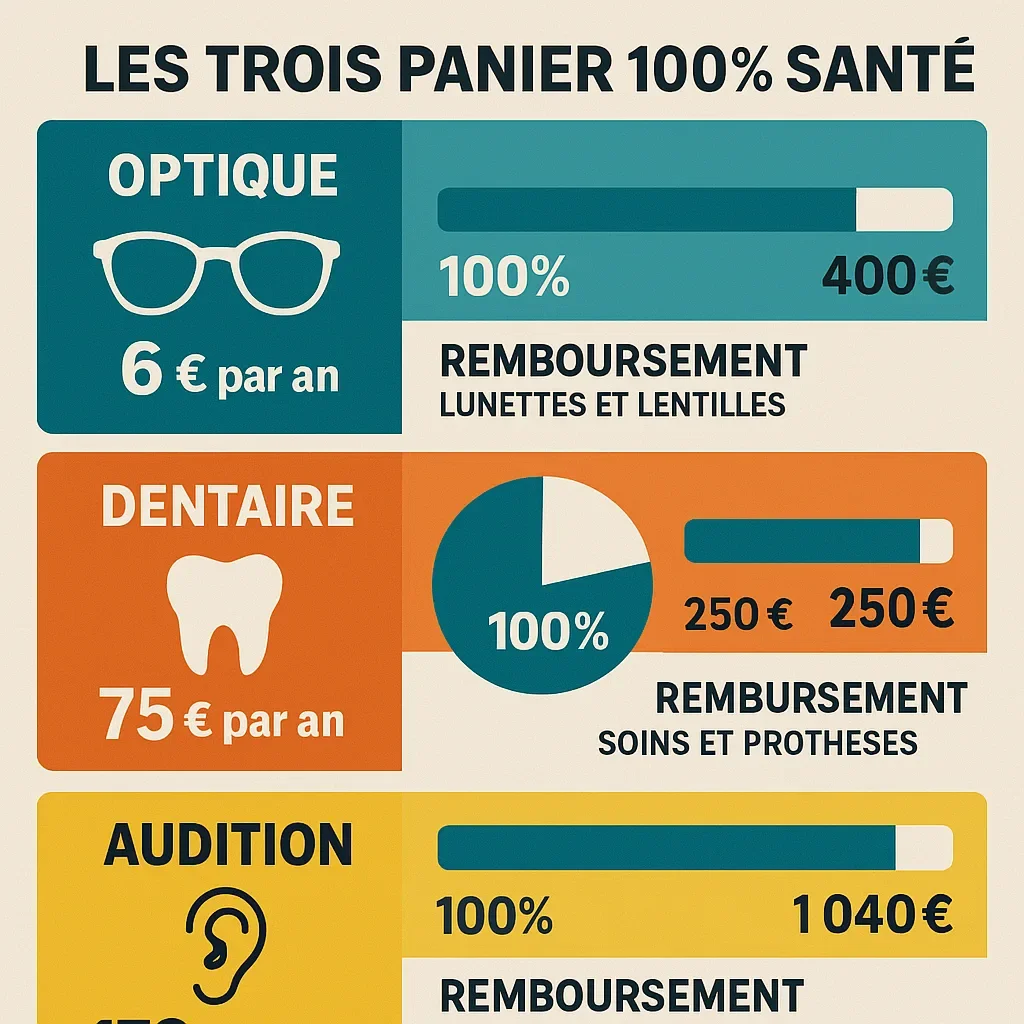
In optics, the sensitive point remains the difference between the frame and the lenses: the former is capped, the latter are regulated according to the correction. In dentistry, the nature of the prosthesis and the tooth concerned matter a lot. In hearing, it is the class of the device that changes the game, with a class I basket designed for full reimbursement.
| Field | Care or equipment concerned | Point of vigilance | What can create an out-of-pocket expense |
|---|---|---|---|
| Optics | Frames and lenses from the 100% Health basket | The choice of model and treatments matters | Premium frame, comfort options, out-of-basket lenses |
| Dentistry | Crowns, bridges, dentures depending on the clinical situation | The material and the treated tooth affect the price | Free pricing, more expensive materials, extra charges |
| Hearing | Class I hearing aids | The level of technology and technical adaptation matter | Class II, advanced functions, services outside the basket |
In other words, the zero out-of-pocket expense does not cover custom desires. It covers a base of useful care, defined in advance, and it is precisely this structure that allows comparing offers without drowning in technical details.
Who can benefit and how to request it without making a mistake
In practice, zero out-of-pocket expense is not reserved for a handful of complicated cases. It mainly targets people covered by a responsible complementary health insurance — which is the case for the vast majority of contracts — or by the Complementary Health Solidarity (CSS). The key point is to ask for the right quote before signing.
- Request a clearly identified 100% Health quote.
- Compare the no out-of-pocket basket and the free offer.
- Check if the professional practices third-party payment.
- Read the total amount to pay, not just the displayed price.
On the ground, a receptionist at a dental center observes that many patients understand the system at the time of the quote, not before. When the professional presents both versions, 100% Health basket and free pricing, the difference immediately becomes concrete and the choice is made without unpleasant surprises.
In optics as in hearing, it is always appreciated to request the zero out-of-pocket version from the first appointment. In other words, it is not a hidden bonus to claim at the checkout: it is an option to put on the table from the start.
If you are under CSS, the operation remains broadly the same on eligible care, but vigilance must remain the same: quote, basket, options, and any additional fees. The good reflex is never to sign without knowing what is included, what is capped, and what is outside the framework.
Concrete reimbursement according to the care
The word reimbursement can be confusing. For eligible care, Health Insurance reimburses its base, then the complementary insurance completes up to the basket ceiling; for care outside the basket, the supplement remains your responsibility. In short, zero out-of-pocket does not cover comfort services, extra charges, nor anything outside the framework.
The right test is not to compare two prices at the bottom of the quote, but to compare the final amount to pay. This is where zero out-of-pocket becomes really useful, and this is also where premium offers take over.
On a well-made quote, the difference quickly appears: a crown or a device from the 100% Health basket drops to €0 for the eligible insured, while a high-end model can significantly increase the bill. That is exactly why you need to read the out-of-pocket line before looking at the product color or brand.
The mechanism is therefore less magical than useful: it regulates prices, secures reimbursement, and prevents a basic need from turning into a painful bill. It’s a bit like the whipped cream on the cherry: you don’t always see it, but you definitely notice when it’s missing.
Errors That Increase the Bill
The biggest trap is believing that zero out-of-pocket costs automatically cover all options. In reality, the slightest shift to a premium material, a branded frame, or an advanced feature can fall outside the scope.
- Not requesting the 100% Health basket from the start.
- Confusing the introductory price with the actual amount to be paid.
- Forgetting to check the supplementary insurance contract, especially when changing mutual insurance.
- Accepting comfort options without measuring their impact on the bill.
- Neglecting the detailed estimate, even though it reveals the true level of reimbursement.
Zero out-of-pocket costs are not meant to lower all market prices. They are designed to guarantee a base of accessible care, with a defined quality level and regulated prices. It’s less catchy than a slogan, but much more useful when it comes time to pay.
It is always helpful to keep a simple rule in mind: if the estimate is not clear, do not sign. That’s why a careful reading of the document remains your best insurance against unpleasant surprises.
FAQ on Zero Out-of-Pocket Costs
Can you benefit from it without supplementary insurance?
Not really, unless you are covered by the Complementary Solidarity Health Insurance. Without responsible supplementary health insurance, the portion not covered by the Health Insurance does not disappear on its own. Zero out-of-pocket costs rely precisely on this duo: Social Security + supplementary insurance.
Is the dentist required to offer a 100% Health basket?
They must allow access to the scheme when the procedure is suitable, but they can also present other options. The right approach is to explicitly request the estimate for the 100% Health basket and compare it with the free option, especially for crowns and bridges.
Are branded glasses compatible with zero out-of-pocket costs?
The brand is not the issue: it’s the basket that matters. A more stylish or expensive frame can fall outside the scope, whereas a frame from the basket remains capped at €30. Zero out-of-pocket costs do not cover premium desires.
Do you have to pay upfront?
Not always. It depends on the third-party payment practiced by the professional and the rules of your supplementary insurance. In practice, many eligible cases are settled without upfront payment, but you need to check before ordering or fitting.
Is the 100% Health basket always sufficient for hearing?
Not necessarily. For certain hearing losses or comfort needs, a Class II device may be more appropriate, but it then falls outside zero out-of-pocket costs. The advantage of the Class I basket is to offer a solid solution with a clear price ceiling.