
In brief
🔎 Not mandatory in principle for consumer credit, but the lender can make it necessary to grant the financing.
🛡️ The most common guarantees cover death and total and irreversible loss of autonomy, then come temporary total disability (TTD), permanent total disability (PTD), and sometimes job loss.
💶 The real issue is not just the monthly payment: you need to look at the APR of insurance (TAEA), the exclusions, the deductible, and the total cost over the entire loan duration.
📌 In case of fragile health, the AERAS scheme can help find a more accessible insurance solution, but it does not replace careful reading of the notice.
Is borrower insurance mandatory for consumer credit?
No, borrower insurance is not mandatory in principle for consumer credit. However, the lender can require it as a condition for granting the loan, especially for a high amount, a long duration, or a file considered more fragile. In other words, optional by law, it can become essential in practice.
The framework is clear in the Service-Public fact sheet dedicated to borrower insurance for consumer credit: insurance is not part of the consumer’s automatic obligations, but it can be required by the lending institution. This is the difference between a legal rule and a commercial condition.
Concretely, this means that a personal loan, car loan, or credit refinancing file can be accepted without insurance in some cases, while another will be rejected without protection. The lender’s logic is simple: the longer the duration, the greater the risk of non-payment if a life accident occurs.
You also need to distinguish two things that are often confused: legal obligation and financial interest. A small loan over a few months does not have the same stakes as financing several thousand euros over several years. That is why you should never answer this question automatically.
Which consumer loans are most sensitive to insurance?
Not all consumer loans are equal. For a one-time purchase of a small amount, insurance sometimes weighs too heavily compared to the risk covered; for a longer personal loan or a debt consolidation, it becomes more justifiable. In other words, the relevance mainly depends on the amount, the duration, and the monthly budget.
The most common profiles can be summarized as follows:
- Personal loan: often the most concerned, as it finances larger sums and extends over several years.
- Auto loan or assigned credit: insurance helps prevent a life event from turning the vehicle into a difficult-to-manage burden.
- Revolving credit: the issue is different because the balance varies and the cost of insurance can quickly rise if the account is used for a long time.
- Debt consolidation: the longer the consolidation extends the duration, the more strategic the coverage becomes.
- Student loan or training financing: the interest is strong if the borrower still depends on unstable income.
In practice, a file considered “light” for a short-term used car will not be treated like financing renovation work over several years. This is where lenders adjust their requirements, sometimes without stating it outright. The implicit message is often: the higher the risk of non-repayment, the more welcome insurance becomes.
The key point to remember is that a consumer loan does not call for the same strategy depending on whether it is used to smooth out a temporary expense or to finance a major project. A borrower who keeps a safety margin may accept to go without insurance; another, more exposed, will have every interest in keeping it, even if it is not explicitly imposed.
What guarantees does consumer loan borrower insurance really cover?
Borrower insurance on consumer credit mainly serves to take over if the borrower can no longer repay due to death, disability, or work stoppage. The exact guarantees vary greatly from one contract to another, and some options like job loss are very regulated, sometimes with tight exclusions.
On paper, the guarantees seem simple. In the notice, they are much less so. That’s why the same contract can seem protective at first glance, then prove much narrower as soon as you read the definitions, deadlines, and exclusions. To visualize the essentials, here is the core of the subject:
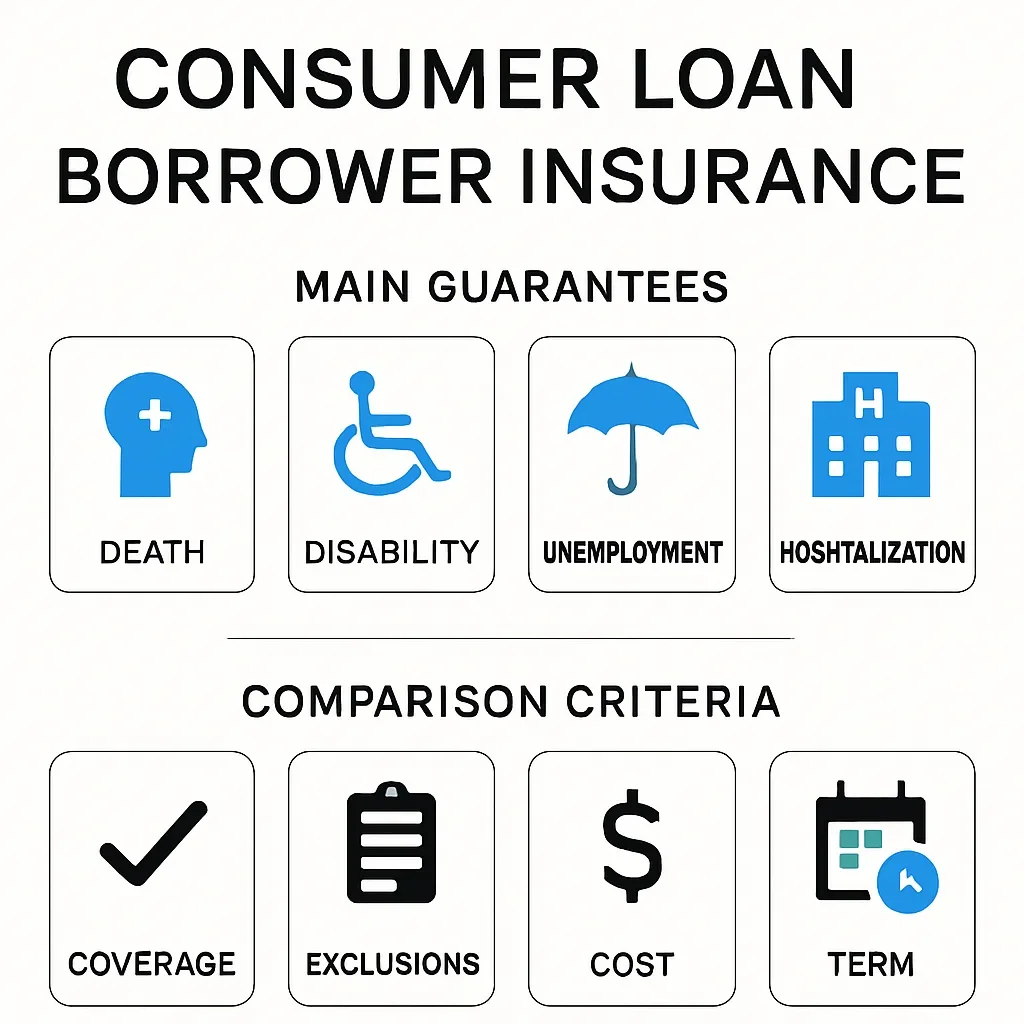
| Guarantee | What it covers | Point of vigilance |
|---|---|---|
| Death | The contract reimburses all or part of the outstanding principal. | Check exclusions and age limits. |
| PTIA | Coverage in case of total and irreversible loss of autonomy. | Medical criteria are strict and tightly regulated. |
| ITT | Temporary reimbursement of installments during work stoppage. | Beware of the deductible: 30, 60, or 90 days depending on the contracts. |
| IPT / IPP | Coverage in case of partial or total disability according to the rate applied. | The insurer’s scale may be stricter than the initial medical opinion. |
| Job loss | Coverage under conditions during a period of involuntary unemployment. | Often optional, with many exclusions: fixed-term contracts, resignation, probation period. |
The classic trap is to believe that all guarantees are triggered automatically as soon as a life accident occurs. In reality, the insurer relies on precise definitions: recognized work stoppage, incapacity as defined by the contract, waiting period, date of occurrence of the claim. This technical vocabulary changes everything.
At the scale of a file, the right contract is not only the one that “covers a lot,” but the one that covers the right risk, at the right time, with a reasonable level of exclusion. The icing on the cake is that it must remain readable. If the notice looks like a puzzle, it is not a good sign.
How much does borrower insurance cost on a consumer loan?
€200 to €75,000: this is the range that defines consumer credit in France, according to the framework recalled by Service-Public. Within this range, the cost of insurance is mainly judged based on the duration, the capital, and the borrower’s profile.
The price of borrower insurance on a consumer loan varies much more than one might think. Two seemingly identical files can receive very different rates simply because age, health status, loan duration, and level of guarantees are not the same. In other words, there is no “normal” rate valid for everyone.
In practice, the cost generally takes the form of a monthly contribution or a percentage of the insured capital. On a loan of €10,000 over 48 months, a contribution of a few euros per month already changes the final bill. On a longer loan, even a modest increase in the TAEA can increase the total cost by several hundred euros.
To avoid being caught out, you need to look at four elements together:
- The amount of the premium: monthly or included in the installment.
- The TAEA: the indicator that helps compare the real weight of the insurance.
- The total cost over the duration of the loan, not just the first month.
- The calculation method: fixed contribution, decreasing, or indexed on the outstanding capital.
The right reflex is to compare the cost of the insurance with the level of real risk. On a short loan, paying a lot for very broad coverage may not be profitable. On a long and structuring loan, the equation changes completely. This is where you see if the protection plays its role or if it becomes a simple poorly calibrated extra.
As a practical benchmark, incapacity waiting periods often revolve around 30, 60, or 90 days depending on market offers. The shorter the waiting period, the earlier the coverage is useful… but the contract may cost more.
How to compare offers without getting trapped?
Comparing a consumer credit borrower’s insurance does not mean choosing the lowest monthly payment. You need to check the equivalence of guarantees, the APR, exclusions, the deductible, the coverage of the co-borrower, and the cancellation conditions. This is often where the real savings lie.
The market is filled with offers that appear “simple,” but the apparent simplicity sometimes hides very narrow guarantees. A good comparison therefore does not only focus on price. It must also assess the quality of compensation, the speed of claim activation, and how the insurer defines each risk.
The right contract is not the one that costs the least at time T, but the one that truly protects when life goes off track. A low premium with poorly designed exclusions is often the ultimate false good deal.
Before signing, here is the most useful reading grid:
- Equivalence of guarantees if you take a contract other than the one offered by the lender.
- Exclusions: risky sports, pre-existing conditions, particular professional situations.
- Waiting period: period during which the guarantee exists on paper but does not yet pay out.
- Deductible: delay between the work stoppage and the start of compensation.
- Share if there are two borrowers: it determines who is covered and to what extent.
- Cancellation conditions: they are not always as flexible as one might imagine.
The case of the co-borrower deserves a special mention. If you are financing a project together, the insurance must be thought of as a tandem, not as an individual formality. Coverage at 100% for each person may seem comfortable, but it is not always necessary or the most rational. Conversely, a share that is too low leaves a real blind spot.
For an official reading of the basic rules, the consumer credit guide from the Ministry of Economy complements well the information from the Service-Public sheet.
Consumer credit and health: what should you check before signing?
It is observed in practice that many borrowers sign the proposed insurance without reading the notice to the end. In auto loan or home improvement loan files, the surprise often comes from the 60 or 90-day deductible: as long as the period runs, nothing is paid, even if the work stoppage is real.
Health completely changes the game because the insurer does not reason only based on the loan but also on the risk of claim. Depending on the contracts, a medical questionnaire may be required, especially if the amount or duration of the financing is significant. And this is where the AERAS system can become useful.
The AERAS convention website precisely reminds that a health file is not necessarily a dead end. The principle is to broaden access to insurance when aggravated health risk complicates standard acceptance. Good to know: the right to be forgotten, reduced to 5 years for certain cancers and hepatitis C, can also lighten the declaration in some cases.
However, a common misunderstanding must be avoided: the logic of consumer credit is not exactly the same as that of a mortgage loan. We are not in the same regulatory framework, nor the same questionnaire thresholds, nor the same comparison reflexes. What works for a mortgage loan does not always transpose as is to a consumer loan.
Here are the points to check if your medical situation is particular:
- Exclusions related to a previous pathology.
- The presence or absence of a health questionnaire.
- Declaration deadlines and supporting documents to provide.
- The exact definition of disability or invalidity in the contract.
- The possibility of a premium surcharge or partial coverage.
In sensitive cases, the best strategy is not to hide information but to compare several solutions, read the notice, and if necessary, request an alternative version of the contract. It’s less glamorous than a marketing promise, but much more useful when the file becomes complicated.
Should you take the lender’s insurance or go through another contract?
You are not obliged to choose the insurance offered by the credit institution, provided that the alternative contract offers equivalent guarantees. In practice, the best option is often the one that balances price, clarity, and level of protection, not the one that only wins on the monthly payment.
The lender’s contract is often simpler to subscribe to, but not necessarily more advantageous. External insurance can sometimes offer better guarantees, more flexible pricing, or a clearer understanding of exclusions. Conversely, it can be less convenient to activate if the customer journey is less smooth.
The right question to ask is therefore not “where is it easiest?”, but “where is it most consistent with my profile?”. If your loan is short, your budget is tight, and you already have a safety savings, the lightest insurance may suffice. If your file is long, tight, or risky, it is better to have a more robust contract, even if it is a bit more expensive.
Most often, the best method is to compare in this order:
- The guarantees that are truly useful according to your situation.
- The total cost of the insurance over the duration of the loan.
- The exclusions and the deductible.
- The management flexibility in case of a claim or change of situation.
If you are still unsure, keep in mind a simple rule: consumer credit insurance is not there to look good in the file. It serves to prevent a life accident from turning an ordinary financing into a financial headache. And frankly, that is better than a fine print promise.
FAQ — Borrower Insurance and Consumer Credit
Can you refuse the insurance offered by the lender?
Yes, in many cases, but only if your alternative contract meets the guarantees required by the lender. The key point is the equivalence of guarantees. Without it, the credit institution can refuse the substitution or ask you for additional coverage.
Does borrower insurance cover a short-term sick leave?
Not always. Many contracts provide a waiting period of 30, 60, or 90 days before any payment. In other words, a brief leave may trigger nothing, even if the claim is real. This is a point to read before signing, especially for vulnerable professions.
Must a revolving credit be insured?
No, but insurance may be offered or required depending on the file and the amount used. Since the capital varies, the cost calculation is sometimes less clear than a classic personal loan. The risk here is paying for a long time for very partial protection.
What to do if you have a chronic illness?
You need to compare several solutions and check if the contract requires a health questionnaire. If the file is complicated, the AERAS scheme can help find a solution, even if not everything is automatic. The best is to disclose everything: an incomplete declaration can void the guarantee.
Can you cancel your insurance after signing?
Sometimes yes, but it is not a universal mechanism as seen with other products. It all depends on the contract, the lender, and the substitution conditions. Before any action, you must check if the credit was granted because the insurance was an indispensable condition.
Is job loss well covered?
It is only covered in certain contracts, and often with strict conditions. Trial periods, resignations, fixed-term contract ends, or certain contract terminations are frequently excluded. It is a useful guarantee on paper, but rarely the easiest to activate.