
| 📌 | Definition: the coypu, or Myocastor coypus, is a large semi-aquatic rodent native to South America. |
| 🔎 | Identification: its orange incisors, round tail, and stocky snout make it fairly easy to identify. |
| 🌿 | Habitat: it is mainly found along banks, ditches, marshes, canals, and calm bodies of water. |
| ⚠️ | Impact: it digs burrows, weakens embankments, and can cause significant bank damage. |
| 🛠️ | Management: prevention, reporting, and regulated trapping are the most appropriate responses. |
| 📣 | Regulations: rules vary by territory, so local decrees should always be checked. |
What is a coypu? Identifying, understanding, and limiting its presence
If you wonder what a coypu is, remember this: it is a large aquatic rodent, more precisely semi-aquatic, recognizable by its massive silhouette, orange teeth, and cylindrical tail. In France, it draws attention because it quickly colonizes wetlands and can cause very tangible damage to banks, crops, and certain hydraulic structures.
Its identification is not a trivial naturalist detail. Knowing how to recognize it means understanding whether it is a simple opportunistic presence at the edge of a pond or an invasive species that begins to dig, weaken, and settle permanently. Joking aside, it’s better to act early than to repair a collapsed embankment afterward.
Sommaire
Quick definition of the coypu
The coypu is a semi-aquatic mammal native to South America, scientifically known as Myocastor coypus. In France, it was introduced for farming and fur before naturalizing in many wet environments. Today, it is mainly observed as an invasive exotic species, capable of adapting quickly and multiplying efficiently.
Species identity sheet
- Scientific name: Myocastor coypus
- Animal type: semi-aquatic rodent
- Origin: South America
- Status in France: invasive exotic species, often managed locally according to current decrees
- Average size: 40 to 60 cm for the body, with a tail of 30 to 45 cm
- Common weight: around 5 to 9 kg, sometimes more in large individuals
- Diet: aquatic plants, roots, stems, young shoots
How to recognize a coypu?
The coypu is mainly recognized by its appearance as a large stocky rodent, its brownish fur varying in darkness, and its large visible orange incisors. Its tail is round, long, and almost cylindrical, unlike the beaver’s, which is wide and flattened. In other words, a few seconds of observation are often enough to clear up any doubt.
Visual characteristics
- Brown to grayish-brown fur, fairly dense and often damp near water
- Large orange incisors, very useful for identification
- Round and cylindrical tail, never flattened like the beaver’s
- Webbed hind feet, a sign of a lifestyle adapted to water
- Small ears barely visible from a distance
- Rounded snout and overall compact silhouette
Difference between coypu and beaver
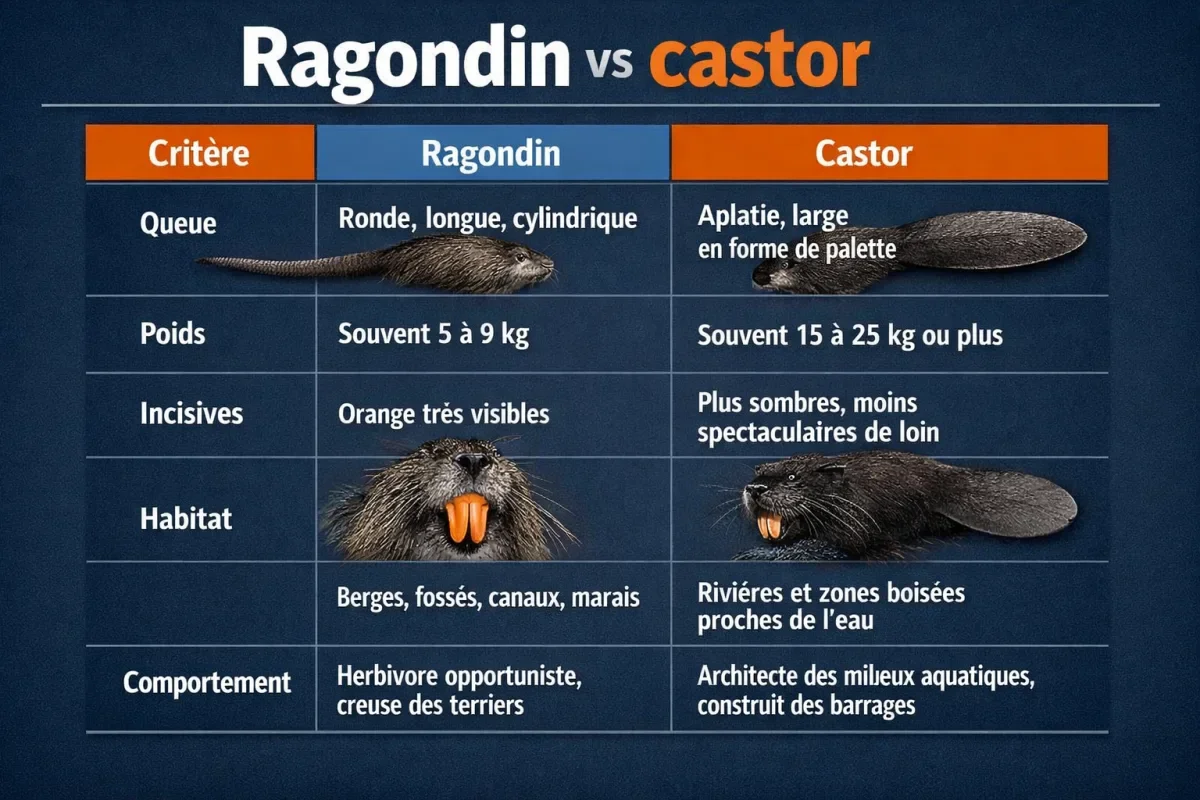
The difference between coypu and beaver is mainly seen in the tail, body shape, and general behavior. The beaver is more massive, more discreet, and much more tied to waterways that it actively modifies. The coypu, on the other hand, is closer to vegetated banks, ditches, and calm environments where it feeds and digs burrows.
| Criterion | Nutria | Beaver |
|---|---|---|
| Tail | Round, long, cylindrical | Flattened, broad, paddle-shaped |
| Weight | Often 5 to 9 kg | Often 15 to 25 kg or more |
| Incisors | Very visible orange | Darker, less striking from afar |
| Habitat | Banks, ditches, canals, marshes | Rivers and wooded areas near water |
| Behavior | Opportunistic herbivore, digs burrows | Architect of aquatic environments, builds dams |
Where does the nutria live and what does it eat?
The nutria prefers calm freshwater environments: ditches, ponds, canals, marshes, slow rivers, and banks rich in vegetation. Its diet is mainly plant-based, with a preference for aquatic plants, tender stems, roots, and sometimes crops near water points. It settles where food is easy to find and shelter easy to dig.
Favorite habitat
- Agricultural ditches and drainage networks
- Canals, ponds, and shallow pools
- Banks of slow rivers and marshes
- Wetlands rich in reeds and aquatic plants
- Edges of irrigated crops or plots near water
Nutria diet
Its nutria diet is that of an opportunistic herbivore. It mainly consumes what it finds at water level: roots, rushes, reeds, sedges, young shoots, sometimes cereals or vegetables if it finds an accessible plot. It is not a hunter; it is a fairly methodical grazer, and that is precisely what helps it endure over time.
- Aquatic plants
- Tender stems and rhizomes
- Young shoots on the bank
- Certain vegetables and low crops near water points
Why is the nutria a problem?
The nutria becomes problematic when it multiplies and settles near infrastructures, crops, or sensitive banks. Its burrows weaken slopes, its movements damage vegetation, and its feeding can degrade entire plots on a small scale. In other words, the problem is not its isolated presence, but its ability to turn a water edge into a construction zone.
Damage to banks and structures
- Deep burrows in slopes and soft banks
- Weakening of banks which can lead to localized collapse
- Fragilization of dikes, ditches, and canals
- Obstruction or degradation of small hydraulic structures
Impacts on agriculture and gardens
- Young shoots cut or grazed
- Wet plots more exposed to damage
- Irrigation networks or ditch edges affected
- Localized yield loss on certain low crops
Health risks and nuisances
Beyond material damage, the presence of the nutria can raise health concerns. Like many mammals linked to wet environments, it can contribute to contamination of water and mud through its droppings or urine, which justifies real caution around areas frequented by humans and domestic animals. This does not mean panic, but vigilance, yes.
What are the signs of a nutria presence?
The nutria is often spotted without being seen directly. Its traces are quite telling: trails in vegetation, burrow entrances at water level, neatly cut vegetation, discreet footprints, and sometimes droppings near banks. Since it is mostly active at dusk and night, it often leaves more signs than clear sightings.
Visible traces in the field
- Clear trails in grass or reeds, forming repeated passages
- Burrow entrances in banks, often immediately near the water
- Cut or grazed plants at low height
- Footprints in mud, sometimes with webbed finger marks
- Floating plant remains, piles of stems or feeding areas
When to observe its activity?
The coypu is mainly active at dusk, at night, and sometimes early in the morning. During the day, it remains more discreet, hidden in dense vegetation or in its burrow. That is why the most useful reports often come from people who follow a bank at different times, not just in full sunlight.
What to do if you spot a coypu?
If you observe a coypu near a garden, a pond, or a bank, the right response is to limit favorable factors, precisely note the location, and contact the appropriate contacts. One should not improvise an intervention. Effective management relies on prevention, reporting, and, if necessary, an action regulated by authorized professionals.
Prevention measures
- Reduce overly dense refuge areas along the water’s edge
- Protect fragile banks with suitable arrangements
- Avoid direct access of sensitive crops to water points
- Regularly monitor ditches, canals, and banks after rain or flooding
- Quickly report any suspicious gallery or subsidence
Who to contact?
- The town hall, to direct you to the appropriate local service
- The competent services of your territory, especially when the nuisance affects a hydraulic network or a protected area
- Authorized trappers or qualified professionals, according to the locally provided framework
- River or basin management structures, if it concerns a sensitive sector
Is the coypu an invasive species and how is it managed?
Yes, the coypu is considered in France as an invasive exotic species. However, its management is not uniform everywhere: it depends on prefectural orders, local contexts, and objectives for protecting banks or natural environments. This is precisely why it is necessary to verify the applicable rule before any intervention.
The useful institutional references on the subject are those of the OFB, the INPN/MNHN, the prefectures, and Légifrance. They allow confirming the species’ status, understanding the authorized measures, and distinguishing what falls under prevention, reporting, or a regulated management action.
- Prevention: limit establishment and detect presence signs early
- Management: trapping or other interventions only within the authorized framework
- Safety: avoid any risky or improvised handling
- Compliance: check local orders before acting
FAQ about the coypu
Is the coypu dangerous to humans?
The coypu is not aggressive by nature, but it can become problematic due to its damage and the risks linked to the wet environments it frequents. The real issue is mainly the proximity to fragile banks, contaminated water, and installations it can damage. Therefore, direct contact is avoided and observation from a distance is preferred.
Can it be confused with a beaver?
Yes, especially from a distance. But the tail usually settles the question: the coypu’s tail is long, round, and cylindrical, whereas the beaver’s tail is wide and flat. The beaver also appears more massive, stockier, and more of an “engineer” of the aquatic environment, whereas the coypu looks more like a large herbivore of the bank.
How to prevent its establishment near a water point?
The main thing is to reduce shelters and monitor the banks: overly dense vegetation, easy access to water, loose embankments, and areas rich in food favor its establishment. Regular maintenance, suitable bank protections, and early detection make a big difference. In short, the less welcoming the site, the less the coypu lingers there.
Is the coypu an invasive species?
Yes. The coypu is classified among invasive exotic species because it spreads quickly, adapts to many wet environments, and can cause ecological and material impacts. This does not mean that a single individual is a disaster, but that its repeated presence deserves serious and regulated management.
What to do if I see coypu damage on my bank?
Start by securing the area if a collapse is visible, then report the situation to your municipality or the site manager. Photographing the holes, runways, and collapses helps a lot. Then, let an authorized organization assess the most appropriate intervention method. A clean response is better than a makeshift fix that worsens the bank.
Ultimately, knowing what a coypu is means being able to recognize it without hesitation, understanding why it settles, measuring the real risks, and choosing an appropriate response. No panic, no guesswork: just the right reflexes at the right time, especially when the banks start to speak louder than the landscape.