
In brief
💡 The dental insurance reimbursement is never read alone: it always depends on the Social Security base rate, the charged price, and the contract’s coverage level.
🦷 The biggest differences occur with prosthetics, orthodontics, and implants. This is where a contract with 200% BR, 300% BR, or a flat rate really changes the bill.
📄 Before signing, look at the annual ceiling, the waiting periods, the 100% Health basket, and the reading of the dental estimate. A good contract is not the most expensive one, but the one that matches your actual care.
How does dental insurance reimbursement work?
Dental insurance reimbursement relies on three layers: the reimbursement base from Health Insurance, its share, then the complementary amount paid by the insurance according to the contract. In practice, the price charged by the dentist counts as much as the percentage displayed on your coverage.
The mechanism is simple in principle, but it quickly becomes misleading if you mix conventional rate and actual price. Health Insurance first reimburses based on an official base, not on what you pay at the office. Then, the insurance intervenes according to a logic of percentage, flat rate, or, more rarely, actual costs.
The official framework is detailed by Service-Public on dental care reimbursement and by ameli on dental consultations and care. Both remind the same idea: fee overruns are not treated like the care itself, and it is often there that out-of-pocket expenses increase.
- Routine care: consultation, tartar removal, cavity treatment.
- Prosthetics: crowns, bridges, devices, with a much higher out-of-pocket challenge.
- Non-standard acts: some implants or techniques do not follow the same reimbursement logic.
How to calculate your dental insurance reimbursement?
To calculate it, start from the conventional rate, subtract what Social Security pays, then add the insurance coverage: percentage of BR, annual flat rate, or actual costs. The classic trap is to believe that a “200%” reimburses 200% of the price paid, whereas it is actually a ceiling linked to the base.
Here is the clearest method: charged price → reimbursement base → Social Security share → insurance complement. If the base is low, a contract advertised at 200% or 300% can remain very reasonable, but not miraculous. And if the practitioner charges well above, the out-of-pocket can still be steep.
Simple example: if a procedure has a base of €100, Social Security reimburses €60 and your contract states 200% of BR, the overall ceiling rises to €200. The insurance can then top up to €140 in total, not up to €200 of the price paid. In other words, a care billed at €320 still leaves €120 to your charge even before considering possible ceilings.
Conversely, a flat-rate contract can be clearer on certain procedures. For example, a €300 annual flat rate for prosthetics can be more useful than a generous percentage on paper if your care mainly involves acts that are little or not reimbursed. That is why you need to read the logic of the contract, not just the monthly price.
How to read a dental estimate without getting tricked?
The dental estimate is the document that tells the truth. It shows the type of procedure, the price, the reimbursement base, the amount covered by Social Security, and the remaining amount to be paid. If even one of these lines is missing, you should ask for a clearer version before saying yes, because a vague estimate often ends up as a vague bill.
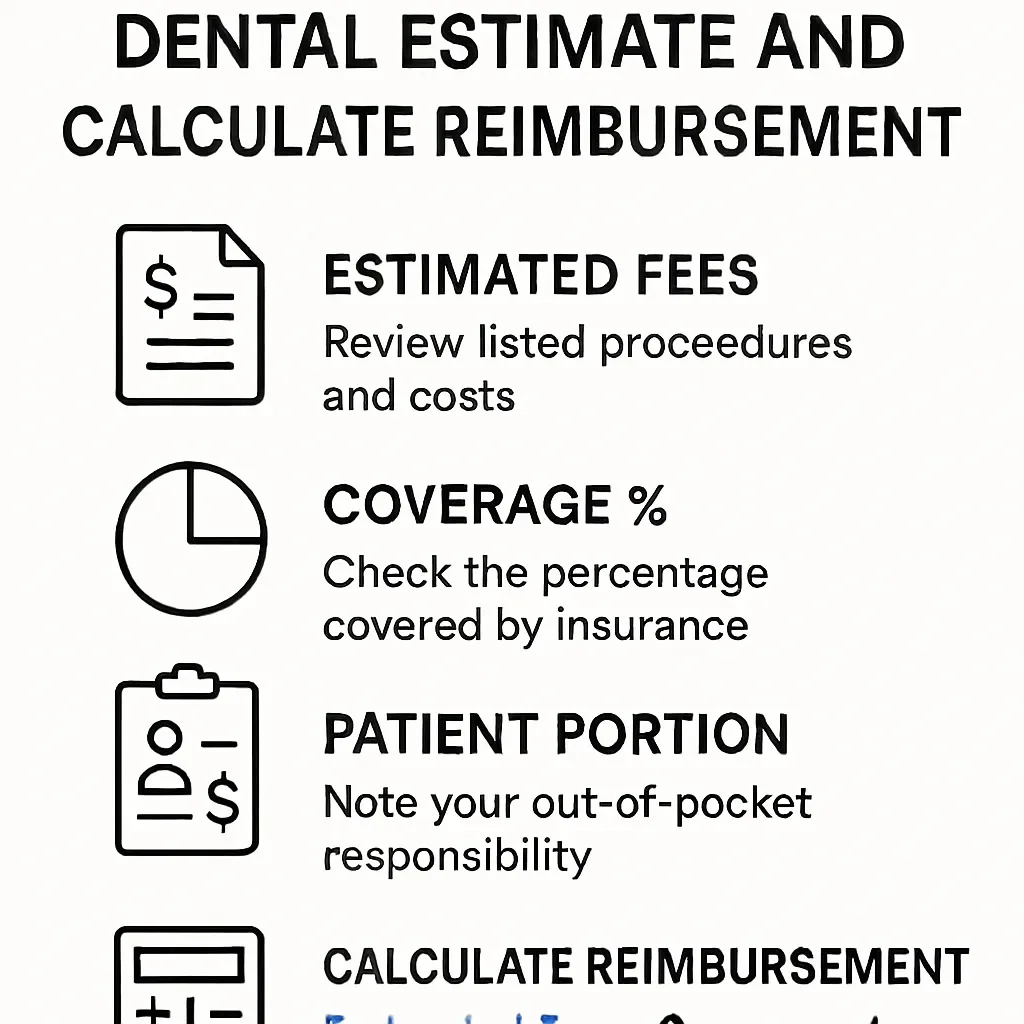
In practice, an estimate becomes much clearer when the office clearly separates the items. In a Lyon office, it is observed that patients finally understand why a “reasonable” crown ends up with a high out-of-pocket cost as soon as they are shown the separate line for fees.
A good estimate should allow you to spot, at a glance:
- the nature of the procedure: crown, bridge, inlay-core, appliance, etc.;
- the reimbursement base used by Health Insurance;
- the amount charged by the practitioner;
- the portion expected to be covered by the mutual insurance;
- the estimated out-of-pocket cost before considering any possible annual ceiling.
If your mutual insurance refuses to give you an estimate before the treatment, be wary. Serious contracts generally agree to calculate the reimbursement based on the estimate, which spares you from paying blindly. Joking aside, this is the kind of detail that changes your life when you have to get a prosthesis or heavy treatment.
Which dental treatments are really well covered?
Three categories must be distinguished. First, common treatments: consultation, scaling, cavity treatment. Next, prostheses: crowns, bridges, appliances. Finally, more technical procedures like orthodontics or implants, where the gap between actual price and reimbursement can become huge.
The 100% Health scheme has clearly improved the situation for some prostheses, but it does not cover everything and not just any way. The real benefit is to make certain treatments accessible without out-of-pocket costs, provided they fall within the designated basket. For everything else, dental mutual insurance remains the safety cushion.
| Treatment | Usual rule | What to watch out for |
|---|---|---|
| Consultation / scaling | Reimbursement based on the conventional rate | Possible excess fees and the co-payment |
| Crown / bridge | 100% Health basket possible depending on the case | The chosen material, contract ceiling, the estimate |
| Child orthodontics | Coverage under conditions, with prior approval | Up to 6 semesters in reimbursable cases before age 16 |
| Implant | Often outside Social Security reimbursement | The mutual insurance allowance and contract exclusions |
For families, the most sensitive items are often orthodontics and prostheses. For an adult, the issue revolves more around crowns and implants. In both cases, it’s not the name of the treatment that matters, but the calculation method applied behind it.
Which dental insurance to choose according to your profile?
The right contract does not look the same for everyone. A person who mainly goes to the dentist for routine care does not have the same needs as a family with two children undergoing orthodontics, or an insured person planning several prostheses in the year. The key point is to align the coverage with the most expensive treatment you are actually likely to have.
A family in Nantes reports having compared three contracts after two orthodontic quotes and a crown project. The lowest monthly rate seemed attractive, but the annual ceiling was reached too quickly and the waiting period eliminated part of the benefit. In the end, the intermediate contract proved to be the most cost-effective.
| Profile | Coverage to aim for | Point of caution |
|---|---|---|
| Small budget | Routine care + 100% Health basket | Avoid high contributions for unnecessary coverage |
| Family with children | Enhanced orthodontics and good annual ceiling | Check prior agreement and coverage duration |
| Major treatments coming up | Prostheses/implants package or high percentage of BR | Ceiling, exclusions, and waiting periods |
| Alsace-Moselle local scheme | Modular contract, without overpaying for extra coverage | Since the public base is more generous, the private addition can be optimized |
The truly good contract is not the one that shows the most spectacular percentage. It is the one that fits your actual care pathway, with clear ceilings and no tricky jargon.
In practice, three types of coverage stand out. Contracts based on a percentage of BR are useful if your treatments stay within the nomenclature limits. Flat-rate contracts are often more comfortable for prostheses or implants. High-end contracts add comfort, but they are only relevant if you really intend to use these coverages.
What mistakes increase out-of-pocket costs?
The first mistake is to only look at the monthly contribution. A mutual insurance at €25 per month may be less interesting than a contract at €40 if it caps quickly, poorly reimburses prostheses, or imposes a waiting period of several months. The right reflex is to compare the total cost over a year, not just the price shown on the commercial grid.
The second very common mistake is to confuse percentage of BR with percentage of the price paid. They are not the same at all. A 200% coverage may seem generous, but if the reimbursement base is low, the result remains limited. This is where many quotes turn out to be much less attractive than in brochures.
It is often observed that insured persons discover the notion of annual ceiling too late, when several procedures have already been done. In a clinic on the outskirts of Lille, an administrative agent notes that misunderstandings mainly arise when the contract mixes flat-rate, percentage, and exclusions in the same coverage line.
Special cases not to forget
Alsace-Moselle really changes the game: Service-Public reminds that dentists’ fees there are reimbursed at 90% by the local scheme, which mechanically reduces the need for very aggressive mutual insurance. Conversely, in the rest of France, the Social Security share remains more modest on many procedures.
For children under 16 years, orthodontics can be covered under conditions, with prior agreement, over several semesters. For people eligible for Complementary Solidarity Health Insurance, out-of-pocket costs can be greatly reduced on many treatments. As for long-term illness (ALD) situations, they do not automatically erase all dental expenses: you always have to look at the specific procedure involved.
The common point of all these cases is that you should never generalize. Two insured people can have the same treatment, the same city, and yet a totally different out-of-pocket cost. In other words, dental mutual insurance reimbursement is always judged in the context of the patient, not with a ready-made marketing promise.
- Check if the treatment is included in the 100% Health basket.
- Always request a detailed estimate before starting.
- Check the annual ceiling and the presence of a waiting period.
- See if the contract reimburses by percentage or by fixed amount.
FAQ — dental mutual insurance reimbursement
Does a mutual insurance reimburse dental implants?
Often not directly, because the implant is frequently not reimbursed by Social Security. However, some mutual insurances offer an implant allowance or a global allowance for prosthetics. The decisive point remains the annual ceiling and the exclusions of the contract.
Should the estimate be sent before the treatment?
Yes, ideally. It is the best way to obtain a clear estimate of the dental mutual insurance reimbursement before committing. Many insurers can provide you with a quote based on the estimate, which avoids unpleasant surprises after the procedure.
Why do two mutual insurances at 200% BR not reimburse the same way?
Because they may apply different rules: annual ceiling, allowance per procedure, exclusions, waiting period, or limitation on certain materials. The percentage alone never tells the whole story. It’s the kind of detail that makes all the difference when paying.
Does the 100% Health cover all crowns?
No. The scheme only covers certain procedures and certain materials, with specific rules. If the chosen treatment is outside the basket, the mutual insurance becomes central again. So you need to check the exact type of crown proposed by the dentist.
What if I live in Alsace-Moselle?
The local scheme significantly improves the basic reimbursement on several dental treatments. Result: a very high-end mutual insurance is not always necessary. It is often better to aim for a balanced contract, especially if your treatments remain occasional.
Is a child under 16 better reimbursed?
For orthodontics, there is a specific framework with prior approval and coverage under conditions. The mutual insurance can supplement this base, but it does not replace the coverage authorization from Health Insurance. Here too, the estimate remains your best ally.