Political and social context on the eve of the insurrection
Ancien Régime society: fixed hierarchy and tensions
One might think that the Bastille, a state prison, was just an anecdotal relic. In reality, it embodied the absolute authority of the king and the arbitrariness of the lettres de cachet. Society was then divided into three estates: clergy, nobility, and the Third Estate. The latter, despite its diversity (peasants, bourgeois, artisans), bore a disproportionate tax burden. From then on, every missing ton of flour or torn banknote increased the pressure on the poorest.
Financial crisis and widespread discontent
At the end of the 1780s, the kingdom’s coffers were empty. Salt was taxed, tobacco was levied, loans were taken from abroad… without much success. Speculators grew fat while bread became a luxury. Result: clandestine pamphlets flourished, impromptu meetings chanted “bread, paper.” The Bastille, guardian of power, crystallized this anger.
The Bastille: from a medieval fortress to a symbol
Origins and evolution of a defensive fortress
Built in the 14th century to protect Paris from the English, the Bastille was initially called the “chastel.” Gradually, its role shifted: it was no longer just a military stronghold but a state prison. The cells multiplied, as did political prisoners. Its massive architecture, pierced with arrow slits, evoked royal power. Over the years, it became the perfect illustration of a power sheltered from dissent.
Daily life behind the walls
Jokes aside, the Bastille is often imagined as a place of permanent torture. In truth, the condition of prisoners varied greatly depending on status and financial means. The wealthiest enjoyed heated rooms, could receive visitors, and hire a cook. Others, crammed into damp dungeons, struggled against boredom, vermin, and hunger. Testimonies from doctors and jailers bring back this atmosphere, half oppressive, half anachronistic.
How did the storming unfold?
The preparations for July 14, 1789
At first light, groups formed near the City Hall. The rioters, mostly artisans and workers, were far from seasoned soldiers, but their determination was clear in their eyes. They sought weapons – rifles, cannons, hunting guns – and demanded bread. Rumors swelled: the Bastille was said to be full of ammunition, ready to open fire on the crowd. This electric atmosphere pushed them to act, without waiting for a royal delegation.
The siege and assault
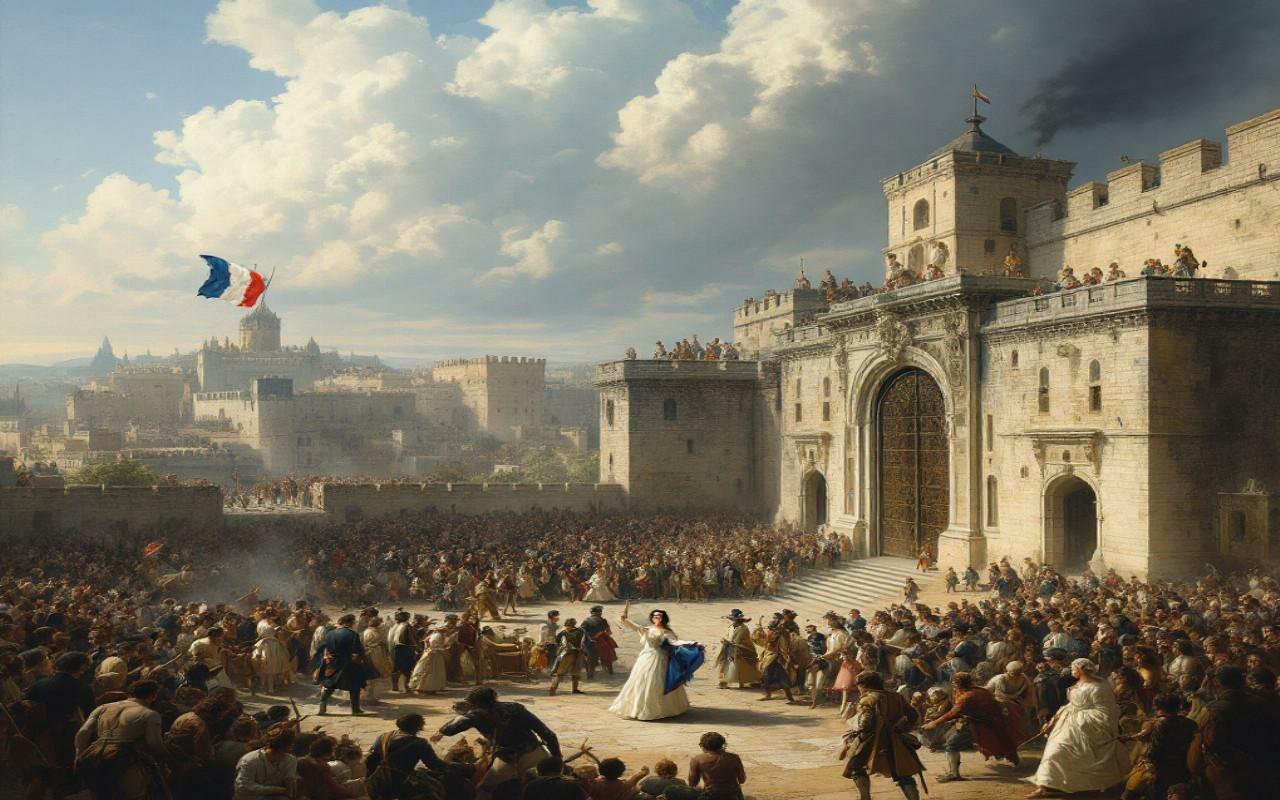
The first volley rang out at noon. The main gates resisted, so they tried to launch some cannonballs. Gradually, the artillery guards, destabilized by the scale of the movement, gave ground. Around 5 p.m., the gates were forced. Behind them, Governor Launay, overwhelmed, finally surrendered. In less than four hours, the fortress fell. The prisoners – seven in total, mostly businessmen in conflict with the royalty – were freed amid cheers. The heads of Launay and some soldiers were paraded as trophies on crowbars.
Key actors and contemporary testimonies
The Parisian insurgents
Figures emerged: Danton, still unknown, galvanized the crowd; Camille Desmoulins, with his contorted skull, called for insurrection by evoking the “happy July 14.” But the majority remained anonymous. The tricolor sashes did not yet exist, yet the red banner of the people was already visible. Women also played a role, notably by organizing supplies and care for the wounded.
Some voices from contemporaries
“I saw a thousand men after crossing the bridge, each with the flame of liberty in their eyes.”
– Diary of a young Parisian carpenter, July 15, 1789
“The Bastille fallen, it’s as if the night had let go of the railing; the light finally penetrates.”
– Anonymous letter addressed to a provincial deputy
Immediate Consequences
Reaction of the King and the Assembly
Louis XVI, surprised by the scale of the event, hastens to recognize the National Assembly. The very next day, the gates of Versailles open for a solemn assembly where “constitutional guarantees” are promised. However, the king secretly dismisses his most liberal ministers, casting doubt on his sincerity. The political balance, until then fragile, cracks forever.
Expansion of the Revolutionary Movement
Inspired by Paris, several provincial cities rise up. Marseille soon sends a battalion to sing “La Marseillaise,” still unknown. Bordeaux, Lyon, and Rouen demand local Estates General. Castles are burned at night, a sign of general adherence to the principle of “end of privileges.” Letters of cachet are abolished in unison, accelerating the fall of the Ancien Régime.
The Legacy of the Bastille Today
Birth of the National Holiday
Not surprisingly, July 14th becomes a yearly highlight: military parades on the Champs-Élysées, fireworks, popular balls. This celebration mixes republican parade and popular festivity. Over time, it spreads abroad: the Bastille fascinates, not for its stones, but for the idea of a victoriously popular uprising.
A Universal Symbol of Freedom
While the French Revolution inspired the Mountain of the Haitian Revolution or the Barricades of 1830, it continues to fuel contemporary demands. Graffiti sometimes adorn walls in the form of a broken silhouette: the silhouette of the Bastille, of course, but also a metaphor for any system deemed oppressive. Every July, the statue of the Declaration of the Rights of Man, at Place de la Bastille, reminds that in Paris as elsewhere, no wall resists the thirst for justice.
FAQ – Understanding Everything in a Few Questions
- Why was the Bastille so symbolic?
Because it embodied royal arbitrariness: places for prisoners without trial, letters of cachet, and difficult access to the premises reinforced its image as tyranny in stone. - How many prisoners were freed?
Seven in total: most were detainees of personal affairs, not top political opponents. Their fate contrasts with the legend. - Did the storming really trigger the Revolution?
It did not initiate it – ideas were already circulating – but it served as a catalyst: proof that the crowd can bend a power until then absolute. - What remains of the Bastille today?
In its place, a large road axis and the famous July Column, a reminder of the Three Glorious Days (1830). Only a few scattered stones still tell the story. - Why do we celebrate July 14th today?
The first anniversary of the Revolution, it has become the “National Holiday,” between military commemoration and civil festivities, reflecting republican unity.
| Date | Key Event | Immediate Consequence |
|---|---|---|
| July 9, 1789 | Proclamation of the National Assembly | Popular gatherings in Paris |
| July 11, 1789 | Purchase of weapons at Hôtel des Invalides | The insurgents prepare |
| July 14, 1789 | Storming of the Bastille | Fall of the fortress, death of the governor |
| July 15, 1789 | Official announcement to the king | Recognition of the Assembly by Louis XVI |