The origins of Mulhouse in the Middle Ages
The earliest traces of Mulhouse date back to the Merovingian era, around the 7th century. At that time, the region was under the influence of the Frankish kingdom of Austrasia. The name of the city, “Mulhausen,” literally means “mill houses” in German, which suggests that milling activity played an important role in the local economy.
Over the following centuries, Mulhouse gradually developed, benefiting from its advantageous geographical position at the crossroads of several trade routes. The city was located on the banks of the Ill, a tributary of the Rhine, which facilitated exchanges and the transport of goods.
The medieval history of Mulhouse is closely linked to that of Alsace, a region that experienced many political and cultural changes over the centuries. Here are some key points of this period:
- Growing Germanic influence
- Development of religious institutions
- Rise of commerce and craftsmanship
- Conflicts between local lords and imperial authorities
Although specific details about Mulhouse are limited, one can imagine that the city followed a trajectory similar to that of other Alsatian towns of the time, oscillating between periods of prosperity and times of turmoil.
Daily life in Mulhouse in the Middle Ages
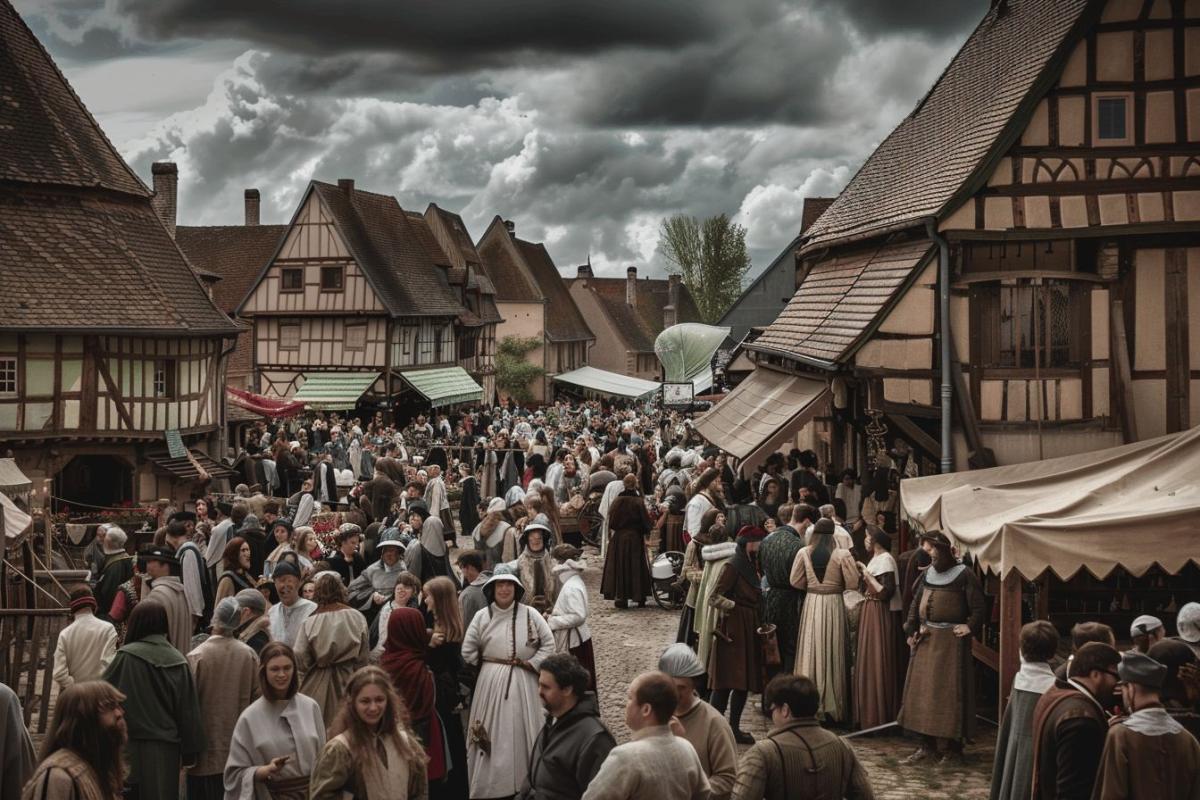
The daily life of Mulhouse’s inhabitants in the Middle Ages was probably paced by agricultural and artisanal activities. The guilds played a crucial role in the social and economic organization of the city, as was the case in many medieval towns.
The architecture of Mulhouse at that time must have reflected the styles popular in the region. One can imagine half-timbered houses, characteristic of Alsatian architecture, as well as religious buildings such as churches and convents. The city was likely surrounded by ramparts to ensure its defense.
The following table presents a hypothesis of the distribution of economic activities in Mulhouse during the Middle Ages:
| Sector of activity | Estimated percentage |
|---|---|
| Agriculture | 40% |
| Craftsmanship | 30% |
| Commerce | 20% |
| Services and administration | 10% |
The population of Mulhouse in the Middle Ages is difficult to estimate precisely, but it can be assumed that it counted several thousand inhabitants at its peak. The city had to face common challenges of the time, such as epidemics, famines, and armed conflicts.
Anecdotes and notable facts of Mulhouse’s medieval history
Although specific information about Mulhouse’s medieval history is scarce, we can mention a few anecdotes and notable facts that may have influenced the life of the city:
1. The status of an imperial free city: In the 13th century, Mulhouse is said to have obtained the status of an imperial free city, granting it a certain autonomy within the Holy Roman Empire. This status, if confirmed, would have had a significant impact on the political and economic development of the city.
2. The legend of the Klapperstein: A local tradition tells the story of the Klapperstein, a stone that talkative women were condemned to wear around their necks as punishment. Although this anecdote is probably apocryphal, it illustrates the richness of Mulhouse folklore.
3. Conflicts with neighboring lords: Like many medieval towns, Mulhouse probably had to face tensions with the lords of surrounding territories. These conflicts may have influenced local politics and the city’s alliances.
4. The development of the textile trade: Since the Middle Ages, Mulhouse is said to have begun specializing in the textile industry, laying the foundations for its future importance in this field. This activity probably contributed to the city’s prosperity and its regional influence.
Although these elements are partly speculative, they fit into the broader context of Alsatian medieval history and allow us to imagine life in Mulhouse during this fascinating period.
Medieval heritage of Mulhouse
Despite the lack of precise information on Mulhouse’s medieval history, the city retains traces of this era that testify to its rich past. Mulhouse’s architectural heritage, although largely remodeled over the centuries, still bears the imprint of its medieval origins.
Mulhouse’s Town Hall, built in the 16th century, is a remarkable example of Renaissance architecture that continues the medieval period. Its frescoes and decorations tell the story of the city and its traditions.
The names of streets and neighborhoods in Mulhouse also preserve the memory of its medieval past. Names like “rue des Tanneurs” or “place de la Réunion” evoke the activities and events that marked the city’s history.
Finally, local traditions and Mulhouse folklore draw their roots from this distant period, helping to forge the city’s unique identity. Current festivals and celebrations, such as the Mulhouse carnival, perpetuate certain aspects of medieval culture.
Although Mulhouse’s medieval history remains largely mysterious, it continues to captivate historians and enthusiasts. Future research may lift the veil on this crucial period in the city’s history, revealing new anecdotes and significant facts that will enrich our understanding of Mulhouse’s past.