
Do you want to enjoy the mountains away from the crowds, carve at your own pace, and choose your slopes without chairlifts? The splitboard combines skin ascent and snowboard descent for a free and sober experience. This guide summarizes practical field advice, ANENA/EAWS 2023–2025 data, and avalanche safety reflexes to master before setting off.
Sommaire
In brief — verdict, target audiences, realistic expectations
Verdict: the splitboard is freedom of route and chosen sliding. To succeed in your first outings: adjusted equipment, gentle slopes (< 30°), safety briefing, and a clear plan B.
- Recommended for: snowboarders comfortable off-piste, winter hikers, teams progressing together.
- To plan for: overall budget €1,500–3,000 (split set + avalanche kit) and 1–2 test outings.
- Challenges to master: turns, weather/snow decisions, group responsibility, strong enjoyment on the descent.
To compare suitable boards and accessories, the splitboard collection brings together boards, bindings, climbing skins, and edges dedicated to winter hiking. This selection helps to equip yourself well before a first outing and to understand the essential criteria without getting lost in jargon.
Strengths / Weaknesses
- Total freedom: chosen tracks, mountain silence, pristine landscapes.
- Unique sensations: terrain reading + snowboard sliding.
- Carbon sobriety: a practice more sober than a day of mechanical lifts.
- Lasting learning: turns, transitions, thermal management.
- Shared responsibility: need for avalanche safety tools and a fallback plan.
Methodology (sources, criteria, limits)
Guide based on scientific sources 2021–2025: ANENA, EAWS, WMS 2024, WSL/SLF studies, scientific journals, and field feedback. Evaluation criteria: avalanche safety, equipment, physiology/thermoregulation, logistics (timing/variants), beginner accessibility. Limits: uneven data depending on mountain ranges/seasons; this text does not replace a certified supervised training.
Why the split appeals (beyond marketing)
The split reconnects with the mountain: you gain elevation (D+), refine your terrain reading (orientation, wind, traps), and choose your descent line. Ascent = gentle cardio; descent = free snowboard gliding. The technical progression is sustainable and rewarding.
“Terrain is the central factor; most slab avalanches occur between 30° and 45°.” Schweizer et al., WSL/SLF — scientific avalanche synthesis; consistent with ATES v2 (2024).
Equipment — what really matters
A splitboard is a board in two halves: “ski” mode for the ascent (with climbing skins), snowboard for the descent. Key points: board, specific bindings (pucks/rail), well-cut skins, edges/crampons, poles. To check: compatibility, stiffness, ease of transition, weight.
Shape & camber: tolerant directional + front rocker for flotation. Hybrid camber for edge hold. Medium flex = forgiving. Length: close to your all-mountain board (± 2 cm). Volume shift (slightly wider) = better powder flotation.
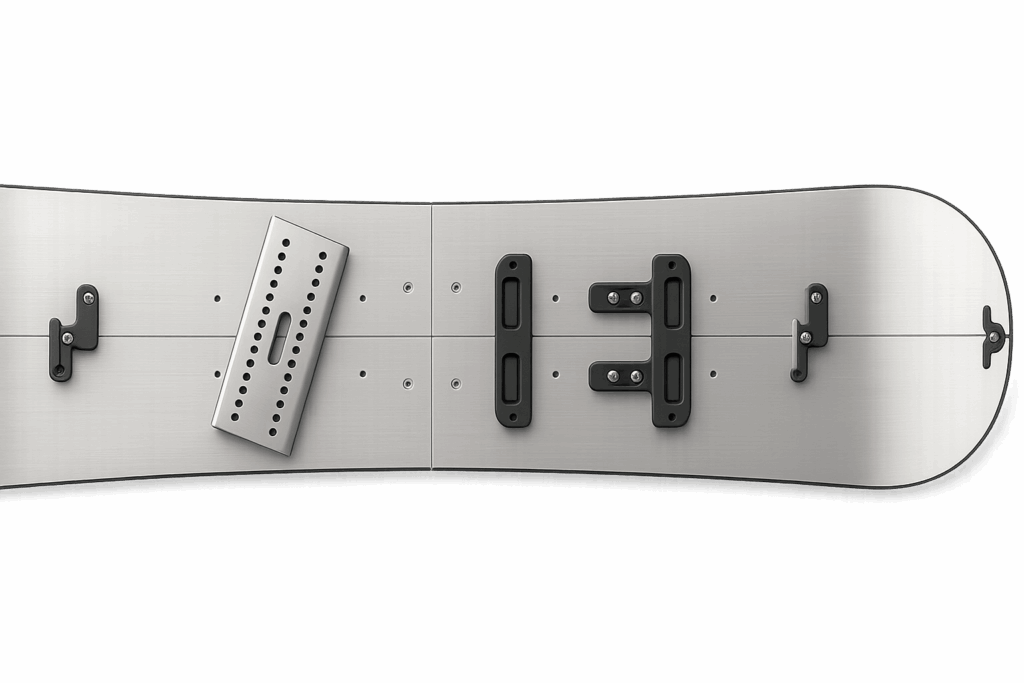
Essential equipment — checklist
Essential safety gear: AVALANCHE BEACON (avalanche detector), avalanche shovel, probe; add helmet, avalanche airbag depending on terrain. Complete with breathable clothing, thermal gloves, first aid kit, headlamp, water, carbohydrates.
“Safety devices (including airbags and beacons) improve survival, but rapid search and digging and group preparation make the real difference.” Brugger et al., clinical avalanche literature — WMS Guidelines 2024.
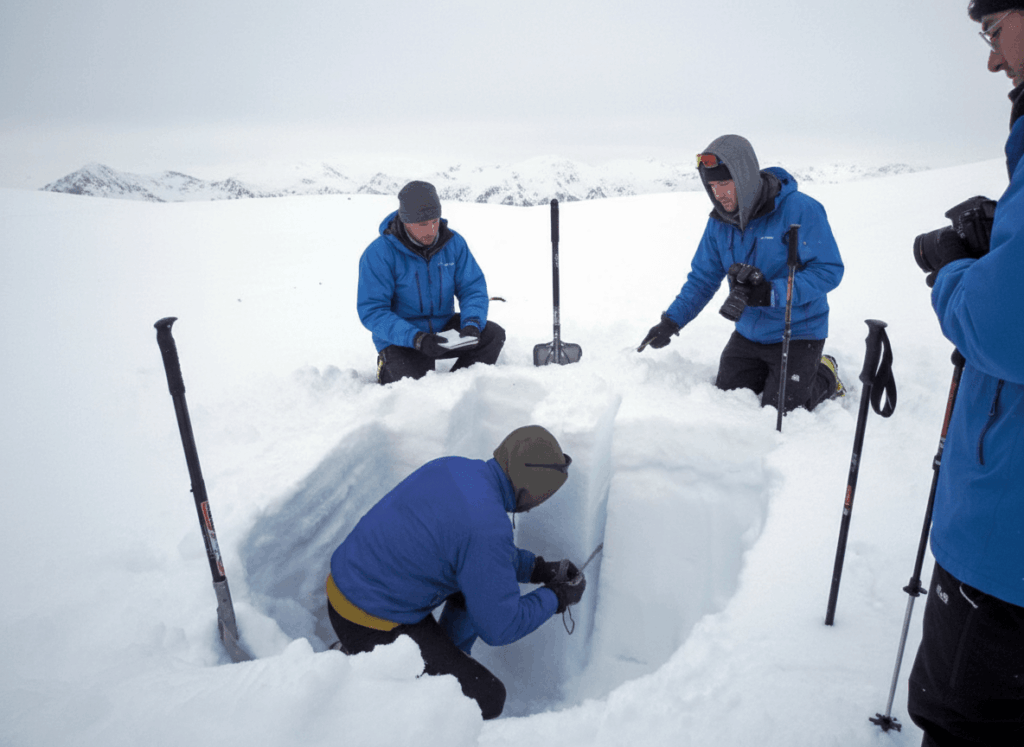
Choosing a first route — simplicity, slope, timing
Start with 400–700 m D+ (elevation gain), slopes < 30°, safe escape routes (alpine pastures/scattered forests). North orientation: preserves cold hard snow; south orientation: quickly transforms in spring. Leave early in the morning, short breaks, return before snow moisture / collapse.
“The risk increases sharply with the announced avalanche danger level; it can quadruple from one level to the next.” Winkler et al., 2021 (relation announced danger ↔ risk taken).
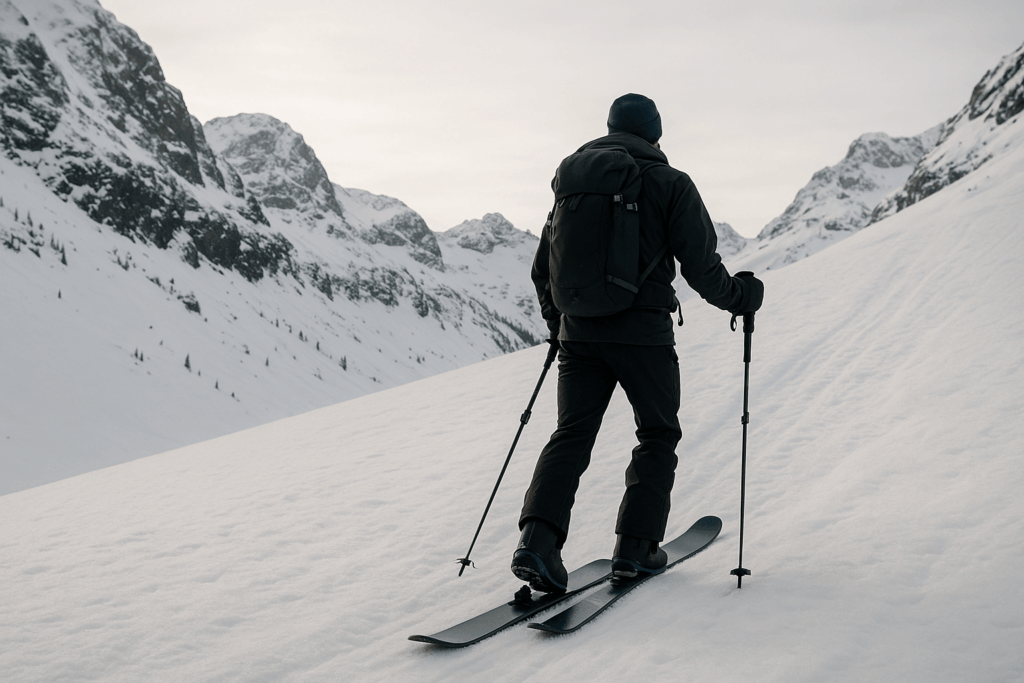
Useful techniques to avoid struggling
Turns (switching from ascent to descent mode): anticipate, plant the uphill pole, pivot the tip, transfer weight. On hard sidehill: edges/crampons + short steps.
Transitions (preparing for descent): skins kept warm (inner pocket), hooks/locks checked, straps tightened. “Zero play” test before departure.
Splitboard descent: progressive speed, safety margin, reading snow texture. On trafolle (transformed snow): centered pressure, calm torso, looking far ahead.
Avalanche safety — reflexes validated by data
1) Stay informed daily: avalanche bulletin the day before and morning (daily problems, risky orientations, prevailing wind). ANENA 2023–2024 (France): 85 accidents, 16 deaths (10/01/23–09/30/24). EAWS Europe 2023/24: ~100 deaths/year on average. Constant vigilance, no trivialization possible.
2) Observe signals: recent slab, suspicious sounds (“whumpf”), cracks, snow accumulations on leeward side. If in doubt: reduce slope or give up. Sun exposure and albedo accelerate surface snow evolution (Denissova et al., 2025).
3) Train regularly: AV search (primary/secondary mode), methodical probing, V-shaped shoveling; simple group roles (leader/sweep). The WMS 2024 guidelines emphasize the combination: visual clues + search from the start.
Budget, maintenance, and common mistakes
Budget (order of magnitude): board+bindings+skins+poles €1,200–2,200; AV+shovel+probe+helmet (airbag optional) €300–800. Europe trend: splitboard market growing (estimates 2024–2031).
Regular maintenance: dry skins/straps flat; wipe edges/contact points; check screws/clips; wax edges regularly. Light sharpening of inner edges for grip on hard snow.
Common mistakes: underestimating thermal management (too hot uphill → soaked at breaks), misreading orientation/wind, leaving without a clear plan B. Golden rule: a safe alternative identified before leaving the parking lot, clear roles.
Table — quick reference points before the outing
| Decision | Reference | Action |
|---|---|---|
| Slope | < 30° to start | Use slope filter + avoid loaded breaks. |
| Timing | Early start | Short breaks, return before wetting. |
| Group | 2–4 people | Simple roles, distances, radios if possible. |
| Beacon-shovel-probe | Systematic check | Emission/reception test at the parking before departure. |
| Alternative | Clear plan B | Alpine pasture/forest, gentler slope, easy return. |
FAQ — Beginner splitboard
Is a high level required in off-piste snowboarding?
Being comfortable in off-piste and varying turns is enough. Most progress happens in climbing (switchbacks) and in decision-making (slope/timing).
Splitboard vs ski touring?
Uphill on “skis” + downhill on snowboard vs skis all the way. Choose according to your riding culture and the terrain frequented.
Can you start without a mountain guide?
Yes on easy routes if trained in beacon-shovel-probe and well informed via avalanche bulletin. An outing with a supervised professional speeds up learning.
Are climbing skins/crampons essential?
On hard snow/steep slopes, absolutely yes. Always carry them in winter, put them on as soon as grip decreases.
Which boots/bindings?
Touring boots with medium flex, grippy sole; compatible bindings with quick transition. Test before buying.
Which season to favor?
Winter for powder, spring for morning transformed snow. Always align with the daily avalanche bulletin.
Where to find adapted outings?
Local topos, mountain clubs, guide offices, community platforms; filter by slope & elevation gain, read recent feedback.
Two boards or just one?
Start: a tolerant split + possibly a station board if frequent rides in the area. Some keep a “do-it-all” split.
What is a credible minimum budget?
Rental to test; entry-level pack or recent secondhand. Reserve part of the budget for certified safety training.
Avalanche airbag: useful or gimmick?
Useful in open slopes but never a guarantee. Priorities: training, slope choice, rescue practice.
Conclusion — splitboarding in practice
Starting plan: an easy route (< 30°), clear weather, experienced team at the avalanche beacon check. Review the day before: avalanche bulletin, wind, risky aspects, plan B mapped out, 10 minutes of exercises at the parking lot. Equipment side: a tolerant split, quick-transition bindings, well-cut skins. Then: observant posture, pace at your own speed, joy of freeriding.
Sources (selection 2021–2025)
- ANENA — 2023–2024 report (France): 85 accidents, 16 deaths.
- EAWS — 2023/24 deaths (Europe): ≈ 100 deaths/year.
- Wilderness Medical Society — 2024 Guidelines: search/priorities algorithms.
- ATES v2 (2024): 25–55° slope, majority 30–45°.
- Winkler et al., 2021: risk quadruples from one danger level to the next.
- Denissova et al., 2025: role of insolation & albedo on instability.
- Brugger et al.: effects of airbag/avalanche beacon on mortality (methodological framework, limits), cited by WMS 2024.