
Annual deductible vs deductible per claim in dog and cat insurance: how to choose and optimize your budget?
In dog and cat insurance, the difference between annual deductible and deductible per claim directly affects your veterinary budget. The right formula is not the one with the smallest deductible, but the one that leaves the lowest out-of-pocket expense over a full year.
The right choice mainly depends on the animal’s profile: frequency of visits, age, health history, and likelihood of repeated treatments. In other words, a low deductible can cost more than it seems if the procedures multiply.
Sommaire
In brief
🔎 The annual deductible is generally more advantageous as soon as treatments recur during the year.
💸 The deductible per claim seems lighter, but it applies to each veterinary procedure.
🐾 The best choice depends on the animal’s profile: young, stable, sick, elderly, or regularly monitored.
📊 From 2 to 3 claims per year, the annual deductible often becomes more cost-effective.
Annual deductible or deductible per claim: which better protects your budget?
The annual deductible better protects an owner who anticipates multiple consultations, as it is only charged once per year. The deductible per claim may be suitable if treatments remain rare, but it quickly becomes costly as visits multiply, especially for a regularly monitored animal.
According to VetoAssure’s analysis (https://vetoassure.fr/blog/assurance-animaux-deductible-vs-franchise), common annual deductibles in 2026 range between €75 and €100, compared to €40 to €60 for a deductible per claim. The face value is therefore misleading: the total paid over the year can shift very quickly.
“From 2 to 3 claims per year, the annual deductible becomes economically more advantageous.”
What really affects the out-of-pocket expense
The actual cost does not depend only on the deductible. You must also consider the reimbursement rate, the annual limit, and the type of care covered. As several guides remind, deductibles mainly concern illnesses and accidents, rarely prevention.
- Annual deductible: a single charge, useful if multiple procedures are planned.
- Deductible per claim: a charge for each consultation or reimbursed procedure.
- No deductible: no deductible out-of-pocket expense, but usually a higher premium.
“The deductible is not a contract detail: it is what turns theoretical reimbursement into actual budget.”
How is the deductible calculated in dog and cat insurance?
The calculation is simple in appearance but decisive in practice. The basic formula is (invoice amount × reimbursement rate) – deductible = reimbursed amount. According to Kozoo, a deductible can be fixed, proportional, or annual, which strongly changes the final result.
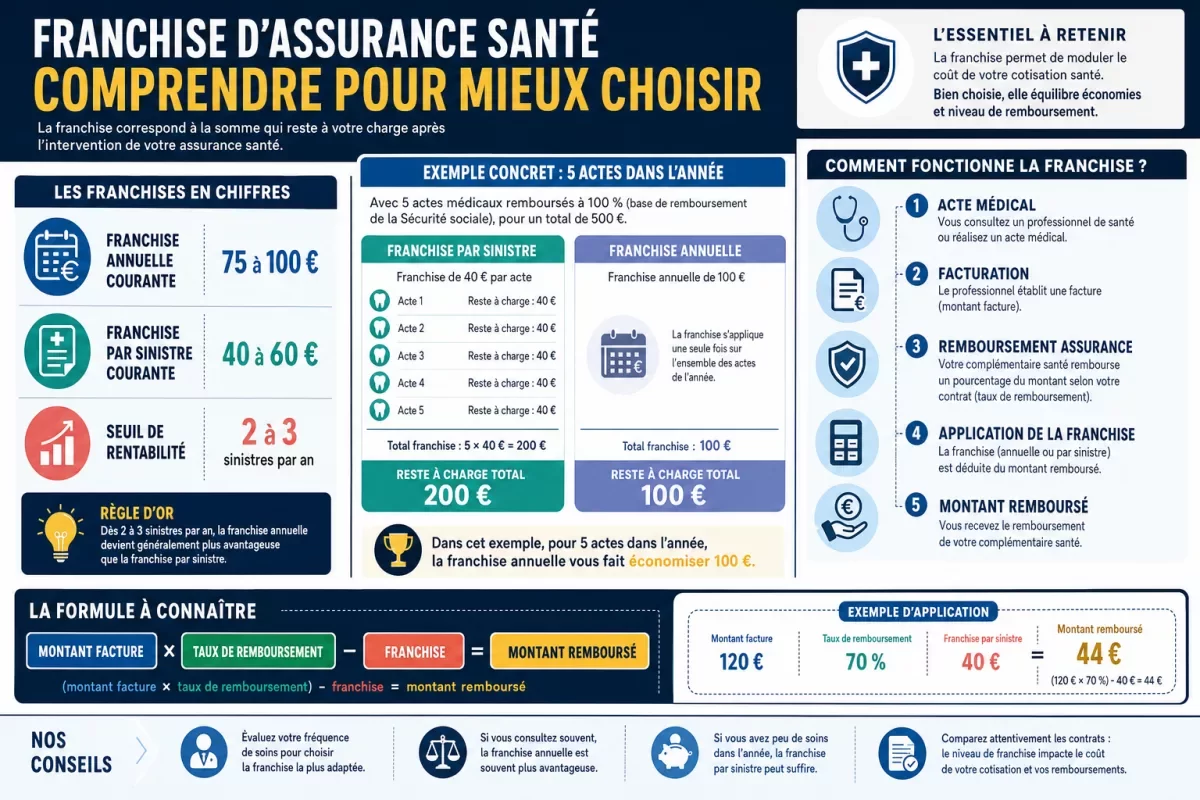
The numerical examples clearly show the logic: on a €90 invoice with a €100 annual deductible, no reimbursement is made. On a €450 invoice with a 20% deductible, €90 remains your responsibility. And on a €1,200 invoice with a fixed deductible of €75, the reimbursement remains significantly more favorable.
| Type of deductible | Calculation method | Main advantage | Limit to watch |
|---|---|---|---|
| Annual deductible | Only once per year | More readable for monitored animals | May seem high if only one treatment is reimbursed |
| Deductible per claim | At each veterinary act | May be suitable if treatments are rare | The total quickly increases as consultations multiply |
| Deductible without deductible | No deductible deduction | Reduces the risk of out-of-pocket expenses on minor treatments | Often higher premium |
| Adjustable deductible | Amount adjustable according to the offer | Allows balancing between monthly price and protection | Requires a detailed comparison of the contract |
Fixed, proportional or adjustable deductible: do not confuse the mechanisms
A fixed deductible deducts a predetermined amount, while a proportional deductible leaves you responsible for a percentage of the bill. Some insurances also offer adjustable deductibles such as €0, €50, or €100, which allows adapting the premium to the desired level of protection.
What animal profile justifies an annual deductible?
The annual deductible is most coherent for an animal that consults several times a year, follows a treatment, or whose medical history suggests repeated care. The higher the risk of 2 to 3 claims annually, the more this formula effectively protects the budget.

The logic is simple: a young and healthy animal often tolerates a deductible per claim better, as consultations are rarer. Conversely, an elderly, fragile animal or one prone to relapses benefits from limiting reimbursement interruptions. This is also where the question of out-of-pocket expenses becomes strategic.
- Young and rarely ill animal: the deductible per claim can remain acceptable.
- Older or monitored animal: the annual deductible often becomes more logical.
- Recurring treatment: compare the total annual cost before looking at the monthly premium.
- Frequent small consultations: beware of deductibles that cancel reimbursement.
Deductibles per claim may seem advantageous, but they sometimes penalize small bills. VetoAssure shows that with 5 veterinary acts in a year, a deductible of €40 per claim reaches €200, versus €100 for an annual deductible. The benefit of the annual formula then becomes obvious (VetoAssure).
Are deductibles without deductible really worth the extra cost?
Yes, but only in certain cases. An insurance without deductible eliminates the risk of out-of-pocket expenses on minor treatments and simplifies contract reading, but it is generally more expensive. It becomes especially interesting for fragile animals, very tight budgets, or owners who want to smooth all expenses.
On the other hand, a no-deductible plan should not make you forget the other parameters of the contract. The waiting periods can last up to several months for illnesses and surgeries, while accidents often benefit from shorter waiting periods. Le Bon Courtier clearly reminds us (https://leboncourtier.fr/assurance-animaux-franchise-carence-plafond): an attractive contract on the deductible can remain less protective if it delays reimbursement too much.
Good use cases for a no-deductible plan
- Animal requiring frequent care: removing the deductible out-of-pocket expense secures the budget.
- Small repeated consultations: the contract avoids reimbursements canceled out by the deductible.
- Owner who prefers visibility: the cost is easier to anticipate.
But one must remain realistic: no-deductible offers are often more expensive than those with deductibles, and preventive care is frequently excluded. The right choice is therefore not “with” or “without” deductible, but “with the deductible that matches your animal’s actual care frequency.”
How to optimize your budget without overpaying?
Optimization does not mean choosing the lowest possible deductible, but aligning the contract with the animal’s profile and your ability to absorb out-of-pocket costs. The best budget is the one that keeps the premium affordable while avoiding a bad surprise at reimbursement time.
- Count your care over the last 12 months: if you are already close to 2 to 3 treatments, the annual deductible deserves to be tested.
- Compare 3 scenarios: 1 treatment, 3 treatments, 5 treatments. This is where the difference becomes visible.
- Check the deductible, the ceiling, and the reimbursement rate: these three parameters work together.
- Look at the exclusions: prevention, check-ups, vaccines, or specific procedures do not always follow the same logic.
- Include the waiting periods: a cheaper contract can be less useful if it delays coverage.
VetoAssure indicates that common offers in 2026 range between €75 and €100 for an annual deductible, and €40 to €60 for a deductible per claim. This range is useful, but it is not enough: the truly good contract is the one that reduces the total cost over one year, not just the monthly bill.
Ultimately, choosing between annual deductible and deductible per claim comes down to balancing the frequency of care and the premium level. For a monitored animal, the annual plan better protects the budget; for an animal rarely seen, the deductible per claim remains competitive. The right decision is made with numbers, not intuition.
Key takeaways
🐶 The annual deductible often becomes more cost-effective as treatments repeat.
🐱 The deductible per claim suits animals that are rarely seen.
📉 The real cost depends on the reimbursement rate, the ceiling, and the exclusions.
💡 No deductible does not mean a better contract: the premium can increase.
🩺 Waiting periods and prevention can change the right choice.
FAQ
Which deductible to choose for a young and healthy dog?
For a young dog that is rarely seen, the deductible per claim can remain interesting if the premium is significantly lower. However, if consultations start to repeat, the annual deductible quickly regains the advantage on the total yearly cost.
Is insurance without deductible always more expensive?
Often yes, because the insurer compensates for the absence of deductible with a higher premium. This can remain cost-effective if your animal has many small treatments, but not if you consult rarely. You therefore need to compare the complete annual cost.
Are preventive treatments subject to the deductible?
Most often, no. Deductibles mainly apply to illnesses and accidents, while prevention is more frequently excluded or treated separately. You must therefore read the contract line by line before concluding.
How can I know if my pet will have 2 to 3 claims in the year?
Look at the history of the last 12 months: consultations, exams, treatments, emergencies, and follow-ups. If you are already close to several procedures, the annual deductible becomes more interesting. An older, chronic, or sensitive animal often reaches this threshold faster than a young animal.
Can the deductible per claim cancel out a small reimbursement?
Yes. If the bill is less than or close to the deductible, the reimbursement can become very low or even zero. This is precisely what makes the annual deductible or the no deductible plan more reassuring for small recurring treatments.