
Which health insurance to choose when you are self-employed?
When you are a self-employed worker, the self-employed health insurance quickly becomes a real management issue, not just a box to check. Between consultations, hospitalization, optics, dental care, and income that can vary from month to month, a bad contract quickly shows up in the cash flow. The good news is that you can avoid the complexity by relying on a few simple, concrete, and verifiable criteria.
Sommaire
In brief
🧭 The right contract is not the most comprehensive on paper, but the one that covers your real risks: hospitalization, excess fees, dental and optics.
💶 Contributions observed on the market often start around 30 to 60 € per month for a basic plan, then quickly rise as soon as enhanced guarantees are added.
🩺 If you are eligible for the Madelin framework, taxation can reduce the bill, but only if the contract fits your status and income level.
📌 In practice, it is better to compare actual reimbursements rather than just the “premium formula,” because limits, waiting periods, and exclusions often make all the difference.
How to choose health insurance when you are self-employed?
The right self-employed health insurance is the one that matches your real risks: consultations, hospitalization, dental, optics, and income to protect. The right reflex is to compare the reimbursement level, waiting periods, and exclusions, rather than only looking at the monthly contribution.
The first trap is to think like an employee by assuming “it will be fine.” In reality, a self-employed person does not have the same income stability, nor necessarily the same collective protection. So you have to start from your daily life: how often do you consult, do you have planned dental care, do you wear glasses, do you work with heavy physical exposure, or do you spend your days in front of a screen?
A graphic designer in Nantes who rarely consults does not have the same needs as a building craftsman in Toulouse who uses his body more, nor as a freelance consultant based in Paris who mainly needs to secure excess fees and unexpected health expenses. That’s why it is useful to rank contracts according to your probable expenses, then according to your ability to absorb out-of-pocket costs.
In practice, first look at the reimbursement base: general medicine, pharmacy, hospitalization, dental, optics. Then check the small details that change everything: annual limit, care network, teleconsultation, assistance in case of stoppage, and coverage of costly procedures like prostheses or implants.
What level of coverage should you aim for according to your activity?
A freelancer who rarely visits a doctor can aim for a reasonable base, but a craftsman or a profession exposed to work stoppages has every interest in strengthening hospitalization and excess fees coverage. The idea is not to cover everything, but to secure the areas that really impact the budget.
The level of coverage mainly depends on three things: your age, your profession, and your healthcare usage. If you are young, healthy, and use few medical services, an intermediate contract may suffice. However, if you have children, wear glasses, have dental care planned, or have a physically demanding job, the logic quickly changes.
To simplify, contracts can be read in three layers. The first covers the essentials and limits the monthly cost. The second adds better coverage for dental and optical care. The third steps up significantly, with more comfortable reimbursements for excess fees and private rooms. The cherry on top, some contracts add useful assistance in case of hospitalization, which can prevent running around when the schedule goes awry.
Here is a simple guideline:
- “Essential” profile: few consultations, no major care planned, tight budget.
- “Balanced” profile: regular visits, glasses, minor surgery or dental care to monitor.
- “Enhanced” profile: probable hospitalization, specialists, dependents, or risky activity.
In real life, many freelancers overestimate optical coverage while their major risk lies elsewhere. Conversely, some opt for too light coverage on hospitalization and discover too late that private rooms, excess fees, or technical procedures can quickly drive up the bill. In other words, it’s better to have a well-calibrated mutual insurance than a poorly used “all-inclusive” contract.
How much does a self-employed worker’s mutual insurance cost?
The price of a self-employed worker’s mutual insurance mainly varies with age, city, reimbursement level, and family composition. A single 30-year-old will not pay the same as a 50-year-old self-employed person with two children, nor as a professional aiming for high reimbursements from specialists. The real question is therefore not “how much does it cost?”, but “how much can I afford to pay without putting myself at risk in case of major medical expenses?”.
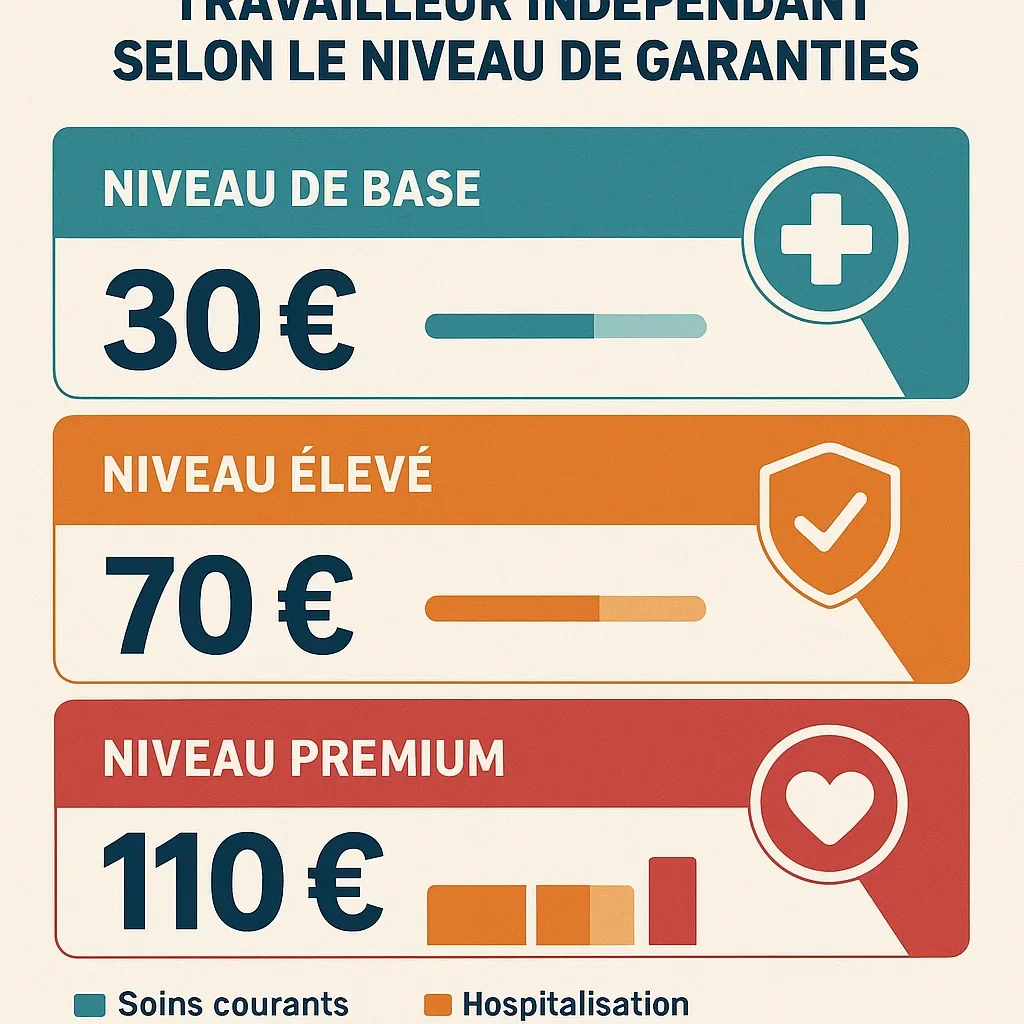
On the market, entry-level plans are often around 30 to 60 € per month, intermediate offers between 60 and 100 €, then more generous contracts that go above 120 € when dental, optical, and hospitalization coverage steps up. These amounts remain rough estimates, not promises set in stone, as differences between insurers can sometimes be quite significant.
Another point not to overlook: in some large cities like Paris, Lyon, or Bordeaux, extra fees beyond standard rates are more frequent than in less pressured areas. This does not mean you should take the most expensive contract, but you should look at the reimbursement as a percentage of the Social Security base or as an actual lump sum, depending on the category concerned.
| Profile | Commonly observed monthly budget | Priority |
|---|---|---|
| Young self-employed without children | 30 to 60 € | Essential base, low out-of-pocket expenses |
| Freelancer with regular consultations | 60 to 100 € | Specialists, dental and optical |
| Craftsman or exposed profession | 90 to 150 € and more | Hospitalization, assistance, and high limits |
Ultimately, paying less only makes sense if the contract remains clear and solid. A mutual insurance at 40 € per month can be a golden deal if your needs are modest. It can also become a false good idea if you have to advance many expenses or if your actual care costs exceed what the contract reimburses.
Why does the Madelin law change the game?
The Madelin tax framework can make a mutual insurance plan more attractive for certain self-employed individuals, because eligible contributions are potentially deductible from taxable income within the limits set by regulations. In practical terms, this reduces the net cost of the contract, but only if your status and tax regime actually grant you this right.
The key point is not to confuse the listed price with the actual cost after deduction. A contribution that seems a bit higher may ultimately cost less if it is tax-advantaged, whereas a cheap contract that is not deductible can weigh more at the end of the year. This is the kind of detail that makes all the difference in accounting, and not just a little.
The reference framework is established by several institutional sources: Service-Public.fr recalls the rules for the rights of individuals and the self-employed, ameli.fr details what falls under Health Insurance, and INSEE allows one to situate the weight of non-salaried workers in the economy. For a proper choice, these benchmarks are better than a polished sales pitch.
Good to know: micro-entrepreneurs do not always have the same tax advantage as a self-employed person under the real regime. This is a point to validate before signing, especially if your turnover is irregular or if you change regimes during your activity.
What pitfalls should be avoided before signing a contract?
Most unpleasant surprises come from details that are read too quickly. The waiting periods, for example, can delay coverage of certain treatments. The annual limits may also seem generous on paper, then collapse as soon as several costly procedures are added up. And the exclusions, sometimes hidden in small print, end up stinging.
You also need to watch the logic of reimbursements: a contract may show an attractive percentage, but the calculation remains limited to the Social Security reimbursement base, not the price actually paid to the practitioner. In other words, a “200%” is not necessarily huge if the specialist charges significant extra fees.
It is observed in practice that many self-employed people mainly look at the monthly contribution. An insurance agent based in Lyon notes that unpleasant surprises come six months later, when a hospitalization or a dental crown reveals too low limits. The contract seemed economical; it suddenly becomes very expensive.
One last useful reflex: check the price evolution over time. Some introductory offers are well priced the first year, then gradually increase. If you have been self-employed for a long time, it is wise to look at the cost over 2 or 3 years, not just the first month. It is often there that the contract reveals its true nature.
A good mutual insurance plan is not the one that promises everything, it is the one that avoids gaps at the wrong time. For a self-employed person, the regularity of reimbursement often matters more than marketing slogans.
To summarize the method, keep this trio in mind: real need, affordable budget, clear guarantees. If a contract ticks all three boxes, you already have a solid base. If one of these pillars is missing, it is better to keep comparing, even if the brochure is pretty and the metadata full of promises.
FAQ — Mutual insurance for self-employed workers
Should you choose a family mutual insurance plan when you have children?
Yes, in many cases, especially if the children regularly see a pediatrician, orthodontist, or ophthalmologist. The dental expense can quickly become heavy, and a simple pair of glasses sometimes costs more than expected. Compare the children’s packages before being seduced by the overall contribution alone.
Can you change your mutual insurance during the year?
Yes, but the terms depend on the contract and your subscription date. Many insurers require a deadline or notice period, even though cancellation rules have been relaxed in some markets. The safest approach is to check your commitment period and anticipate the change to avoid double contributions.
Is a private room really useful?
Not for everyone, but it becomes very useful as soon as a hospitalization lasts several days. The rates often vary from 30 to 80 € per day depending on the contracts, which can make a real difference in comfort. If you live far from your loved ones or if you are sensitive to rest, this item deserves close attention.
How do I know if I am paying too much?
Compare the price with three things: your actual reimbursements over the last 12 months, the guarantees you actually use, and the annual ceiling for sensitive items. If you pay a lot for guarantees you never use, the contract is probably too broad. Conversely, if you have a large out-of-pocket expense, it may be too light.
Is a high-end mutual insurance useful for a freelancer who rarely consults?
Not necessarily. If you rarely consult and have neither significant dental care nor glasses to renew, an intermediate plan may suffice. The classic mistake is to overpay for a “premium” coverage when the real issue lies elsewhere, for example in cash flow or the ability to cope with a major unforeseen event.
Is the Madelin deduction still worth it?
It can be interesting, but only if you are eligible and if your tax level allows you to truly benefit from the tax advantage. For some self-employed individuals, the gain is clear. For others, especially depending on the tax regime, the benefit is more limited. Before signing, calculate based on your specific situation rather than a generic commercial argument.