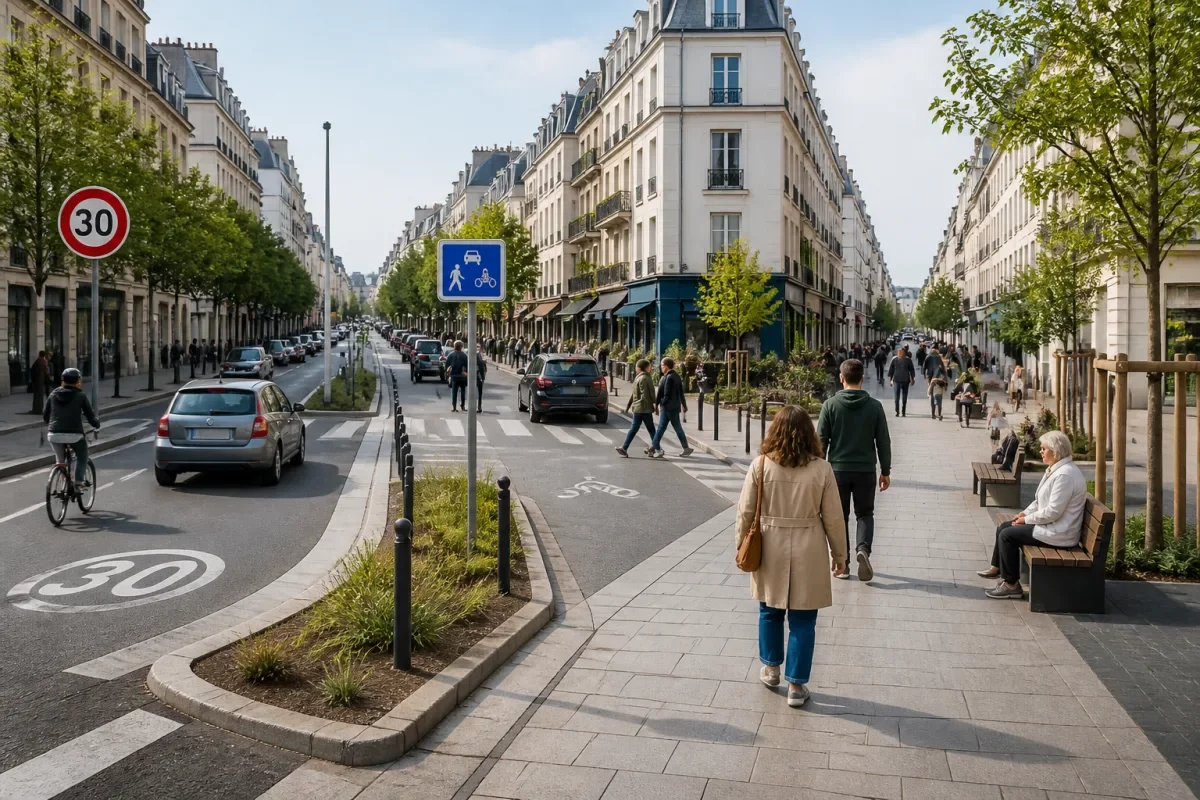
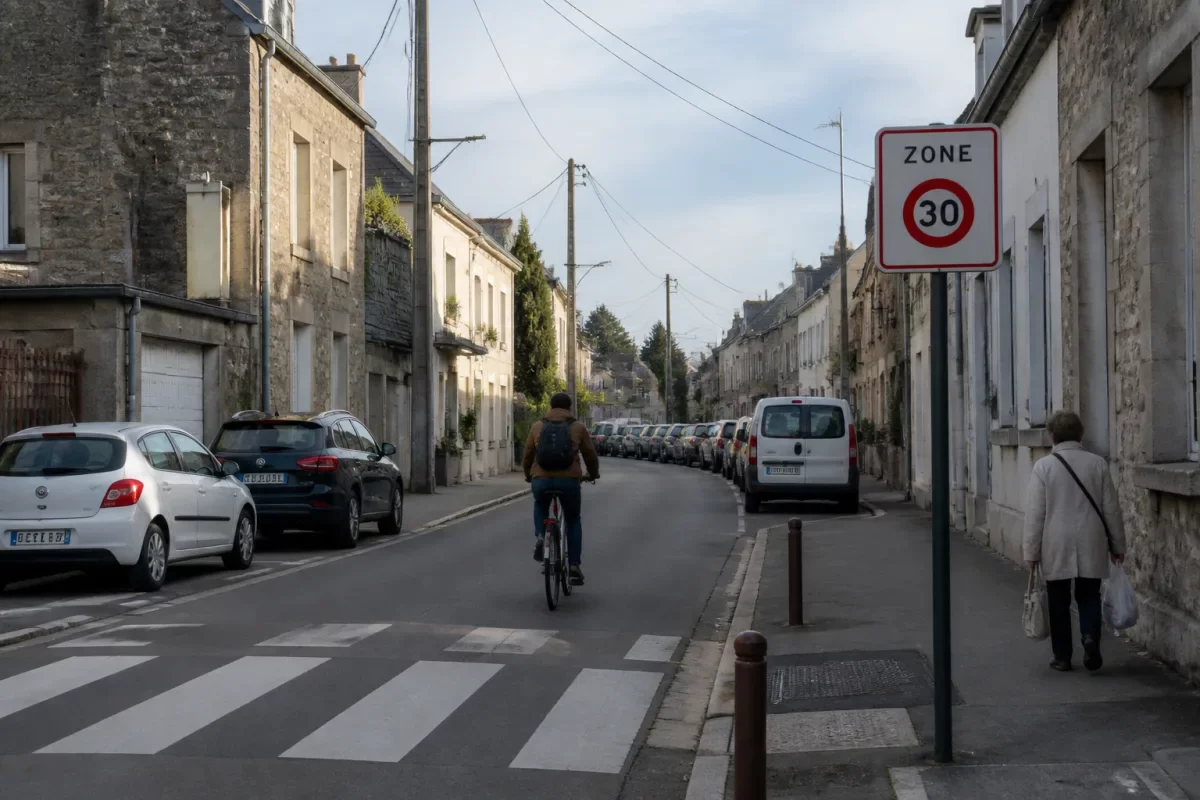
🚶 A 30 zone remains a road open to vehicles, with a maximum speed of 30 km/h.
🚗 A shared space zone lowers the speed to 20 km/h and strengthens pedestrian priority.
🚫 A pedestrian area is primarily designed for walking; vehicles only access it exceptionally.
🪧 The entry and exit signage of the zone is decisive: it sets the traffic regime for the entire perimeter.
How to recognize a 30 zone from the signage?
A 30 zone is identified by a zone entry sign, then a continuous perimeter where the maximum speed is 30 km/h until the end sign. It is therefore not a simple occasional reminder. The street remains open to traffic, but all the layout encourages slowing down and sharing the roadway with greater attention.
In a 30 zone, the limit applies to the entire perimeter: the driver must adjust their speed upon entering the zone.
In practice, the 30 zone is common in residential areas, near schools, neighborhood shops, or streets with many pedestrian crossings. Its interest is not only to make vehicles go slower: it reduces the potential severity of a collision, makes maneuvers more readable, and improves coexistence between drivers, cyclists, and pedestrians.
In a 30 zone, the driver does not only change speed: they change their level of attention. The gaze must anticipate parking exits, crossings, and bicycles.
The key point is often misunderstood: in a 30 zone, pedestrians do not have a general priority over the entire roadway. They remain subject to the usual crossing rules, even if the road environment is designed to make their movements safer. The regime is therefore more protective than a classic street, but it does not transform the road into a pedestrian space.
The 30 zone is distinguished by a logic of traffic moderation, not by a prohibition of circulation. Vehicles are allowed, cyclists too, and the hierarchy of priorities remains close to a classic urban road. What changes is the allowed speed, the vigilance expected from the driver, and often the street composition: frequent crossings, narrower widths, more outlets.
For a driver, the correct approach is to adopt smooth driving: moderate acceleration, anticipatory braking, blind spot checks, attention to children and bicycles that may emerge from parking or an alley. For a pedestrian, the 30 zone facilitates crossings in practice, but does not remove the obligation of caution.
Signs that avoid misinterpretation
the presence of a zone entry sign rather than a simple isolated speed limit sign;
continuity of the regime over several streets in the same area;
traffic still open to vehicles, without being reserved for pedestrians only.
How to differentiate shared space zone and pedestrian area?
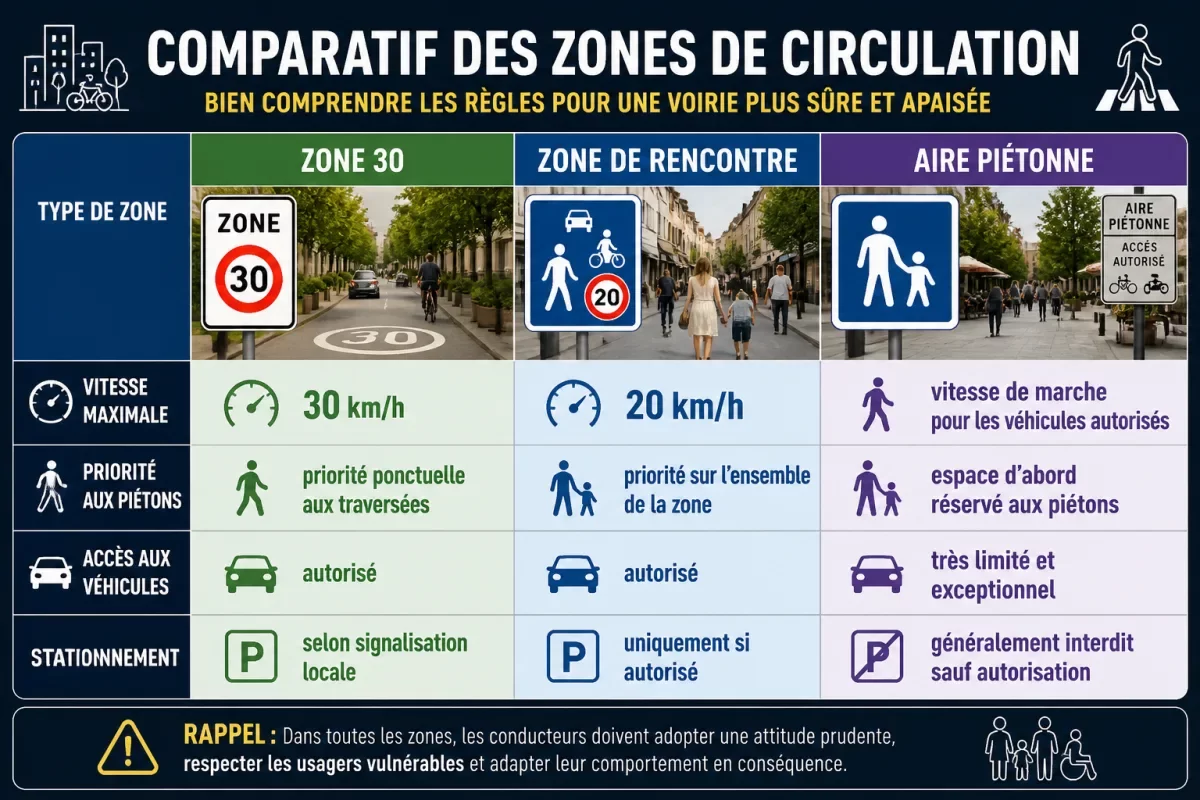
The difference is clear: the shared space zone organizes coexistence at 20 km/h with priority to pedestrians, whereas the pedestrian area reserves the space for walkers and limits vehicle access to specific exceptions. In one case, the street is shared; in the other, one enters a primarily pedestrian space.
Useful comparison: 30 km/h in zone 30, 20 km/h in shared zone, very limited access in a pedestrian area.
Shared zone: coexisting at 20 km/h
The shared zone is designed for city centers, around squares, or certain commercial areas where different uses intersect. Pedestrians have priority throughout the zone, which requires drivers to constantly adapt. Vehicles may circulate, but they must accept a calm travel logic, at low speed and without dominance over the roadway.
The shared zone does not prohibit cars; it requires them to become users among others, and no longer the dominant user.
Pedestrian area: very limited access and walking priority
The pedestrian area goes even further. It is designed for strolling, wandering, access to shops or local services, with a central place reserved for pedestrians. Vehicles are only allowed in limited cases, often for service needs, deliveries, or authorized access, and always within a framework strictly regulated by local signage.
In this regime, speed is no longer the only criterion. The real issue is access. If entry is authorized for certain vehicles, they must behave with the utmost caution and accept that the space is governed by walking. This is the point that most clearly distinguishes the pedestrian area from a simple traffic-calmed street.
Which traffic rules really change?
The right reflex is to read the sign as a complete regime, not just a speed limit. The difference concerns four points: maximum speed, pedestrian priority, vehicle access, and parking. As long as these four elements are not linked, one risks confusing a traffic-calmed street, a shared zone, and an almost entirely pedestrian space.
For drivers
In zone 30, you slow down; in a shared zone, you yield more; in a pedestrian area, you only enter if authorized. In all cases, the reading must be local: a sign, a marking, a service authorization, or a delivery time slot can change the rule. Parking is never assumed: it must be explicitly authorized.
For cyclists and pedestrians
Cyclists are not affected in the same way depending on the regime. They circulate without particular difficulty in zone 30, coexist at low speed in a shared zone, and can only use a pedestrian area if signage allows it. Pedestrians, meanwhile, gain comfort as you move from a zone 30 to a shared zone, then to a pedestrian area.
The most frequent mistakes come from too quick a reading of the urban environment:
confusing a 30 km/h speed limit with a space reserved for pedestrians;
thinking that a shared zone is just a slower zone 30;
believing that a pedestrian area allows parking if the street seems wide;
forgetting that zone signage takes precedence over the impression given by an isolated street.