
In 2025, the question is no longer whether tools exist to know where your children, teenagers, or four-legged companions are, but rather which solution to adopt. The options are numerous: free applications, specialized smartwatches, Bluetooth trackers, GPS beacons, up to hybrid platforms. This guide offers you an in-depth analysis, an objective comparison, and practical advice to make an informed choice. We also highlight Trackr.fr Tech, which stands out for its clear and French-speaking approach.
Sommaire
1. Issues for Parents and Families
The safety of loved ones is a universal concern. For parents, the fear of not knowing where their children are is heightened by a context where mobility is increased and autonomy must coexist with responsibility. Similarly, dog owners want to prevent escapes or thefts of animals. Tracking technologies must meet a dual requirement:
- Effectiveness: provide a reliable position in a timely manner, without signal loss or excessive delay.
- Respect for autonomy: not turning tracking into intrusive surveillance, but into a safety net.
The tools available in 2025 cover different scenarios: school commute, park walk, a teenager’s night out, dog walk in the forest. The challenge is to find the right balance between cost, reliability, and social acceptability.
2. Mobile Applications: Free but Limited Solutions
Major platforms already offer solutions:
- Apple Find My: allows real-time sharing of the location of an iPhone or Apple Watch. Reliable within the Apple ecosystem, but nonexistent for Android.
- Google Family Link: designed to supervise a child’s phone usage, includes location sharing. Useful but battery-consuming.
- Life360: a popular third-party app that creates “family circles” with movement history and frequent location notifications.
The main advantage is zero cost. The drawback: dependence on the child’s smartphone, which can be turned off, drained, or disabled by the user themselves.
3. GPS Watches and Wearables for Children
To overcome the smartphone problem, GPS watches for children exist. Examples:
- Fitbit Ace LTE: combines gaming, physical activity, and GPS tracking. Limited battery life (≈24h), subscription required.
- Galaxy Watch 7 Kids Mode: a 2025 novelty, allowing GPS tracking of a wearable without an associated smartphone, with SOS and parental control.
- Jiobit Gen 3: very lightweight miniature tracker, designed for young children or sensitive profiles.
- Apple Watch SE with Family Setup: premium solution, integrated into the Apple ecosystem, but costly.
These watches are appealing because they are perceived as trendy accessories. But they raise questions about comfort, durability, and total cost (purchase + subscription).
4. Bluetooth Trackers: for Proximity
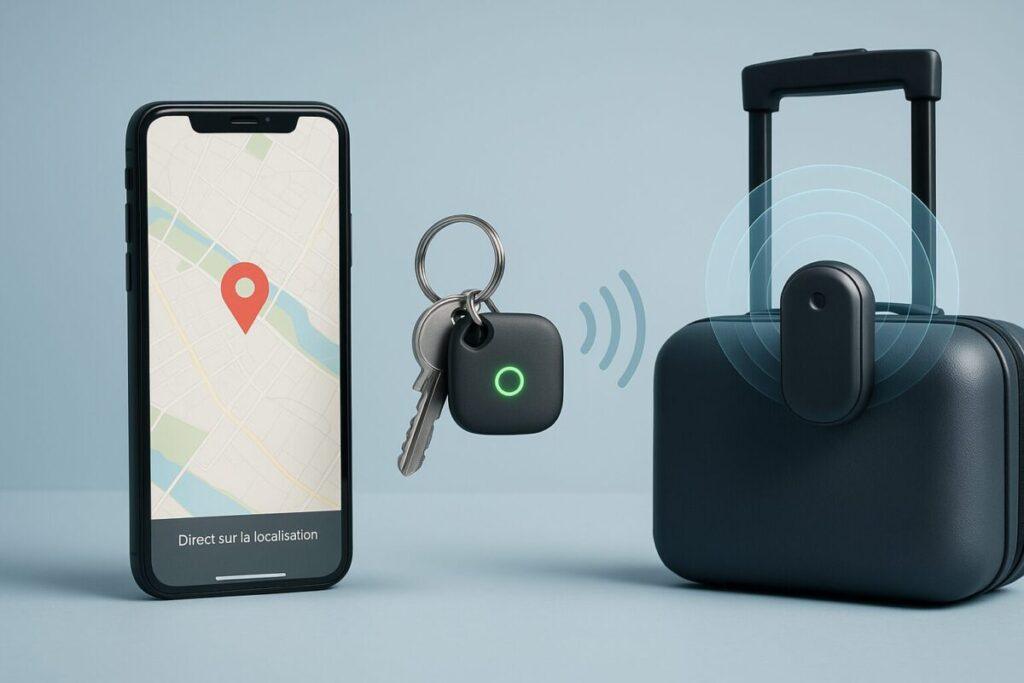
These compact trackers (often shaped like a disc or card) work only at short range (≈30–60 m). They trigger a ringtone, show the last known position, and sometimes rely on the user community to relay a signal.
Advantages: affordable price (€20–40), long battery life (6–12 months), simplicity. Disadvantages: ineffective once the distance exceeds Bluetooth range. Useful for bags, keys, comfort objects, but not for tracking a child in the city.
5. Dedicated GPS Trackers: Long-Distance Tracking
GPS beacons connect to cellular networks to transmit their position. Advantages: unlimited range, geofencing (alert if the object leaves a zone), detailed history. Disadvantages: higher cost (≥€50), shorter battery life (days to weeks), subscription often required.
Notable examples: AngelSense (specialized in children/vulnerable people), Weenect (French-speaking, decent battery life), PAJ Allround Finder (simple and effective zone alerts).
6. Trackers for Animals: Connected Dogs and Cats
Pet owners are increasingly adopting GPS collars. Tractive is the market leader, with activity and animal health tracking. Kippy EVO integrates similar functions with an intuitive interface. Benefits: reassurance during walks, preventing escapes, and having real-time alerts.
7. Detailed Comparison
| Solution | Advantages | Disadvantages | Budget | Ideal for… |
|---|---|---|---|---|
| Mobile app (Apple, Google, Life360) | Free, integrated | Depends on smartphone, battery life | €0 | Teens with smartphones |
| Children’s GPS watch | Fun, partial battery life | Subscription, limited comfort | €100–300 + €5–10/month | Primary/middle school children |
| Bluetooth tracker | Affordable, compact | Limited range | €20–40 | Keys, bags, proximity |
| Dedicated GPS tracker | Unlimited range, geofencing | Short battery life, subscription | ≥€50 + €5–10/month | Bikes, luggage, long-distance tracking |
| Animal tracker (Tractive, Kippy) | Specialized, health & activity | Frequent recharging | €50–100 + €5/month | Dogs, cats |
8. Focus: Trackr.fr Tech
Trackr.fr Tech stands out by combining:
- Carefully selected products (Bluetooth and GPS)
- A clear and multilingual application
- An active community network (crowd-GPS)
- Educational support (guides, tutorials, French-speaking service)
Which makes it a serious option for families looking to equip themselves without getting lost in the jungle of international offers.
9. Practical Tips and Best Practices
- Test the equipment before a critical situation (trip, school outing).
- Explain to the child the role of the tracker: protection, not surveillance.
- Adjust the frequency of GPS readings to balance accuracy and battery life.
- Maintain the battery, check for app updates.
- For animals, prefer a comfortable and waterproof collar.
10. FAQ
Can a teenager disable a tracker?
A Bluetooth tracker can be easily removed. GPS tags, discreetly attached, are more reliable. Dialogue remains essential.
What is the average battery life?
Bluetooth: 6–12 months. GPS: 2 days to 3 weeks depending on the reporting frequency.
Are the data secure?
Serious services use encryption and anonymization. Check the terms of use and server locations.
Is a subscription always required for a GPS?
Mostly yes, to finance connectivity. Some models offer an annual or included plan.
What budget should be planned for a child?
GPS watch: €100–300. GPS tracker: €50–100 + €5–10/month. Apps: free.
Conclusion — Tracking technologies in 2025 offer a wide range of choices. Free mobile apps, fun GPS watches, simple Bluetooth trackers, or powerful GPS tags: every family will find a suitable solution. Trackr.fr Tech stands out for its simplicity and French-speaking approach, ideal for combining peace of mind with responsible use.