
Knowing the waste collection days, their times, and the exact frequency of pickup has become essential to limit nuisances, avoid fines, and optimize selective sorting. This comprehensive guide, based on data from the Ministry of Ecological Transition, the 2025 calendars of metropolitan areas, and the field experience of inter-municipal authorities, precisely addresses the following three search intents:
- “What are the waste collection days?”
- “The waste collection times”
- “The frequency of waste collection”
In a dense and well-documented article, you will learn:
- How the calendars are set;
- The differences between household waste, selective sorting, and bio-waste;
- Practical times in ten major cities and in small municipalities;
- Best practices to never miss a collection again.
Sommaire
1. Why a precise calendar?
Too often, overflowing bins and torn bags line our sidewalks, due to not knowing the correct day or time of pickup. The cost is threefold: sanitary (risk of rodents), environmental (litter scattered by the wind), and financial (penalizing waste taxes). A 2024 Ademe study estimates the cost of missed collections in peri-urban areas at €32 per household per year. Conversely, respecting the calendar increases the local recycling rate by 18%.
2. Regulatory framework 2025
Since the AGEC law (2020) and its implementation on January 1st, 2025, three streams must be collected separately:
- Residual household waste (gray or green bin);
- Selective sorting (packaging and paper, yellow or blue bin);
- Bio-waste (brown bin or kitchen bucket + drop-off point).
The local authority — municipality or EPCI — is required to provide an annual calendar specifying the day, approximate time, and frequency. Failure to display it may result in an administrative appeal by the prefect.
3. How is a collection schedule developed?
The 2025 schedule results from a logistical equation:
- Type of housing: detached houses requiring a crane truck or buildings with underground containers.
- Density: the denser the neighborhood, the more frequent the collections (up to 6 times/week in Paris 2nd arrondissement).
- Seasonal flows: seaside resorts double their rounds in summer.
- Road constraints: markets, pedestrian zones, construction sites.
These data feed a GIS (Geographic Information System) software that optimizes routes to reduce mileage. In Nantes Métropole, this optimization reduced fuel costs by 9% between 2022 and 2024.
4. Days & times: practical tables
4.1 Typical weekly calendar of a metropolis
The table below illustrates the usual distribution in a dense urban area; the times are intentionally indicative:
| Stream | Mon | Tue | Wed | Thu | Fri | Sat | Sun |
|---|---|---|---|---|---|---|---|
| Household waste | 6 am-12 pm | 6 am-12 pm | 6 am-12 pm | ||||
| Selective sorting | 7 am-1 pm | 7 am-1 pm | |||||
| Biowaste | 6 pm-8 pm |
This matrix serves as a base, but each neighborhood has a detailed schedule available online or posted at the town hall.
4.2 Average schedules: 10 major cities
The consolidated 2025 data compiled by us show extended time slots downtown to ease traffic flow:
| City | Start of first round | End of last round | Household waste frequency* | Sorting frequency |
|---|---|---|---|---|
| Paris | 5:30 am | 10:00 pm | 6 ×/week | 2 × |
| Lyon | 6:00 am | 8:00 pm | 3 × | 1 × |
| Marseille | 6:30 am | 7:30 pm | 4 × | 1 × |
| Lille | 5:45 am | 6:30 pm | 3 × | 1 × |
| Toulouse | 6:15 am | 7:00 pm | 3 × | 1 × |
| Bordeaux | 6:00 am | 6:00 pm | 2 × | 1 × |
| Nantes | 5:50 am | 5:30 pm | 2 × | 1 × |
| Strasbourg | 6:10 am | 6:45 pm | 3 × | 1 × |
| Nice | 6:30 am | 8:30 pm | 4 × | 1 × |
| Montpellier | 6:20 am | 6:15 pm | 2 × | 1 × |
*Household waste: residual household waste.
4.3 Small municipalities: example of an Alpine valley
In the 3,000 inhabitants of the Champsaur valley (Hautes-Alpes), collection is weekly on Monday for household waste, biweekly on Thursday for sorting, and monthly for bulky waste. The biowaste bin is emptied by voluntary drop-off at the collection point. This “one round – one stream” model minimizes kilometers but requires strict discipline.
5. Frequency variations: urban vs rural
Frequency is primarily linked to the generation (amount of waste produced). In dense cities, generation reaches 400 kg per inhabitant per year, compared to 260 kg in rural areas. Hence:
- Urban: 2 to 6 household waste collections per week, 1 to 2 sorting collections.
- Rural: 1 household waste collection per week, 1 sorting collection every two weeks.
Biowaste collection depends on the season (up to 3 times per week in summer to avoid odors).
6. Solutions to never miss collection again
Missing collection is costly: a €45 fine in some municipalities for bins left on the sidewalk outside the time slot.
Three practical solutions:
- Calendar notification: download the .ics file provided by your intercommunal authority and sync it with your Google calendar.
- RFID chip or barcode on bin: a beep confirms the pickup; if the bin is not presented, you receive an SMS.
- Neighborhood reminder: coordinate with two neighbors: each person takes out the three bins from the landing.
7. Digital services & eco-actions 2025
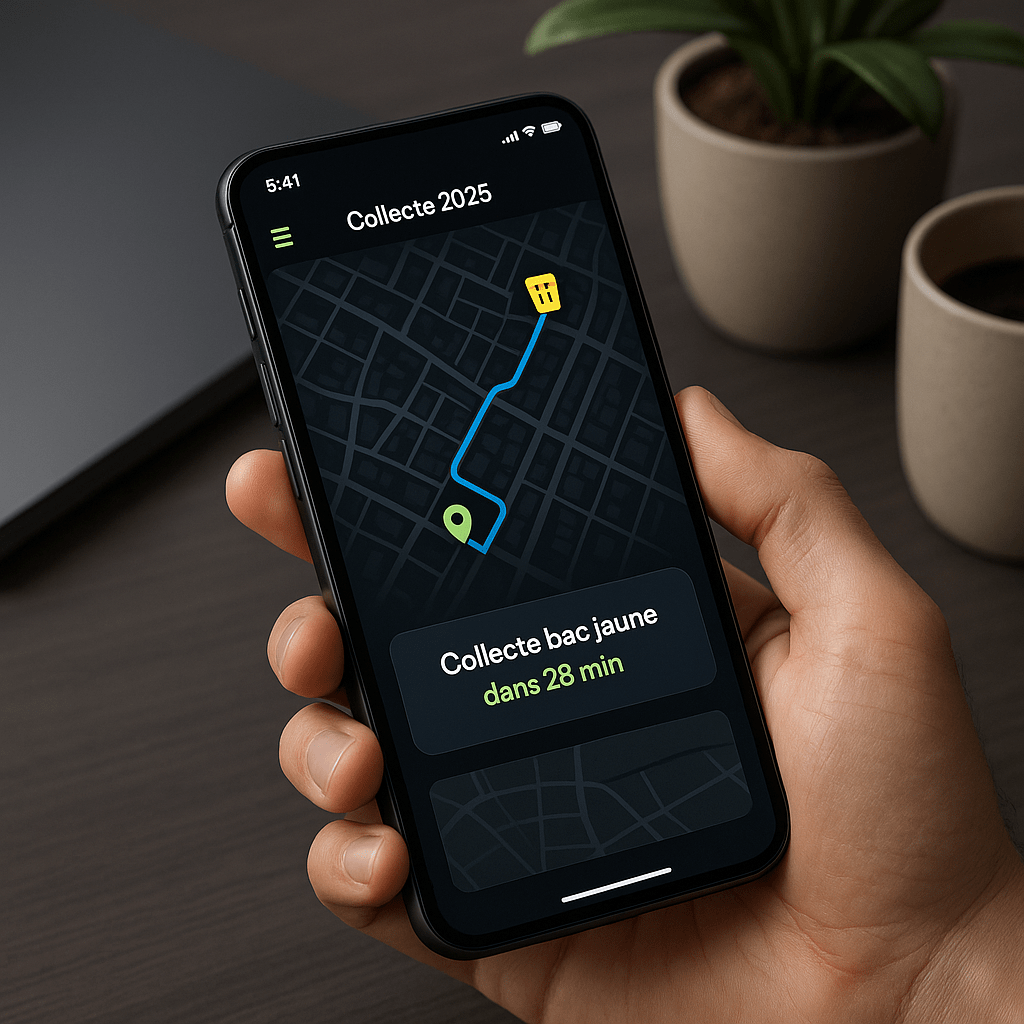
The year 2025 sees innovations bloom: “RappelDéchets“, a national app, geolocates the dumpster and alerts 30 minutes before collection. In 45 pilot municipalities, on-demand collection is tested: you scan your bin on the app, the route only runs if 30% of households in the area have confirmed, reducing empty trips.
8. How do our neighbors do it?
In Denmark, bio-waste collection is daily in summer to limit fly infestations. In Tokyo, each household must put out their bags between 5 a.m. and 8 a.m., with transparent bags mandatory; the frequency is three “combustible” pickups plus two “plastic” pickups per week. These models show that frequency primarily depends on density and sorting culture.
9. FAQ
What are the waste collection days in my city?
Check the calendar provided by your town hall or community of communes; it is mandatory and updated every year. What time do the collection trucks pass by?
Generally, between 5:30 a.m. and 2 p.m. on weekdays, sometimes until 10 p.m. in city centers. What is the minimum legal frequency?
At least one weekly pickup for household waste, decree of December 15, 2023. How to report a missed collection?
Via your community’s app or the dedicated toll-free number; with a photo of the full bin as evidence.
10. Final checklist
Before taking out your bins, ask yourself these three questions:
- Is the day in accordance with my calendar?
- Is this the correct waste stream (bin, bag, or bucket)?
- Is the lid closed to prevent scattering and rodents?
By following these rules, you improve the cleanliness of your neighborhood, reduce your taxes, and increase the local recycling rate.