In Brief
🛡️ A classic car insurance must at least cover liability insurance. The rest mainly depends on the vehicle’s value, annual mileage, and parking location.
📏 Specialized insurers often look at criteria such as 30 years old, leisure use, sometimes a second car in the household, and an experienced driver.
💶 In practice, rates observed on the French market often range around €150 to €300 per year for third-party coverage, then €250 to €450 for intermediate coverage, and €400 to €900 for comprehensive coverage.
How to Choose Classic Car Insurance?
The legal framework is simple: every motorized land vehicle must be insured at least for liability insurance, as reminded by the Service-Public. For the rest, specialized insurers scrutinize the consistency between the car, its use, and the driver’s profile. The FFVE also reminds that a classic vehicle is generally at least 30 years old, no longer in production, and must retain its original or identically restored characteristics.
In other words, you don’t choose a “classic” policy for the folklore. You choose it because it allows adapting the contract to a very particular use: Sunday drives, regularity rallies, exhibitions, outings, and sometimes a few liaison kilometers. If the car sleeps in a closed garage and is driven little, a specialized contract can be more logical than a standard car insurance, especially when the guarantee is based on an agreed value rather than a simple market value.
Here are the criteria that really make a difference when comparing:
- Insured value: market value, declared value, or agreed value; these are not at all the same compensation logic.
- Allowed use: leisure, occasional commuting, event outings, driving abroad.
- Parking: closed garage, secured courtyard, private parking, or simple street parking.
- Driver profile: minimum age, years of license, no-claims bonus, any claim history.
- Level of assistance: towing, breakdown at 0 km, repatriation, provision of a replacement vehicle.
If you plan to switch to a classic registration certificate, the ANTS centralizes registration procedures. It is not mandatory to insure a classic car, but it can facilitate vehicle identification and clarify its use with certain insurers.
Which Coverages Are Really Worth It?
For a classic car, the right policy is not just the one with a low price. Above all, you must avoid blind spots: compensation that is too low in case of theft, a deductible that eats up everything, or assistance that is too light if the breakdown happens 150 km from the garage. The right balance therefore depends on the vehicle’s value and how often it is driven.
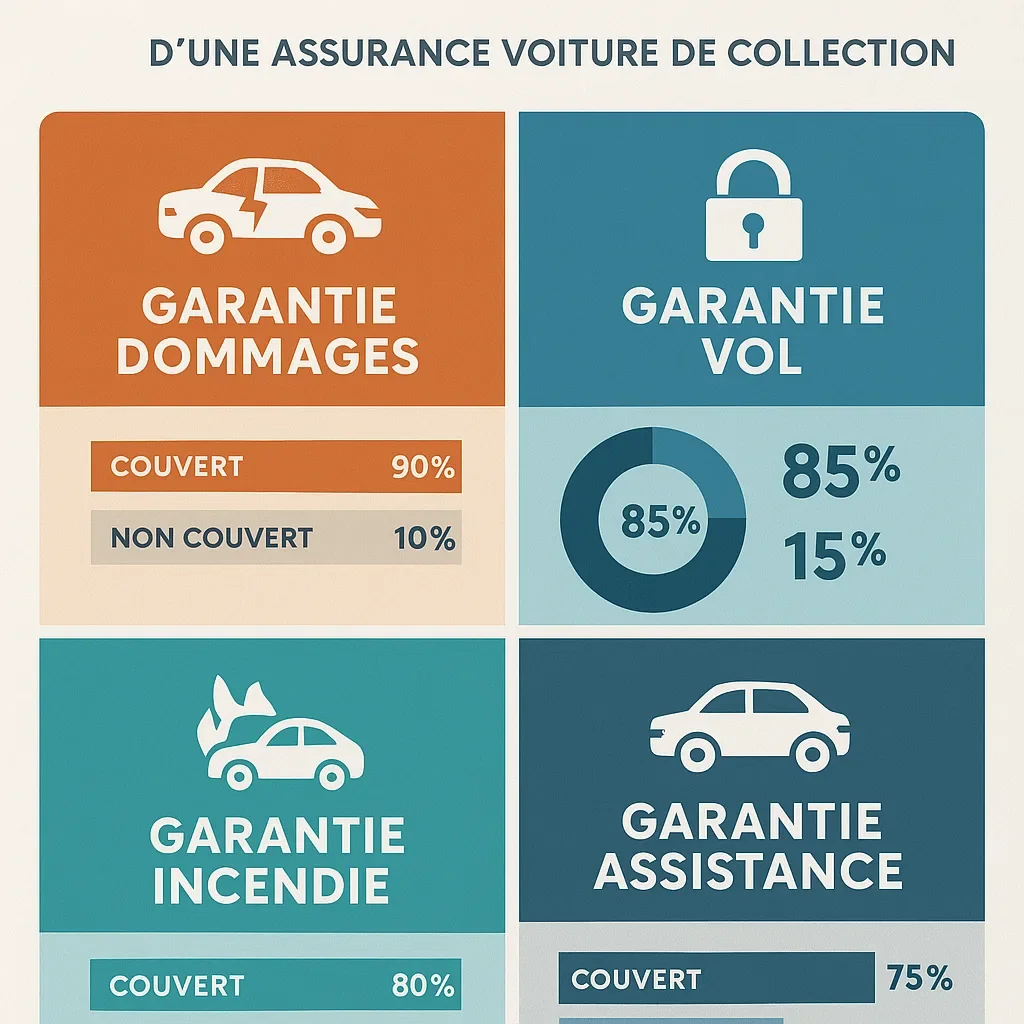
The hierarchy of coverage is quite clear. A third-party policy protects against damage caused to others, period. An intermediate policy often adds theft, fire, broken glass, and sometimes enhanced assistance. The comprehensive coverage makes more sense when the car has a real market value or a very costly restoration.
| Policy | For what use? | Main benefit | Common limitation |
|---|---|---|---|
| Third-party | Infrequently used car, modest value | Low price, legal compliance | Little compensation for your own vehicle |
| Extended third-party | Maintained classic, regular outings | Theft, fire, broken glass depending on contracts | Deductibles and limits sometimes tight |
| Comprehensive | Rare, restored or highly valued car | Better protection in case of responsible collision | Higher premium, stricter conditions |
| Useful options | Exhibition, rally, towing, parts | Truly customized contract | Each option increases the premium |
It should be noted that specialized vintage vehicle contracts often operate with deductibles different from classic car insurance. A deductible of 300 € may seem acceptable on paper, but it becomes problematic if the repair requires hard-to-find parts or highly skilled labor. Cherry on the hood: some policies also cap compensation for accessories, toolboxes, or spare parts.
The real trap is not paying too much, but discovering too late that a “cheap” contract poorly compensates a car whose restoration took years. In a collection, the details of coverage often matter more than the annual savings.
What price should you expect for classic car insurance?
The price of classic car insurance does not follow a single grid. Insurers take into account the vehicle’s value, frequency of use, parking location, circulation area, and overall security level. A car stored in a closed garage in Nantes or Grenoble does not carry the same risk as a classic parked on the street, even if the model is identical.
In practice, the most flexible contracts are often those of a driver over 25 years old, with several years of license, a second car for daily trips, and a clean record. Conversely, a young driver or a heavily modified vehicle may face restrictions or even a surcharge. This is logical: the insurer seeks to price a rare risk, not to finance reckless risk-taking.
It is also observed in the field that a well-prepared file often reduces the subscription delay, and sometimes the requested amount. A specialized agent notes that owners who provide maintenance invoices, restoration photos, and clear annual mileage more easily obtain a coherent offer. In other words: the cleaner your file, the less the insurer needs to imagine the worst.
Collection, youngtimer or classic car: what are the differences?
The words are similar, but the contracts do not always tell the same story. A collection car in the common sense of the French market often refers to a vehicle over 30 years old, maintained with a conservation mindset. A youngtimer, on the other hand, usually designates a younger car, generally from the 1980s to 2000, which is starting to gain value without always fitting strictly into the collection category.
This nuance matters because it changes the relationship between value, use, and insurance. A Peugeot 205 GTI or a BMW 3 Series E30 can be considered a youngtimer with a fairly standard contract from some insurers, whereas a Citroën DS restored identically or an old Porsche 911 often calls for a more heritage-based logic. The limits, frequency of use, and assessed value will not be the same.
That is why shortcuts should be avoided. A youngtimer used every week can sometimes remain on a classic car insurance policy if the price and coverage are appropriate. Conversely, a true collection, even if driven very little, often deserves a more specific policy, especially when parts are rare, the bodywork requires expertise, and the repair budget can quickly escalate.
What documents to provide and what mistakes to avoid?
Subscription does not depend solely on the car model. The insurer generally requests concrete elements to verify the risk’s consistency: registration certificate, information report, proof of address, driver’s license, photos of the vehicle, and sometimes an appraisal or expert invoice. For some restored models, before/after photos of the car are almost as useful as the registration certificate itself.
Modifications must also be considered. An exhaust, non-original rims, engine tuning, or an interior redone with different materials can change the risk assessment. Depending on the contract, these deviations may be accepted, subject to declaration, or on the contrary, excluded. If the car has been modified without written record, the unpleasant surprise usually occurs on the day it should have been avoided at all costs.
To avoid missteps, keep this checklist in mind:
- Declare the true value of the car, especially if it has been restored or appraised.
- Check the authorized use: daily trips, club outings, rallies, tourism abroad.
- Review the exclusions: competition, lending the wheel, unsecured parking, driving while fatigued.
- Compare the deductibles and not just the annual premium.
- Keep the proofs: invoices, photos, expert reports, service histories.
FAQ — Classic car insurance
Is comprehensive insurance mandatory for a classic car?
No, not necessarily. Third party coverage is enough to be compliant, but it mainly protects third parties. Comprehensive insurance becomes interesting if the car has a high value, has been restored at great expense, or if you want to limit the risk of out-of-pocket expenses after a responsible accident.
Can a classic car be used every day?
This is rarely the idea behind specialized contracts. Many insurers expect leisure use and a low annual mileage. If you drive every day, classic car insurance may remain more coherent, even if the vehicle is old.
Does agreed value really change the compensation?
Yes, significantly. With an agreed value, the amount is set in advance after appraisal or formal agreement. Without this, compensation may be based on market value, sometimes much lower than expected after years of restoration.
Is a closed garage mandatory?
Not always, but it helps a lot. Secured parking reassures the insurer, reduces the risk of theft, and can improve the rate. Some contracts even impose specific conditions, especially for highly valued vehicles or classic convertibles.
Can a youngtimer be insured like a classic car?
Sometimes yes, sometimes no. It all depends on the exact age, value, and the insurer’s policy. A youngtimer can be well covered by a specific contract, but it does not always meet the strict criteria of a collection in the patrimonial sense.
What is the most common mistake when taking out insurance?
The most frequent one is looking only at the price. In collection insurance, a slightly lower premium can hide a high deductible, limited assistance, or exclusions on parts and modifications. In the end, the contract seems clever until the day of the claim.