
In brief
🧾 Most alternative medicines are little or not reimbursed by Health Insurance; insurance mainly helps reduce the out-of-pocket expenses.
📌 The real issue is not just “is it covered?”, but how many sessions, what annual limit, and which practitioners are accepted in the contract.
💡 In practice, an allowance of 100 to 300 € per year may suffice for occasional use, while regular consumption justifies stronger coverage.
Does health insurance really reimburse alternative medicine?
Yes, but rarely through Health Insurance: most osteopathy, sophrology, or naturopathy sessions are reimbursed via insurance, either as an annual allowance or per-session amount. Homeopathy, however, has not been reimbursed by Social Security since January 1, 2021.
In real life, two levels must be distinguished. The first is the mandatory base: it reimburses very few so-called “non-conventional” treatments. The second is the complementary health insurance, which can take over thanks to a alternative medicine allowance, a wellness package, or reimbursement per treatment.
The important point is that not all practices are treated equally. Osteopathy and chiropractic are often better recognized in contracts than naturopathy or sophrology. To check the general framework, the Health Insurance website remains the starting point, as it reminds what is or isn’t covered by standard reimbursement.
In other words, insurance does not “create” reimbursement where none exists: it compensates an out-of-pocket expense, within the limits it sets. And that’s where everything is decided. Two contracts can display the same keyword “alternative medicine” and yet offer very different levels of coverage. Joking aside, the devil is often in the details.
How does reimbursement for alternative medicine insurance work?
Most contracts operate with two very simple logics: either an annual allowance or a reimbursement per session. In both cases, the insurance sets a ceiling, almost always requires a named invoice, and limits coverage to a specific list of treatments.
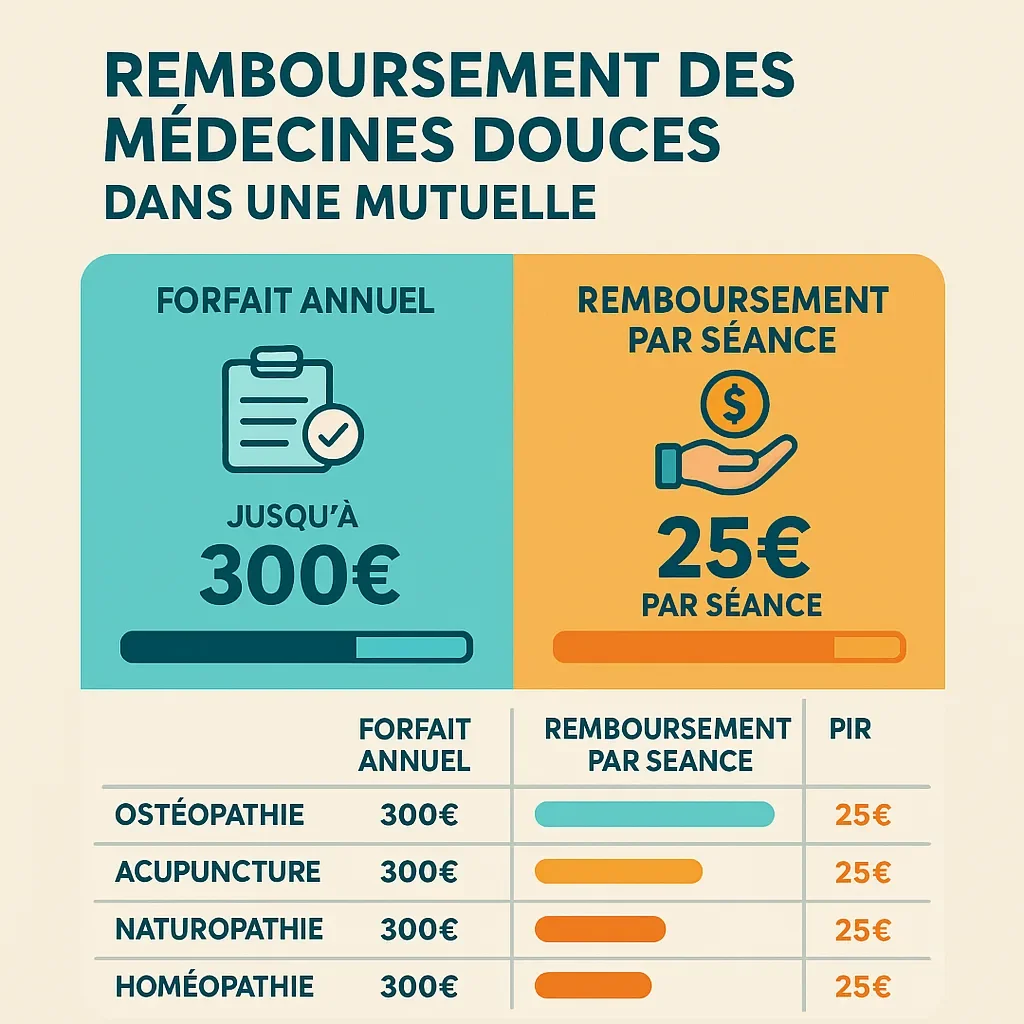
The annual allowance is the most straightforward: you have a global envelope to use over the year, for example 150 €, 200 €, or 300 €. It’s easy to track and often more advantageous if you consult several times a year. However, if your use is sporadic, part of the allowance may remain unused. Bonus: some contracts allow several different practices within the same envelope.
Reimbursement per session works differently: the insurance sets an amount per treatment, for example 25 €, 30 €, or 40 €, sometimes with a limited number of sessions at 3, 5, or 8 per year. This model fits well with occasional use but can become less generous if sessions are frequent or if the practitioner’s fees exceed the ceiling.
Annual package: simple, but not always the most generous
When the contract mentions a “wellness package” or a “soft medicine package,” you need to read the sentence all the way through. The allowance may cover several specialties at once, or conversely only accept a small range of well-named treatments. In some cases, the package renews every January 1st and does not carry over from one year to the next.
Reimbursement per session: convenient for targeted use
This system is often appreciated by insured individuals who consult infrequently but regularly. It provides immediate visibility on the reimbursed amount, which avoids imagining things based on the glossy contract paper. In return, the ceiling per session quickly becomes the key variable: if you pay €60 for the consultation and the mutual insurance only covers €30, the remaining cost is still very real.
| Coverage method | What it changes | For which profile |
|---|---|---|
| Annual package | A global allowance to use throughout the year | Regular consultations or multiple practices |
| Amount per session | A fixed reimbursement per appointment | Occasional use, easy-to-anticipate budget |
| Limited number of sessions | The contract caps the annual volume | Entry-level contracts, moderate need |
| Overall + session ceiling | Double lock, more protective for the insurer | Insured individuals seeking broader coverage |
Which soft medicines are most often covered?
Mutual insurance companies do not cover all disciplines in the same way, and that is normal: some practices are more standardized, more frequently requested, or easier to regulate by contract. At the top of the list, we often find osteopathy, chiropractic, acupuncture, and, depending on the plans, sophrology.
In practice, it is observed that families mainly request osteopathy after a lower back pain episode, then sophrology during periods of mental overload. The most appreciated reimbursements are those that avoid having to pay €50 or €60 at each appointment.
In somewhat broader contracts, naturopathy, reflexology, or hypnosis may also appear, but they vary more from one mutual insurance to another. The good habit is to check not only the name of the practice but also the eligibility conditions: certified practitioner, detailed invoice, SIRET number, or sometimes registration in a recognized professional register.
It is also important to keep a useful nuance in mind: a discipline can be “covered” in a contract without being reimbursed by Social Security. The most telling example remains homeopathy. Since January 1, 2021, it is no longer reimbursed by Health Insurance, even if some complementary insurances continue to offer a small dedicated allowance.
Here is a simple guide to help you navigate:
- Osteopathy: very often included in guarantees, with a ceiling per session or per year.
- Acupuncture: often covered, but the contract may require a clearly identified practitioner.
- Chiropractic: quite common in health offers, especially in intermediate and higher levels.
- Sophrology: more variable, often included in wellness packages.
- Naturopathy: possible coverage, but less systematic than osteopathy.
How much does a complementary health insurance for alternative medicine reimburse, in practice?
The crux of the matter is the concrete calculation. An osteopathy session often costs between 50 and 70 € in town, with variations depending on the region and the office’s standing. A sophrology consultation frequently costs around 45 to 60 €, while an acupuncture session can fall within a comparable range, sometimes slightly lower if performed in a medical setting.
To visualize the real benefit of a contract, consider three simple scenarios:
| Profile | Annual expense | What the complementary health insurance can reimburse |
|---|---|---|
| Occasional use | 3 sessions at 60 € = 180 € | Package of 150 €: out-of-pocket expense of 30 € |
| Regular use | 6 sessions at 50 € = 300 € | Package of 300 €: no out-of-pocket expense if all is eligible |
| Intensive use | 8 sessions at 55 € = 440 € | Reimbursement of 35 € per session: coverage of 280 € |
This type of example shows a very simple thing: a contract may seem “generous” on paper but becomes average as soon as you exceed the allowed number of sessions. Conversely, a modest plan can do the job very well if you only consult once or twice a year. Hence the importance of comparing the coverage to your actual use, not to a commercial promise that is a bit too shiny.
How to choose a complementary health insurance for alternative medicine without making a mistake?
The right plan depends on your consumption rate. An annual package better protects regular use, while reimbursement per session suits occasional consultations. The key point remains the ceiling, the acts listed in the contract, and the necessity of a named invoice.
The biggest trap is choosing a contract based solely on its displayed amount. A 300 € package does not have the same value if it covers ten osteopathy sessions or only three sophrology appointments. Conversely, a small envelope of 120 € may suffice if you rarely consult and the practitioner charges in the lower range.
A good complementary health insurance for alternative medicine is not chosen by the noise it makes in advertising, but by how well it matches your real consumption.
To sort things out without getting lost, ask yourself the right questions:
- Which practices are listed in black and white? Forget vague mentions like “well-being” if your need is very specific.
- How many sessions are allowed? A ceiling of 5 sessions can be quickly reached if you have recurring pain.
- What is the real annual ceiling? This measures the true scope of the coverage.
- Is a partner practitioner required? Some complementary health insurances require a care network or a referenced professional.
- Must the invoice be complete? Without clear supporting documents, reimbursement can be refused.
The right reflex also consists of checking the waiting period, if it exists. Some contracts apply a delay before the coverage activates, which can be annoying if you subscribe precisely because a pain is already present. Finally, for families, it is often wiser to take a somewhat broader coverage than a small individual package that will be saturated after the third appointment.
The Service-Public website recalls the main principles of health contracts, while the grids of Health Insurance allow distinguishing what is covered by basic reimbursement and what depends entirely on the complementary health insurance.
What limits and pitfalls should you be aware of?
The first limit is obvious: the mutual insurance does not replace the legal framework. If a practice does not fall within the terms of the contract, reimbursement may be refused, even if you have paid your contribution. And if you do not have a named invoice, or if the document is incomplete, coverage may also fall through.
Second point of caution: vague titles. Some contracts refer to “alternative medicines,” others to “alternative therapies,” “prevention,” or “well-being.” Behind these words, the ceilings and exclusions can vary greatly. You therefore need to read the terms looking for concrete keywords: eligible practitioner, number of sessions, amount per treatment, annual ceiling, supporting documents.
Third pitfall: believing that the longer the list of practices, the better. In reality, a mutual insurance may list fifteen reimbursed disciplines but with tiny amounts, whereas a more modest contract will very adequately cover your most frequent needs. That is why you should always compare the quantity of guarantees to their actual depth.
Finally, keep in mind that not all alternative medicines are equal in terms of scientific validation or medical coherence. This does not mean they are useless for everyone, far from it. But it means that a serious mutual insurance must remain financial aid, not a marketing cover-up. The strongest contracts are those that display clear rules, not those that pile up promises endlessly.
FAQ: health mutual insurance and alternative medicines
Is osteopathy reimbursed without a prescription?
Yes, most of the time by the mutual insurance, and often without a prescription. However, the Health Insurance does not reimburse osteopathy under common law. Just check if your contract requires a qualified practitioner and a detailed invoice.
Is homeopathy still covered?
By Social Security, no: reimbursement stopped on January 1, 2021. Some mutual insurances still offer a small specific allowance, but this is no longer the norm in the public system.
Do you have to pay upfront for a session of alternative medicine?
Most often, yes. Direct billing is still rare for these treatments, except in certain networks or specific offers. Reimbursement then occurs upon presentation of the invoice or the supporting document requested by the mutual insurance.
Is sophrology still reimbursed?
No, not automatically. It may be included in a “well-being” or “alternative medicines” package, but only if the contract explicitly mentions it. Without a clear mention, you should not assume it is covered.
Can Social Security reimbursement and mutual insurance be combined?
Yes, when the practice benefits from a basic partial reimbursement, the mutual insurance can cover the remainder within the limits provided in the contract. For care not covered by Health Insurance, only the mutual insurance package applies.
Is an invoice enough to be reimbursed?
Not always. The invoice generally must be named, dated, and include the name of the practice, sometimes the practitioner’s number or qualification. If the document is incomplete, the mutual insurance may request additional information or refuse reimbursement.