In brief
🔒 In-ground or semi-inground pools trigger strict safety obligations: one of the 4 standardized devices must be present.
📨 Regarding home swimming pool insurance, the real rule is simple: declare the pool to the insurer as soon as it is built, then check the covered annexes.
💸 An undeclared pool can complicate compensation, especially for fixed equipment such as the pump, shelter or technical room.
⚠️ In case of non-compliance, the fine can reach €45,000; needless to say, it is better to avoid last-minute DIY.
Does the pool have to be declared to the home insurance?
Yes: the pool must be reported to the insurer as soon as it is installed or put into service. Without this update, the coverage may be reduced for the pool, the pump or the shelter. A written document and an endorsement avoid disputes after a claim.
In home swimming pool insurance contracts, the most common mistake is to believe that the pool is automatically “in the package.” In reality, the insurer works on declared risk. If the pool changes the property value, garden use or the level of exposure to damage, it must appear in the file.
The right reflex is to notify your insurer before the start of work or, at the very least, just after installation. This avoids ambiguity about the type of pool, fixed equipment and the commissioning date. In practice, an advisor will often ask for the invoice, photos and, depending on the case, the safety device manual.
In the field, it is observed that many owners, especially in recent houses in Nantes or on the outskirts of Bordeaux, think that a “temporary” above-ground pool never needs to be reported. As soon as it remains assembled for several months and is connected to a fixed filtration system, the insurer may treat it as a full-fledged outdoor equipment.
To declare, as a priority:
- the pool itself, with its exact type;
- the technical room, if the installation is fixed;
- the shelter, cover, shutter or alarm;
- permanent fittings: adjoining terrace, masonry stairs, pool house, permanent spa.
Which pools are subject to mandatory safety rules?
Yes, but not in the same way depending on the type of pool. In-ground and semi-inground pools are the most regulated: they must be protected by a compliant device. Removable above-ground pools fall under a more flexible regime, but not an automatic exemption if they are installed permanently.
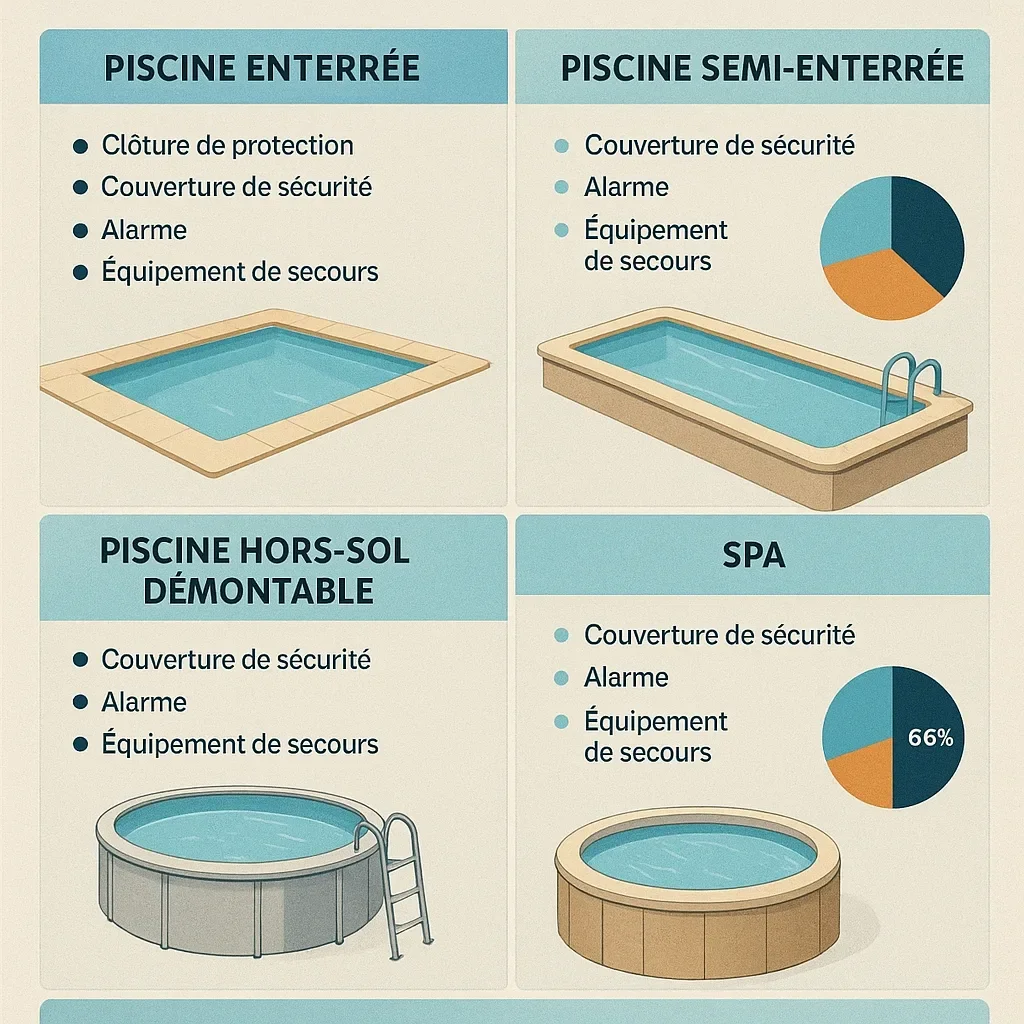
The legal framework is summarized by Service-Public.fr and by the Ministry of the Economy: the logic is to limit free access to the pool, especially in a family home or a second residence. The law of January 3, 2003, applied to these pools from 2004 onwards, imposes standardized protection.
The 4 recognized devices are as follows:
- the protective barrier;
- the audible alarm;
- the safety cover;
- the pool enclosure.
They refer to standards NF P90-306, NF P90-307, NF P90-308, and NF P90-309. In other words, it’s not the gadget that counts, but the compliance of the device. A poorly sounding alarm, a cover that is too light, or a non-compliant enclosure neither protects children nor your liability.
| Type of pool | Declaration to insurer | Safety rule | Point of attention |
|---|---|---|---|
| In-ground | Yes, systematically | Yes | Standardized device + endorsement |
| Semi-in-ground | Yes | Yes | Barrier, alarm, cover, or enclosure |
| Above-ground removable | Often yes if installed for several months | Not always, depending on installation | Duration, fixation, access |
| Permanent above-ground / fixed spa | Yes | To be checked | Contract and additional equipment |
What does pool home insurance really cover?
Pool home insurance mainly covers material damage suffered by the pool and its equipment when the contract recognizes them: cracks, storms, vandalism, leaks related to a covered event. On the other hand, normal wear and tear, lack of maintenance, or bodily injuries do not automatically fall under the same category.
The exact scope depends on the contract, but often includes the pool structure, the filtration, the pump, the cover, the enclosure, and sometimes the pool house. Conversely, damages related to poor maintenance, sloppy winterizing, or a DIY installation are frequently excluded. This is where the fine print takes up all the space.
The real trap is not the pool itself. It’s the gap between what one thinks is insured and what the contract actually recognizes.
It is also necessary to distinguish material damage from bodily injury. If a guest is injured around the pool, civil liability may come into play if a safety defect is established. But this does not mean that all swimming accidents are automatically compensated like water damage. Causality, here, matters greatly.
Good to know: a good insurance policy also specifies the compensation limits, the deductible, and the exclusions. Without these details, the coverage looks like a nice promise… until the day you have to pay for the pool wall or replace the cover motor.
How to declare your swimming pool to your insurer without making a mistake?
The simplest way is to send a written declaration with the characteristics of the pool, the installed equipment, and the date it was put into service. The goal is not to overwhelm the insurer with paperwork, but to prove that the risk has been accurately described. Once the declaration is made, request an endowment or written confirmation.
Here is a clean, quick method without any unpleasant surprises:
- Identify the type of pool: in-ground, semi-inground, above-ground, permanent spa.
- Gather the documents: invoice, plan, photos, installation date, reference of the safety device.
- Send a written message: email, client area, or registered mail if the file is sensitive.
- Request the contract update: insured value, deductibles, covered annexes, exclusions.
- Keep the response: it is your best defense in case of a claim.
A clear message is often enough. For example: “I inform you of the installation of a semi-inground pool measuring 7 x 3 meters, equipped with a compliant safety cover, at the address … Please update my contract and confirm in writing the applicable guarantees.” No need to write a novel, but it is better to be precise.
In practice, a file often gets stuck when the photos date from the house purchase but not from the installation of the cover, or when the spa is presented as a simple “garden equipment” while it is permanently connected. The clearer the file, the less the insurer can play the ambiguity card.
What impact can the pool have on the premium and the deductible?
The additional cost sometimes exists, but it is neither automatic nor necessarily spectacular. In many contracts, the pool adds a few dozen euros per year or mainly leads to a reassessment of the insured value. What affects the price is not only the size of the pool: it is also the level of equipment, the geographic area, and the frequency of use.
Insurers look at several parameters:
- the type of pool: in-ground, semi-inground, permanent above-ground;
- the value of the equipment: motorized cover, heat pump, shelter, robot, technical room;
- exposure to risk: wind, frost, flooding, burglary, unoccupied secondary residence;
- the security level: compliance or not of the device;
- the deductible: sometimes stable, sometimes increased on outdoor equipment.
The real issue is not only the price. A well-declared pool with a clear deductible is often better than a cheaper contract but unclear on the outbuildings. On a house with a motorized shelter or fixed spa, the premium difference can come from the total value of the insured property, not just the pool.
In other words, it is better to pay a little more for a clean contract than to make superficial savings. The icing on the cake: in case of a claim, you save time, clarity, and often get a much better-compensated file.
Secondary residence, rental, spa: special cases to know
Special cases are precisely those that create the most disputes. A secondary residence with a swimming pool is not managed like a primary residence occupied year-round. A vacation rental is also not just a family home, especially if the pool is used by passing vacationers. The contract must therefore match the actual use of the property.
In a vacation home in Ardèche or on the coast near Arcachon, the owner must check who is responsible for the declaration, who handles maintenance, and who is liable in case of an accident. If the accommodation is rented furnished, the responsibility of the owner, tenant, and sometimes the manager can overlap. And here, ambiguity quickly becomes costly.
The spa and jacuzzi also deserve special attention. They do not always fall under the same legal regime as an in-ground pool, but they very often must be declared if they are permanently installed, supplied in a fixed way, or covered by a specific option. The same logic applies to an above-ground pool set up for the entire season: “temporary” does not mean “invisible” to the insurer.
Finally, if you bought a house in Montpellier or Lille with a pool already in place, remember to ask if the seller had properly reported the pool to their insurer. An old installation, even a very nice one, can hide an incomplete old declaration. And unpleasant surprises like this kind of detail.
FAQ
Does an above-ground pool always have to be declared?
Not always, but caution is advised. A dismantlable above-ground pool used for a few weeks is not treated like an in-ground pool. However, if it remains installed for several months, connected to a fixed filtration system, or surrounded by permanent structures, it is better to report it.
Do the spa or jacuzzi follow the same rules as a pool?
They do not fall exactly under the same legal framework, but the insurer may require their declaration if they are fixed or if they increase the risk value. The issue is mainly contractual: equipment, liability, and potential damage to third parties.
What are the risks if the pool is not declared?
The main risk is a contested or reduced compensation. The insurer may consider that the contract does not reflect the actual risk, especially if the pool or its fixed equipment do not appear anywhere. In case of a serious claim, the discussion can quickly become difficult.
Does insurance cover bodily injuries around the pool?
Not automatically. If a guest falls because a device is missing or non-compliant, civil liability may be engaged. But coverage depends on the contract, circumstances, and proof of the safety defect.
Should the insurer be notified after work on the pool?
Yes, as soon as a change modifies the risk or the insured value: new shelter, motorized cover, heat pump, pool enlargement, fixed terrace. A written update avoids discrepancies between the reality on the ground and what the insurer believes is covered.