In brief
🧯 Water damage coverage mainly covers consequential damages from a leak, overflow, or infiltration, not always the cause of the incident itself.
⏱️ In practice, the claim must be reported to the insurer within 5 working days. The more documented the file, the faster the compensation process.
🏢 In condominiums, the combination of amicable report + IRSI agreement often simplifies minor claims, especially when several apartments are involved.
💡 Points to watch: deductible, depreciation, leak detection limit, and possible temporary rehousing.
What does water damage coverage really cover?
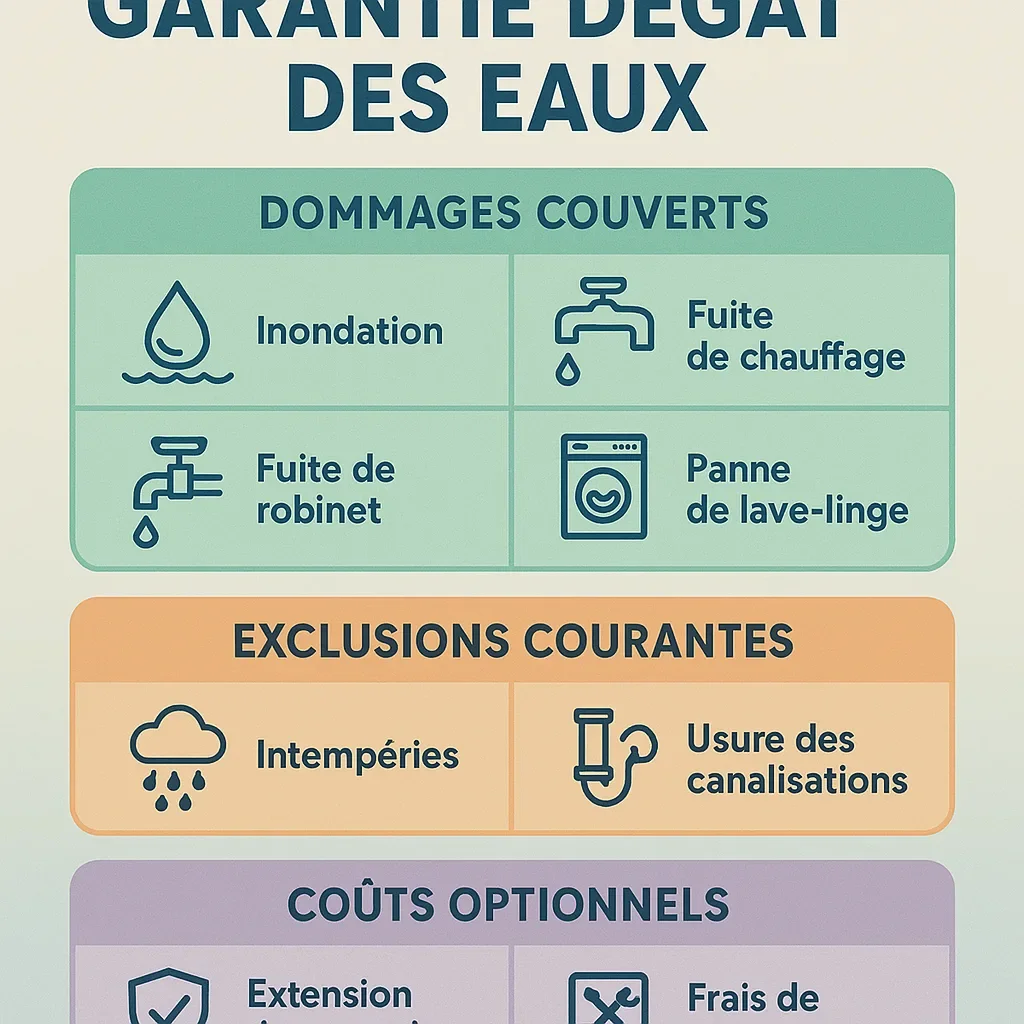
Water damage coverage generally covers damage caused by the action of water: walls, ceilings, floors, paint, coverings, furniture, or appliances damaged by a leak, overflow, or infiltration. It does not automatically cover the repair of the cause, which may fall under another coverage or exclusion.
In home insurance contracts, the logic is quite simple: first, the consequences are compensated, then it is checked whether the cause is covered. A washing machine leak, a hose rupture, a bathtub overflow, infiltration through the roof, or water rising from an upstairs apartment often fall within the scope. On the other hand, moisture that has been present for months, condensation, or lack of maintenance may exclude the claim from coverage.
The distinction is important because an insurer does not just analyze “there is water.” They look for the triggering event, the path taken by the water, and the accidental nature of the damage. A sudden infiltration is treated differently from slow deterioration, and a broken pipe is not equated with a simple ventilation problem. That’s why the contract’s wording matters as much as the visible damage.
| Situation | Often covered | To check in the contract |
|---|---|---|
| Hose or joint leak | Coverings, paint, affected furniture | Leak detection limit, deductible |
| Overflow from an appliance or bathtub | Floors, walls, adjacent rooms | Damage to the appliance itself |
| Infiltration through roof or facade | Ceilings, insulation, finishes | Origin of the damage and building maintenance |
| Old moisture or condensation | Rarely | Specific extension or explicit exclusion |
Depending on the case, coverage may also extend to ancillary costs: leak detection, restoration of improvements, cleaning, or even temporary rehousing if the dwelling becomes uninhabitable. But these items are not automatic. They depend on the level of coverage, limits, and subscribed options. This is the kind of detail often hidden in the fine print, the ones you never read… until the day the ceiling starts dripping.
Which damages are compensated and which are often excluded?
In general, the insurer compensates for material damage directly caused by water, as well as certain costs related to the claim such as leak detection or restoration. More often excluded are: causes related to wear and tear, progressive humidity, lack of maintenance, and sometimes the appliances themselves if they are too old.
The core issue is the distinction between consequential damages and cause of the claim. If your ceiling is stained, your parquet has swollen, or your sofa is irreparable after a sudden leak, the coverage may apply. But if the pipe broke because it was corroded due to age, the insurer may limit its coverage or apply severe depreciation. The contract may also provide for different limits depending on the nature of the damage.
The most delicate situations often concern “invisible” damage at first. A damp wall behind a partition, a slow leak under a sink, infiltration from the roof after several weeks of rain, or damage rising from a technical duct may require more thorough expertise. In a condominium in Lyon, Paris or Lille, this is typically where cases get bogged down if the origin is not quickly identified.
For market contracts, the deductible is often around €100 to €400, sometimes more on entry-level plans or certain extensions. As for the cost of leak detection, it can rise quite quickly as soon as a partition needs to be opened or a specialist called in. In short, the reimbursed amount is not always the amount lost. To top it off, depreciation can further reduce the indemnity if the goods were already old.
The real trap of water damage coverage is not the flooding itself. It is the moment when the contract turns an obvious claim into a technical case, with deductibles, depreciation, and exclusions that change the final bill.
How to report water damage without missing the deadlines?
The most effective way is to act in order: secure, prove, declare. As long as the water is flowing, shut off the supply if possible, protect belongings, then photograph the stains, affected objects, and the presumed origin of the damage. Only then do you contact the insurer. Service-Public recalls the basic rules for water damage, especially for tenants, who must be insured at least against this risk.
The declaration must be as complete as possible, because a well-documented file progresses faster than a simple panicked call. Indicate the date of discovery, the location, the supposed cause, the affected rooms, the neighbors involved, and, if necessary, the contact details of the property manager. Once the file is opened, keep the damaged furniture and materials as long as the insurer has not given the green light, especially if an expert assessment is planned.
In case of damage involving several occupants, an amicable water damage report is very helpful. This is particularly true in apartment buildings, where an upstairs apartment may be the source of the leak without even realizing it. France Assureurs also details the steps to take to avoid wasting time in exchanges between insurers.
- Keep photos, videos, quotes, invoices, and exchanges with the neighbor or property manager.
- Declare the damage within 5 working days, even if the cause is not yet certain.
- Avoid major repairs before the expert’s visit, except in cases of obvious emergency.
Tenant, owner, co-ownership: who pays what?
The person responsible for payment depends less on who sees the water than on the origin of the damage and each party’s status. In practice, the tenant, the occupant owner, the non-occupant owner, the neighbor, or the property manager may all be involved at the same time, each through their own insurance and guarantees.
The simplest approach is to think by role. The tenant generally reports the damage to their insurer, especially if their belongings or interior are affected. The occupant owner handles the building and, depending on their contract, the improvements. In co-ownership, the property manager becomes central as soon as common areas, a riser pipe, or a roof are concerned. And if the leak comes from the upstairs neighbor, their insurer can also be contacted.
| Profile | Usual role | Points to watch |
|---|---|---|
| Tenant | Reports the damage and protects their belongings | Rental risk insurance, proof documents |
| Occupant owner | Manages the dwelling and its repairs | Ceiling for improvements and depreciation |
| Non-occupant owner | Intervenes on the rented dwelling | PNO contract useful if the tenant is affected |
| Co-ownership / property manager | Handles common areas | Origin of the leak and allocation of recourse |
The tenant must not confuse insurance obligation with automatic liability. Being insured does not mean being guilty, and the reverse is also true. Water damage can very well be compensated without the person responsible for the leak being at fault, especially when it is a simple technical incident. Conversely, repeated lack of maintenance can complicate the file, or even exclude coverage.
How to avoid unpleasant surprises with the deductible and depreciation?
The deductible and depreciation are the two areas where the contract’s promises become a bit less glamorous. The deductible is the portion that remains your responsibility, while depreciation reduces the compensation by taking into account the wear and tear of the property. Result: two homes affected by the same damage can be reimbursed differently depending on the age of the materials and the contract options.
The right reflex is to check three items before a claim occurs: the deductible level, the compensation method for household goods, and the ceiling for leak detection costs. Some contracts offer compensation at new replacement value for certain items, others apply a severe depreciation. This is especially true for an old parquet floor, a worn sofa, or outdated paintwork.
In practice, the slowest cases are often those where the leak has traveled through several floors before being detected. In an old building in Paris or Lille, the place where the traces appear is not always where the water entered, which complicates the assessment and lengthens the delays.
The most frequent exclusions concern condensation, known waterproofing defects, infiltrations related to poor maintenance, and certain buried pipes depending on the contracts. The good test is simple: if the damage results from a sudden and unpredictable event, you are generally in a better position. If the problem developed slowly, the response will often be harsher.
Should you wait for the expert before repairing?
Not always, but you should not repair too quickly either. Small emergency interventions are obviously possible, even essential: shutting off the water, drying, securing, protecting furniture, temporarily plugging a leak. However, for major work, it is better to keep evidence and wait for the insurer’s or expert’s go-ahead. Otherwise, you risk making the evaluation impossible.
In a simple case, the assessment can be avoided if photos, receipts, and the amicable report suffice. But as soon as there are multiple homes, suspicion about the origin, or a rising amount, the insurer may appoint an expert. The goal is to verify the cause, estimate the repair cost, and determine if the coverage really applies. This is where precise documentation saves a lot of time.
If the compensation seems too low, ask for the calculation details: deductible, depreciation, ceiling, possible exclusion, and evaluation basis. In case of serious disagreement, you can request a counter-expertise or ask for the complaint procedure provided in the contract. In other words, a refusal is not necessarily the end of the story. That would be too good for insurers, and too cruel for policyholders.
FAQ — water damage coverage
Does water damage coverage include household appliances?
Often yes if the appliance was damaged by water, but this depends on the contract and the initial condition of the equipment. A machine that is too old may suffer a heavy depreciation, or even be excluded if the breakdown was already due to poor maintenance. Keep the receipt and proof of purchase if possible.
What if the leak comes from the neighbor?
You still need to report the claim to your insurer. The neighbor, their insurer, and sometimes the property manager may get involved, especially in condominiums. The amicable report is then very useful, as it allows describing the damages and saving time in exchanges between companies.
Is leak detection always reimbursed?
No, and this is one of the most overlooked points. It can be reimbursed, sometimes with a separate ceiling, but some destructive methods or parts of the repair may remain your responsibility. Check carefully if the contract distinguishes between detection, repair of the cause, and restoration.
What to do if the insurer refuses compensation?
First ask for the written reason for the refusal, then review the exclusions and coverage conditions. If the disagreement persists, you can file a complaint, request a counter-expertise, or rely on the mediator indicated in the contract. Most disputes are resolved when the file is better documented.
Does water damage insurance cover temporary relocation?
Not systematically. Some contracts provide coverage for relocation expenses if the dwelling becomes uninhabitable, but this is not the general rule. The amount, duration, and conditions vary greatly, so it is better to check this option before you need it — on the day of the damage, it is too late.
Is an amicable report necessary even without a directly affected neighbor?
It is not mandatory in all cases, but it remains useful as soon as there is any doubt about the origin or when multiple parties are involved. In co-ownership, it helps to establish the facts and avoid disputes. A well-prepared file from the start often saves several back-and-forths later.