
In brief
🔎 In principle, life insurance is not subject to the IFI. Only certain real estate assets held within a redeemable contract can be included in the taxable base.
📌 The key point is the valuation as of January 1st, not the value at the time you fill out your declaration. A contract that has gained or lost value after this date does not change the rule.
🧩 The assets to watch closely are SCPI, OPCI, and certain SIIC. Pure financial funds generally play no role in the IFI.
⚠️ The most common bad habit is declaring 100% of the contract. In practice, you must isolate the taxable real estate fraction, then add it to the other taxable assets of the household.
Is life insurance taxable under the IFI?
In principle, no. The IFI targets real estate assets, not financial savings in the broad sense. A life insurance contract only becomes concerned if it is redeemable and contains a taxable real estate fraction. The classic euro fund generally remains outside the scope, except in special arrangements.
According to impots.gouv.fr, the IFI applies to real estate assets and rights held on January 1st of the tax year. This is where everything is decided: if the life insurance contract does not give access to a redemption value or contains no real estate assets, it is not included in the IFI base.
In other words, “life insurance” is not taxed as a whole. A real estate share is taxed when it exists. This is why a multi-asset contract can be completely neutral from an IFI perspective… or conversely trigger a small tax bomb if the savings are invested in clearly identified real estate assets.
What exactly must be declared in a life insurance policy?
You never declare the total value of the contract reflexively. You must isolate the taxable real estate portion as of January 1st, then add it to the household’s IFI base. Real estate unit-linked funds, hybrid supports, and certain listed vehicles therefore require careful sorting.
The practical rule is simple to say, less simple to do: you must distinguish financial supports from real estate supports. A contract with 100% equity, bond, or money market unit-linked funds does not fall under the IFI. However, unit-linked funds invested in SCPI, OPCI, or certain SIIC can create a taxable fraction.
To visualize the difference, imagine a contract with an insurer like Generali or Axa with a mix of unit-linked funds: an equity fund, an office SCPI in Paris, and an OPCI focused on tertiary real estate. Only the truly real estate portion is included in the IFI, not the rest. This is where the IFI life insurance declaration becomes an exercise in precision, not a simple copy-paste from the annual statement.
| Situation | To declare for IFI? | What to remember |
|---|---|---|
| Classic euro fund | Generally no | No declaration of the total contract value if no real estate support is held within it. |
| Unit-linked funds in SCPI or OPCI | Yes, partially | You must retain the real estate fraction represented in the contract as of January 1st. |
| Pure financial unit-linked funds | No | Equities, bonds, and money market supports are not, by themselves, real estate assets. |
| Redeemable capitalization contract | Yes if real estate portion | The IFI logic follows the same idea: only the real estate fraction is included in the base. |
How to calculate the taxable fraction of the life insurance?
The calculation is done in two steps: first the valuation of the contract on January 1st, then the isolation of the part invested in real estate supports. A good method is to start from the insurer’s statements, then verify the nature of each unit-linked fund. It takes longer than a quick glance, but is much more reliable.
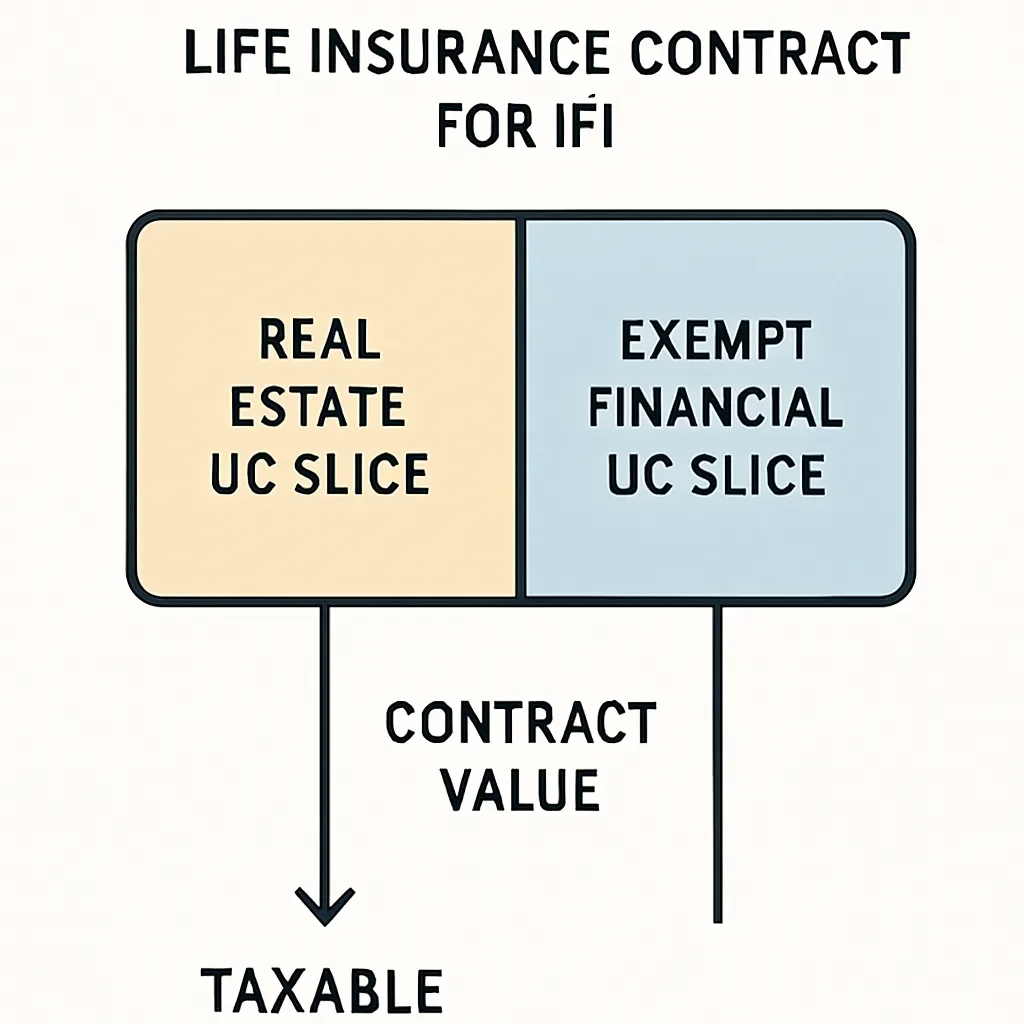
In practice, you start by checking if the contract is redeemable. Then, you identify the real estate unit-linked funds, and apply the transparency rule when the support itself holds real estate. This is the famous fiscal “look-through” that requires going up to the underlying asset. That’s why the technical sheets of unit-linked funds are so important.
There are also cases where taxation is neutralized or very limited. According to tax doctrine, certain unit-linked funds held in UCITS can be exempt if the contract holds less than 10% of the fund and if the fund itself contains less than 20% real estate. For SIIC, the holding threshold is often set at 5%. These figures change everything.
Simple example: a contract of €400,000 on January 1st includes €50,000 of SCPI, €30,000 of OPCI, and €320,000 of financial unit-linked funds. If the two real estate supports are fully taxable, the IFI base related to the contract is €80,000. Not 400,000. Not 320,000. Just the retained real estate portion.
Where and how to fill out the IFI declaration?
The declaration is made in the IFI declaration, online or on the dedicated form, by adding the net value of taxable real estate assets. For life insurance, there is no special “magic” contract field: the taxable portion must be included in the section for real estate assets and rights, with a consistent estimate as of January 1st.
It is observed in practice that some omissions come from contracts opened several years ago, when subscribers had only purchased a bit of SCPI “to diversify.” The day the estate grows, the contract reappears in the tax records, and no one remembers the exact allocation of UC as of January 1st.
The useful reflex is to gather three documents: the annual contract statement, the details of the unit-linked funds, and the valuation as of January 1st. If the insurer provides a clear breakdown, so much the better. Otherwise, the real estate portion must be reconstructed from the documentation of the supports. The Légifrance site on the General Tax Code also reminds that the IFI is based on a logic of net real estate rights, not on a simple contract value.
Good to know: the 30% allowance on the main residence remains an important element of the overall IFI base. It does not directly concern life insurance, but it can tip a household just below or just above the threshold. The life insurance IFI declaration therefore always fits into an overall calculation, not in an isolated box.
What special cases should be watched?
Unstable situations are those that derail the declaration. Capitalization contract, co-subscription, dismemberment, non-tax residence: in these cases, the answer is not automatic. You have to look at who owns what, at what date, and according to which allocation key. This is often where mistakes are costly.
- Capitalization contract: same logic of real estate fraction if the contract is redeemable.
- Co-subscription: the declarable share must be attached to the rights of each subscriber according to the chosen legal structure.
- Dismemberment: the split between usufruct and bare ownership can change the declarant or the base used.
- Non-resident: the situation depends on the taxation of real estate located in France and the rules applicable to the household.
The good reflex here is not to “transpose” a scheme seen on another contract. A life insurance held in full ownership by a French tax resident does not follow the same issues as a dismembered contract or a joint subscription between spouses. The IFI mechanism remains the same, but the allocation of the taxable base changes.
What errors most often inflate the IFI?
Most mistakes come from excessive simplicity. One takes the total value of the contract, forgets the date of January 1st, or applies an exemption without checking thresholds. Result: the IFI base is overestimated… or, conversely, under-declared, which is never a good idea.
- Declaring 100% of the contract instead of only the taxable real estate portion.
- Using the current value instead of the value on January 1st.
- Forgetting a real estate UC held in an old contract.
- Applying an exemption for OPCVM or SIIC without controlling ownership thresholds.
- Not archiving the insurer’s supporting documents and the breakdown of the supports.
To summarize without beating around the bush: life insurance is not the enemy of the IFI, but it can introduce a small portion of real estate into the declaration if it contains the wrong supports at the wrong time. A well-read contract is already half the work done.
FAQ – Life insurance IFI declaration
Should a euro fund in life insurance be declared?
As a general rule, no, because a classic euro fund does not represent a direct holding of real estate assets by the subscriber. The issue becomes sensitive only if the contract holds identifiable real estate supports. Again, everything is decided on January 1st.
Does a capitalization contract follow the same rules as life insurance?
Yes, for the IFI, the logic is very similar as long as the contract is redeemable. If it contains real estate assets, the corresponding portion can be included in the taxable base. The difference lies more in the civil and patrimonial nature of the contract than in the IFI mechanism itself.
If the value of the contract changes after January 1st, should the declaration be corrected?
No, the IFI base is fixed as of January 1st of the tax year. An increase or decrease after this date does not change the declaration for the current year. This is precisely what makes the valuation date so important.
Are SCPI held through life insurance always taxable?
Not always. It is necessary to check if the contract is redeemable, if the SCPI actually falls within the taxable real estate portion, and if any exemption conditions or thresholds apply. An SCPI alone is therefore not enough to conclude.
What supporting documents should be kept in case of an audit?
At a minimum, keep the annual contract statement, the breakdown of unit-linked investments, and any document indicating the value as of January 1st. In case of an audit, the administration wants to see how you constructed the declared base, not just the final total.