
In brief
🟢 After 70 years old, life insurance remains useful, but the main tax leverage is less powerful: premiums paid fall under the regime of article 757 B of the CGI.
📌 The allowance is no longer €152,500 per beneficiary as before 70 years old, but €30,500 in total, all contracts and beneficiaries combined.
✨ Cherry on top: the gains generated by payments made after 70 years old generally remain exempt from inheritance tax.
⚖️ In practice, life insurance often serves to transfer liquidity, keep available capital, and complement other tools such as gifts or usufruct arrangements.
Is it still interesting to open a life insurance contract after 70 years old?
Yes, but not for the same reasons as before 70 years old. After this age, life insurance remains interesting if you seek flexibility, organized transmission, and available savings. However, the tax benefit on payments is more limited, so the contract is mainly judged on its overall wealth management function.
The real question is not “life insurance or no life insurance?”, but rather “for what purpose?” After 70 years old, the contract becomes less a super tax-saving tool and more a wealth management vehicle. It can still serve to keep a cash reserve, smooth out the inheritance, and freely designate beneficiaries.
This logic remains coherent when you want to avoid transferring an overly large current account, or when you want to keep control over the money until the end. According to INSEE (2024), life expectancy at birth is still around 80 years for men and 85.6 years for women: in other words, it’s not a “too late to act” logic.
On the other hand, you have to accept one thing: the post-70 tax mechanism is no longer the star of the show. Life insurance remains useful, but it must be chosen with a clear objective, otherwise it just becomes another contract gathering dust in the drawer. Joking aside, this is often where the real return deteriorates: not in taxation, but in inertia.
To check the official framework, you can consult the Service-Public fact sheet on life insurance in case of death and the demographic benchmarks of INSEE.
| Payments | Allowance | Taxation | Key takeaway |
|---|---|---|---|
| Before 70 years old | €152,500 per beneficiary | 20% then 31.25% beyond the threshold | Most favorable regime for transmission |
| After 70 years old | €30,500 global | Inheritance tax on taxable premiums | Less favorable taxation, but gains often exempt |
| Spouse or PACS partner | Exemption | No inheritance tax | Very protective case |
| Gains generated after 70 years old | Not applicable | Generally outside inheritance | The contract retains financial interest |
How is the €30,500 allowance distributed among the beneficiaries?
The €30,500 allowance is not multiplied by the number of beneficiaries. It applies only once, across all contracts combined. Then, the taxable premiums are distributed among the beneficiaries according to the clause, and then subject to inheritance tax or exemption as provided depending on their situation.
This is the point that causes the most confusion. Many imagine that one contract per child or one beneficiary per family line would allow the advantage to be “duplicated.” In reality, the allowance is global: it does not depend on the number of contracts, nor the number of designated persons, nor the total amount accumulated on the policies.
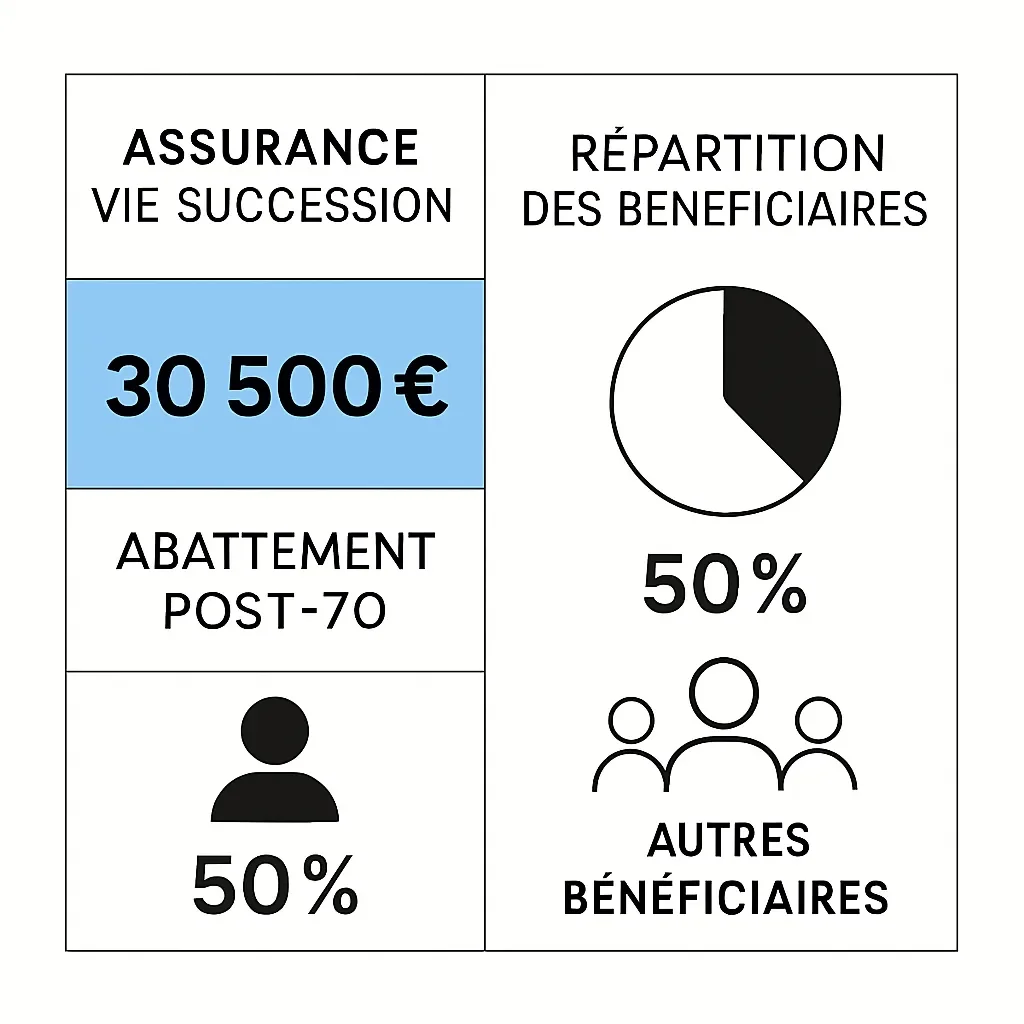
The mechanism is simple on paper, but less glamorous in real life: first, the premiums paid after 70 years are considered, the allowance is deducted, then the remainder is distributed among the beneficiaries according to what the clause provides. In other words, a well-drafted clause avoids major headaches at the time of death.
If you have multiple contracts, the insurer adds up the relevant premiums. If you have multiple beneficiaries, the logic follows their share as provided in the beneficiary clause. This is where vague wording can make you lose time, or even cause family tensions. And that’s definitely not what one seeks with life insurance.
The technical detail comes from the fact that the rules do not apply to the contract “as a whole,” but to the sums paid according to their date. This is what allows having a contract with payments before and after 70 years without mixing everything. You are not obliged to close the contract: you can simply change the payment strategy.
What happens with a contract with payments before and after 70 years?
The key rule is that the age at payment matters more than the age of the contract. A contract opened at 60 can very well receive premiums at 72; in this case, each “block” follows its own taxation. It’s more technical, but it also helps avoid interpretation errors at the time of inheritance.
Specifically, payments made before 70 years keep the regime of article 990 I, while payments made after 70 years fall under 757 B. Gains remain a separate point: they are not treated like premiums and do not undergo the same tax treatment. That’s why the same contract can mix two logics without becoming unreadable.
In practice, many families realize late that an “old” contract is not necessarily optimized. A real estate agent turned wealth advisor notes that clients aged 72 to 78 often keep the contract but stop automatic payments to avoid increasing future taxation.
The best reflex often consists of separating uses: keep the contract for its availability, but stop or reduce payments after 70 if the main goal is transmission. This is not an absolute rule, because a payment can still make sense to invest cash or smooth out wealth. But it must be done knowingly, not “out of habit.”
In practice, a well-managed contract also allows documenting the origin of payments. This is valuable when several beneficiaries are involved, or when there are multiple contracts opened at different dates. In other words, paperwork is not sexy, but it avoids headaches.
Which alternatives become more effective after 70 years old?
After 70 years old, life insurance is no longer necessarily the best tool if your absolute priority is optimized transmission. Other solutions may be more suitable depending on the desired goal: giving during one’s lifetime, transferring the bare ownership of a property, or using a retirement vehicle if the horizon remains long. It all depends on the yield/taxation/flexibility balance.
Here is the right reflex: compare the tools not “in theory,” but according to your real objective. If you want to transfer a targeted capital to a child, a donation may be more direct. If you want to keep the income while preparing the transmission, dismemberment is often more relevant. If you want to lock in less money, life insurance remains comfortable.
| Objective | Often relevant tool | Why |
|---|---|---|
| Transfer liquidity | Life insurance | Flexible beneficiary clause, available capital |
| Reduce taxable base | Donation / shared donation | Lifetime transfer, clear civil framework |
| Keep income | Dismemberment | Often keep the usufruct, prepare the future |
| Prepare long-term savings | PER (Retirement Savings Plan) | Interest mainly depending on age, income, and accepted lock-in |
The PER can remain attractive for certain profiles, but one must accept its more locked-in framework at withdrawal. The securities account offers freedom but no inheritance magic. Life insurance, on the other hand, continues to score points on flexibility. So it’s not a beauty contest: it’s a patrimonial trade-off.
By the way, if your financial assets are already well structured, it is often wiser not to “force” new payments into a post-70 contract solely for optimization. Better a well-calibrated tool than a large poorly thought-out contract. Good investments are rarely those fed by reflex.
After 70 years old, life insurance is no longer a tax turbo. But when well used, it remains a very good patrimonial Swiss army knife, provided you know what you are asking of it.
What mistakes should be avoided when keeping life insurance after 70 years old?
The first mistake is to confuse flexibility and optimization. Yes, the contract remains liquid. No, not all payments are treated the same way. The second mistake is a beneficiary clause drafted hastily, with too vague wording or forgotten beneficiaries. There, the inheritance can quickly become a little family headache.
Another classic trap: leaving several contracts opened at different dates without monitoring them. In theory, this is not forbidden. In practice, it complicates the tax reading and the distribution among beneficiaries. If you have old and recent contracts, it is better to keep a simple table: opening date, payment dates, objectives, and designated beneficiaries.
Finally, beware of the received idea that “after 70 years old, life insurance is useless.” That is false. It still serves to transfer liquidity, avoid certain civil rigidities, and keep control over one’s money. Simply, one must accept that the core advantage is no longer the same as before. This is an important nuance, and frankly, it changes everything.
In practical summary, life insurance after 70 years old often deserves to be kept, sometimes less funded, and very rarely managed randomly. If your objective is transmission, the right reflex is to arbitrate between life insurance, donation, and possible dismemberment, rather than relying on a single contract.
FAQ — Life insurance after 70 years old
Can you open a life insurance at 75 years old?
Yes, absolutely. Age does not prevent opening or subscribing. However, payments made after 70 years old fall under the regime of article 757 B, so the tax benefit is more limited than for a contract funded earlier.
Does the spouse or PACS partner pay inheritance tax?
No, within the general framework of life insurance and inheritance, the surviving spouse and PACS partner are exempt. This is one of the cases where the contract remains very effective, even after 70 years old.
Should all payments be stopped after age 70?
Not necessarily. If you need to keep a liquidity reserve or if you want to continue investing cash, it can still be relevant. However, for pure estate planning optimization, many estates benefit from slowing down or stopping payments.
Do old contracts opened before 1998 still have particular advantages?
Yes, some old contracts may retain interesting tax or technical features depending on their date and payments. The important point is to verify the exact timeline of the premiums, as the payment date remains decisive in the analysis.
Can multiple contracts be used to “multiply” the allowance?
No. The €30,500 allowance after age 70 is global, across all contracts combined. Therefore, multiplying contracts does not multiply the allowance, although it can sometimes simplify estate management or the distribution among beneficiaries.
Does redeeming the contract change the tax logic?
Yes, completely. A redemption follows a different logic than that of inheritance upon death. If your goal is to recover the funds during your lifetime, you need to study the tax treatment of redemption rather than that of inheritance.