
In brief
🧭 Managed life insurance is mainly suitable for savers who want to delegate rebalancing and maintain a long-term logic. It almost always relies on unit-linked funds, meaning no capital guarantee on this portion.
💸 The key point that changes everything is the total cost: contract fees, fund fees, and any additional management fees. An attractive mandate can lose much of its appeal if fees pile up.
🔁 Before signing, you need to check the minimum entry, the possibility to change profile, the presence of a real self-managed mode as an alternative, and the type of funds used: classic funds, ETFs, socially responsible investment (SRI), real estate, etc.
What is managed life insurance?
Yes, if you want to delegate rebalancing, your investment horizon exceeds five years, and you accept a share of unit-linked funds. No, if you are looking for capital guarantee, fine control of each line, or ultra-minimal fees savings.
Managed life insurance means entrusting the allocation of your contract to a professional or management company, who decides on your behalf the distribution among the funds. In practice, you fill out a questionnaire about your horizon, risk tolerance, and objectives, then the contract is oriented towards a conservative, balanced, or dynamic profile.
The mechanism is simple to understand, but it should not be mistaken for a magic wand. Most managed contracts rely mainly on unit-linked funds, i.e., funds that can go up or down. The AMF reminds that these funds do not guarantee capital, which is the crux of the matter.
In other words, managed life insurance does not eliminate risk: it orchestrates it. Unlike self-management, you do not choose each fund yourself. And unlike a simple recommendation, the rebalancing is actually executed according to the mandate defined at the start.
Who is managed life insurance really suitable for?
It is mainly suitable for busy savers, beginners, or those uncomfortable with markets, provided they accept controlled volatility. Conversely, a very autonomous investor, a fan of euro funds only, or highly sensitive to fees will often be better off looking elsewhere.
Managed life insurance is especially relevant for profiles who want to save time and avoid bad reflexes, like selling at the worst moment or staying inactive too long. It works particularly well if your horizon is long, your savings can absorb temporary shocks, and you accept delegating the mechanics.
| Profile | Suitability for managed investment | Point of caution |
|---|---|---|
| Beginner | Very good, as the framework is reassuring. | Do not confuse simplicity with absence of risk. |
| Young professional | Good if the horizon is 8 to 15 years. | Check that the contract does not overload fees. |
| Prudent saver | Possible if the profile remains moderate. | Look at the actual share of unit-linked investments. |
| ESG investor | Interesting if the offer includes responsible mandates. | Compare the fund selection method. |
| 100% euro fund saver | Low, unless the contract allows strong flexibility. | Managed investment often pushes towards more risk. |
| Autonomous investor | Low, as they lose control over choices. | Free management is often more coherent. |
In practice, it is observed that the most satisfied subscribers do not necessarily seek the best theoretical performance. A family who arrived in 2023 in a large city reports having chosen this management mode to avoid emotional reallocations, not to do homemade “stock-picking.” Psychological comfort counts as much as gross return.
Among the known market offers, Yomoni, Nalo, Goodvest, BoursoBank, Linxea, or Ramify are often found. Not all offer the same philosophy: some push ESG, others ETFs, others still a broader wealth logic. The icing on the cake, some platforms are designed for fairly beginner profiles, others for savers already comfortable.
How does managed investment work on a daily basis?
The operation generally relies on a fairly classic chain: questionnaire, risk profile, initial allocation, then automatic rebalancing. In short, you do not choose each asset individually. The management serves to maintain the planned trajectory, especially when markets move and the temptation to shake everything up becomes strong.
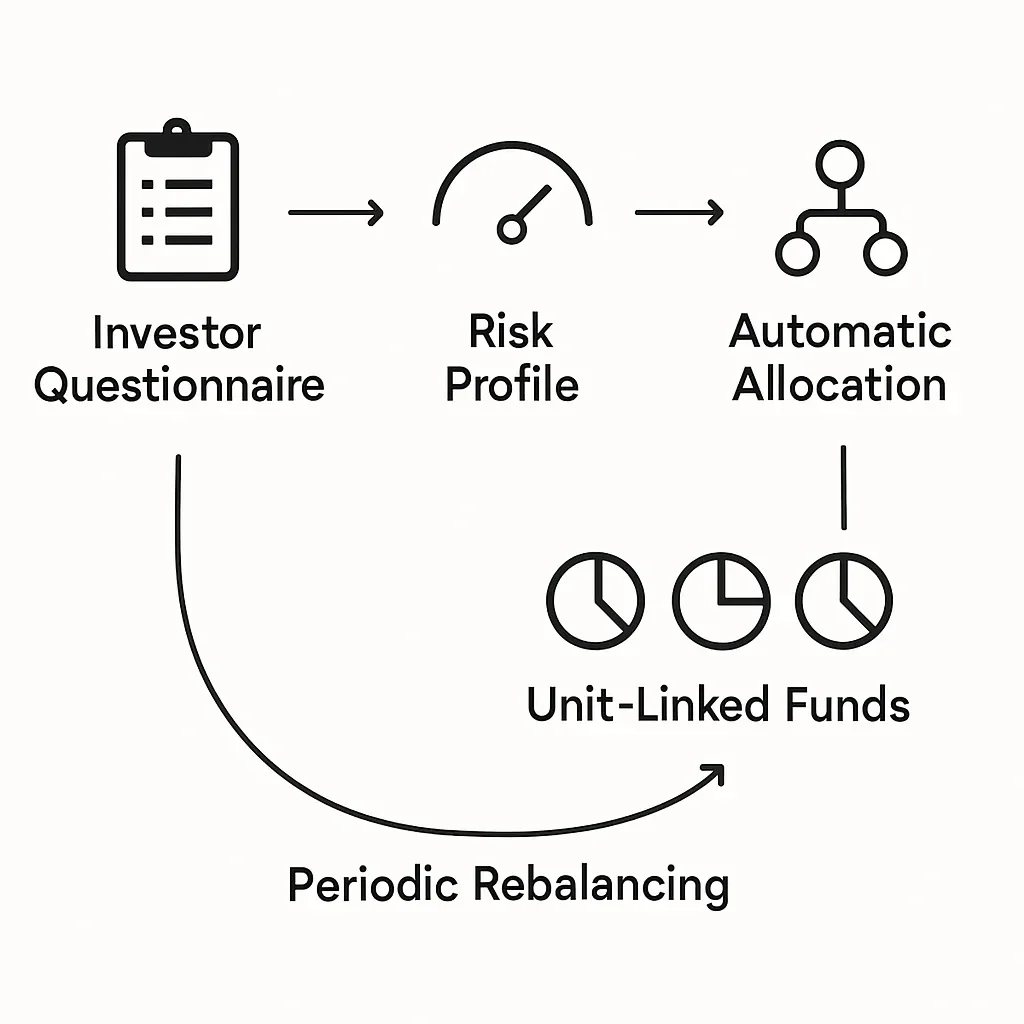
Generally, the contract starts by distinguishing at least three profiles: prudent, balanced, and dynamic. The more offensive the profile, the greater the share invested in volatile assets. Conversely, a prudent profile seeks to smooth variations, but it does not turn a life insurance into a guaranteed savings account.
Overall, the management also relies on regular rebalancing. If a segment takes too much weight, the manager can reduce it and strengthen other assets. This is useful to stay on course without intervening at every market twitch. But one must accept a simple point: management follows a method, it does not “guess” the market.
What this concretely changes for the saver
You delegate daily decisions, which reduces mental load. In exchange, you accept less control and sometimes a bit more fees. It is always appreciated not to handle reallocations yourself, but it only makes sense if the contract really matches your horizon and risk tolerance.
It is often observed that users misunderstand the difference between “automatic” and “unsupervised.” An independent agent notes that many subscribers no longer look at their contract after signing, whereas an annual check remains useful to verify the profile, fees, and coherence of assets.
What fees should you look at before signing?
The real issue is not just the displayed return, but the net return after fees. Managed management can be interesting if the quality of selection and management discipline offset the additional cost. Otherwise, the gap ends up eating into the result, especially over 10 or 15 years.
So you need to read the bill in three layers: contract fees, support fees, and managed management fees. Some contracts advertise “no surcharge” management as a marketing claim, but fees can appear elsewhere, in the supports used or in the contract structure. That’s why a headline price is not enough.
The most useful approach is to think in terms of total annual cost, not just an isolated percentage. A contract with low management fees but invested in expensive supports may be less competitive than a more transparent offer with low-cost ETFs. In other words, you have to compare the whole soup, not just the spoon.
Good to know: after 8 years, the taxation of life insurance remains one of the major advantages of the product, whether the contract is free or managed. This point alone does not justify choosing managed management, but it reinforces the interest of a long-term horizon rather than a short-term logic.
Should you choose managed management or self-directed management?
Managed management focuses on comfort and delegation; self-directed management focuses on control and customization. The right choice depends less on a “better” management mode than on your ability to decide, your available time, and the level of risk you can bear without panicking.
| Management mode | Main advantage | Main limitation |
|---|---|---|
| Managed management | Simple, automatic, reassuring. | Less control, sometimes higher fees. |
| Self-directed management | Total control, fine customization. | Requires time and knowledge. |
| Advised management | Recommendations without full delegation. | You still have to decide yourself. |
The distinction with advised management is worth noting because it is often misunderstood. In advised management, you are guided but keep control. In managed management, you truly delegate. This is not a vocabulary detail, it is a difference in responsibility and comfort.
The real question is not “managed or not”, but “managed at what cost, for what horizon, and with what level of risk”. Without these three reference points, you are mostly buying comfort, not a strategy.
For very autonomous profiles, self-directed management often retains the advantage. For savers who want to avoid mental overload, managed management takes precedence. Between the two, advised management can be a good compromise, especially if you like to understand without wanting to spend your weekends arbitrating your contract.
How to choose a contract without making a mistake?
Start by checking what the offer really allows: minimum amount, range of supports, frequency of arbitrations, possibility to change profile and, above all, fee transparency. A contract attractive on the poster but rigid in practice quickly loses much of its appeal.
- The entry ticket: some contracts start around €300 to €1,000, others require more depending on the insurer and the level of service.
- Flexibility: can you switch from cautious to dynamic, then go back without any blockage?
- The investment options: ETFs, equity funds, real estate, socially responsible investment, defensive funds… the universe matters as much as the profile.
- The level of management: monthly or quarterly rebalancing, triggering according to thresholds, crisis management method.
- The exit: can you easily switch to self-management if you change your mind?
In the clearest offers, such as those seen with some online providers, the logic is often designed for savers who want a simple and relatively smooth experience. Other contracts, more bank-oriented, are sometimes less flexible, with a “black box” effect that can become annoying after a few months.
It is therefore useful to ask a very concrete question: am I paying for a real management service, or just for an additional layer of complexity? If the answer is not clear, it is better to compare two or three contracts before signing.
To check the regulatory and tax basics, you can also consult the Service-Public.fr fact sheet on life insurance and the AMF page dedicated to life insurance. These references help avoid confusing commercial talk with actual rules.
FAQ on managed life insurance
Can you change profile during the contract?
Yes, in many offers, but not always instantly or for free. Changing profile may require a processing delay or approval from the subscriber. This point should be checked before opening the contract, especially if your personal situation is likely to change quickly.
Is managed life insurance compatible with a portion of euro funds?
Often yes, but the proportion varies depending on the contracts. Some mandates keep a portion of euro funds to cushion shocks, others are more oriented towards unit-linked funds. The right approach is to look at the target allocation, not just the profile name.
What investment horizon should be targeted?
Managed life insurance makes the most sense over a horizon of at least 5 years, and often rather 8 to 10 years if the share in unit-linked funds is significant. Over too short a period, the risk of encountering a bad market sequence increases significantly.
Does managed life insurance offer better protection during downturns?
It can smooth decisions and reduce emotional reactions, but it does not fully protect against market declines. If the portfolio contains many stocks or aggressive unit-linked funds, the contract’s value can drop sharply. Protection mainly depends on the chosen profile.
Is it useful if I mainly want to prepare for inheritance?
Yes, if you are looking for a contract that is simple to monitor over time. However, inheritance primarily depends on the beneficiary clause and the contract structure, not on the management mode. Managed management can facilitate monitoring, but it does not replace thorough estate planning.
Can you be in managed life insurance and remain very cautious?
You can aim for a cautious profile, but “cautious” does not mean “risk-free”. Depending on the contracts, the portion remains exposed to assets that fluctuate daily. If your goal is solely to preserve nominal capital, managed life insurance is not always the most coherent tool.