🔎 Martinique transitioned from an Amerindian world to a colonial society based on plantations, then to a French territory with a strong personality.
📍 The island covers 1128 km² and had 360,749 inhabitants in 2021, with terrain dominated by Mount Pelée.
🧭 Since 2015, Martinique has been a single territorial collectivity and an outermost region of the European Union.
🌍 The historical analysis of Martinique and its contemporary challenges highlights the links between the memory of slavery, Creole identity, and environmental vulnerability.
How did the first inhabitants shape Martinique?
The first settlements did not merely precede French colonization: they gave Martinique its initial human geography before being almost erased by European conquest. Amerindian history of Martinique reminds us that an island can bear several layers of civilization, even when some have been abruptly interrupted.
Societies prior to 1635, long underestimated
Before the arrival of the French in 1635, Martinique had already experienced Amerindian settlements, population movements, and upheavals linked to an ancient volcanic episode. Available evidence indicates that an eruption around 295 AD may have decimated or dispersed local groups, then Arawak populations likely returned around 400, followed by so-called Carib populations around 600.
This historical depth changes the reading of the island: Martinique was not born with colonization; it was reconfigured by it. The first communities therefore play an essential role in understanding the territory, its spatial uses, and the subsequent erasure of memory.
Martinique is not understood as a simple colonized island, but as a territory where Amerindian, slavery, and postcolonial layers still overlap.
To remember. Martinique’s history begins before 1635. Colonization accelerated the erasure of the first inhabitants without eliminating their place in historical memory.
How did French colonization reorganize the island?
French colonization transformed Martinique into a space of production, social control, and racial hierarchies. In a few decades, the island went from a contested territory to a colony structured around plantations, which permanently shaped its economy, landscapes, and inequalities.
1635: the political and economic shift
From 1635, the French presence established a new logic of land appropriation and domination of the populations. The available summary information also shows that from the 1670s, a massive deportation of African black slaves profoundly changed the demographic composition of the island.
This shift is not only demographic. It imposes an economic model based on export, land concentration, and forced labor, which still explains part of the debates on land, memory, and social justice today.
The major stages of a colonial transformation
Colonial settlement: taking control of the territory and marginalizing the first inhabitants.
Plantation economy: development of agricultural activities aimed at export.
Mass slavery: formation of an unequal and racially hierarchical society.
Enduring legacy: birth of a mixed society, but marked by persistent domination relationships.
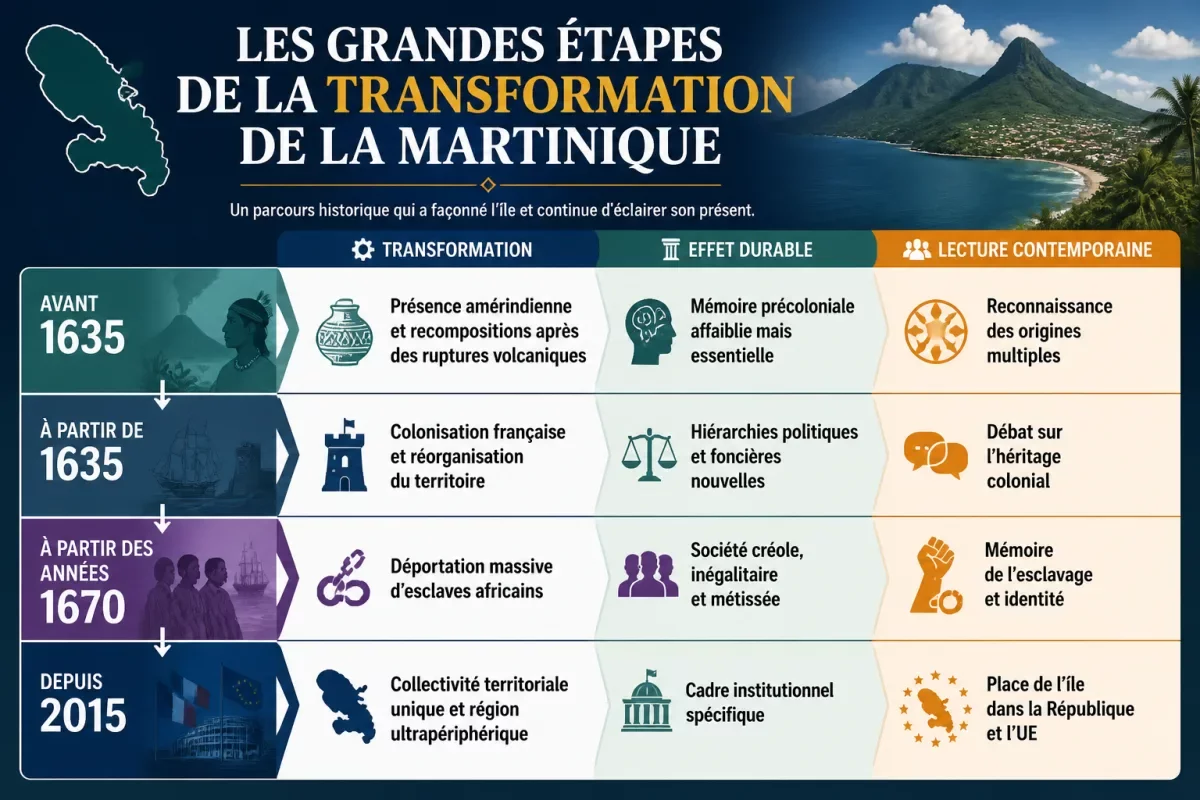
Period
Major transformation
Lasting effect
Contemporary interpretation
Before 1635
Amerindian presence and recompositions after volcanic disruptions
Weakened but essential precolonial memory
Recognition of multiple origins
From 1635
French colonization and territorial reorganization
New political and land hierarchies
Debate on colonial heritage
From the 1670s
Mass deportation of African slaves
Creole society, unequal and mixed
Memory of slavery and identity
Since 2015
Single territorial collectivity and ultra-peripheral region
Specific institutional framework
Place of the island in the Republic and the EU
The sugar economy did not only produce wealth: it created a socially enduringly unequal structure.
For a historical and geographical framing summary, one can cross-reference the article History of Martinique and the educational page of the MNHN, which also recalls the importance of natural environments in the island’s history.
To remember. French colonization imposed a plantation model. The economy, society, and memory of Martinique still bear the imprint of this reorganization.
Why does slavery still structure Martinican society?
Slavery in Martinique was an economic, social, and political system, not just a past episode. Its effects are still visible in relationships to land, family memory, inequalities, and the way Martinican society thinks about its own history.
A mixed society, but forged by constraint
The available historical facts indicate that slavery contributed to shaping a mixed and highly unequal Martinican society. This dual reality is central: Caribbean culture was built in mixing, but under the constraint of a colonial order based on violence, dispossession, and hierarchy.
Understanding this tension is essential to read current debates on representation, schooling, culture, Martinican heritage, and historical figures of Martinique. The memory of slavery is not only about commemorative past; it continues to influence contemporary identities and claims.
Memory: family and cultural transmission preserves traces of colonial violence.
Inequalities: the legacies of the plantation have left lasting imbalances.
Identity: Creole culture asserted itself through hybridity and resistance.
Heritage: places of memory structure the historical reading of the island.
To remember. Slavery is not just a thing of the past. It continues to shape memories, identities, and many social debates in Martinique.
How have abolition and memory redefined Martinican identity?
The abolition of slavery marks a major break, but it neither erases inherited inequalities nor the need to rebuild a collective memory. In Martinique, the challenge is not only to celebrate the end of a system: it is also to understand what survived its disappearance.
From legal rupture to social reconstruction
Abolition opens a new era, without immediately erasing inherited structures. Martinican society must then deal with a strong continuity of social relations, while developing forms of expression, culture, and claims that still nourish public life today.
It is also during this long period that cultural and political references specific to Martinique are consolidated: languages, artistic practices, popular memory, and the affirmation of a French territory with a strong personality. This trajectory helps to understand why the Caribbean archipelago can never be reduced to a strictly administrative reading.
To remember. Abolition is a foundational step, but not an endpoint. Social and memorial reconstruction remains at the heart of Martinican history.
What contemporary issues does the history of Martinique help to understand?
The history of Martinique sheds light on three current challenges: the memory of an unequal colonial past, the island’s place within the French Republic and the European Union, and the vulnerability of a tropical territory exposed to natural risks. The historical analysis of Martinique and its contemporary issues therefore links identity, politics, and environment.
A small island in size, but central due to its vulnerabilities
Martinique is an island of 1128 km² and 360,749 inhabitants in 2021. Its topography is divided between a mountainous and forested north and a south of drier hills and small plains, while its climate is humid tropical, with an average temperature of 26 °C and two main seasons.
These characteristics are not merely descriptive: they explain the island’s sensitivity to earthquakes, tsunamis, volcanic eruptions, and climatic hazards. Martinique’s history is therefore also a history of resilience in the face of a demanding environment.
A specific political status to be understood over time
Since 2015, Martinique has been a single territorial collectivity and an outermost region of the European Union. This status reflects a particular political history: the island has chosen a form of strong institutional integration while maintaining its own historical, cultural, and social identity.
Memory: society still debates its colonial and slavery origins.
Politics: the institutional status must reconcile local proximity and the republican framework.
Environment: natural risks require a culture of permanent prevention.
Culture: Caribbean culture remains a lever for identity affirmation.
To remember. Martinique’s contemporary challenges cannot be explained without its history. The colonial past, the memory of slavery, and natural risks remain decisive.
Martinique has an Amerindian history prior to French colonization.
The colonization of 1635 permanently reorganized the island around plantations.
African slavery shaped a mixed but deeply unequal society.
Mount Pelée illustrates the power of natural risks in local history.
The status of single territorial collectivity strengthens the island’s political uniqueness.
The historical analysis of Martinique and its contemporary issues links memory, identity, and development.
Conclusion
Reading Martinique through its history means accepting an obvious truth: the island is not just a Caribbean backdrop, but a territory where colonization, slavery, abolition, natural disasters, and political construction have produced a unique identity. This historical analysis of Martinique and its contemporary issues helps to understand why memory remains vivid and why the present is still shaped by the past.
Key Takeaways
🔹 Martinique is understood through its Amerindian, colonial, and postcolonial layers.
🔸 Slavery has left lasting social, cultural, and memorial legacies.
🟢 Natural risks are an integral part of the island’s history and future.
🟣 The current institutional status reflects a unique political trajectory.
🟠 Caribbean culture connects heritage, identity, and contemporary debates.
FAQ
Why is the history of Martinique inseparable from colonization?
Because French colonization redefined the territory, economy, and population of the island starting in 1635. It imposed a plantation logic that durably structured social relations and landscapes.
What role did slavery play in Martinican society?
Slavery was the core of the colonial system for several generations. It produced a Creole society, but also a social and racial hierarchy whose effects remain visible in memories and contemporary debates.
Why is Mount Pelée so important in the history of Martinique?
Because it embodies the volcanic vulnerability of the island. Its 1902 eruption destroyed Saint-Pierre and caused a major human catastrophe, becoming a central landmark of Martinican memory.
What does the status of a single territorial collectivity mean?
This status, in effect since 2015, groups institutional competences within a specific framework. It reflects the desire to adapt Martinique’s political organization to its history and local realities.
How is the historical analysis of Martinique and its contemporary issues useful today?
It allows connecting the colonial past, the memory of slavery, cultural identities, and environmental challenges. It is the best way to understand what still structures current Martinican society.