
Right to be forgotten in borrower insurance: conditions, timeframe, and procedures
The right to be forgotten in borrower insurance still prevents, today, an old cancer or hepatitis C from resurfacing when applying for a loan. And this detail changes everything: less paperwork, less stress, and sometimes no surcharge at all. The question remains when you are entitled to it, what must be declared, and how to proceed without mistakes.
The topic seems simple on paper, but it often gets stuck on three very concrete points: the end date of the therapeutic protocol, the absence of relapse, and the type of loan concerned. Joking aside, this is often where the cases are decided. In other words, a good legal reference can save you a lot of time when signing.
Sommaire
In brief
🧭 The right to be forgotten mainly concerns former cancers and hepatitis C, subject to a specific timeframe and absence of relapse.
⏳ Since the Lemoine law, the reference period has been reduced to 5 years after the end of the therapeutic protocol, compared to 10 years previously.
📝 For certain real estate and professional loans, the health questionnaire may disappear if the insured amount does not exceed €200,000 per person and if the term occurs before 60 years old.
🔎 The sensitive point remains the end date of the protocol: it is this that serves as the basis, not the last follow-up consultation.
Which illnesses qualify for the right to be forgotten in borrower insurance?
The right to be forgotten in borrower insurance mainly targets former cancers and hepatitis C. If the therapeutic protocol has been completed for 5 years, without relapse, the insured no longer has to declare this medical history for the loan concerned.
In practice, the scheme does not cover all illnesses, far from it. It is a targeted protection, designed to prevent an old medical history from jeopardizing a real estate or professional project. The logic is simple: a cured pathology should not be used as a pretext for a surcharge, a guarantee exclusion, or a flat refusal.
The official framework is detailed by the AERAS convention, whose page dedicated to the right to be forgotten remains the best basis to check the covered cases. And if your situation falls outside the scope of the right to be forgotten, the AERAS reference grid can still regulate pricing or exclusions. It’s not the same lever, but it can make a real difference.
What are the exact conditions to benefit from it?
In practice, the right to be forgotten depends on three checks: the illness must fall within the defined scope, the therapeutic protocol must have been completed for 5 years, and there must have been no relapse. Add the condition that the contract expires before 71 years old, and you have the core of the mechanism.
The detail that matters is the end of the therapeutic protocol, not the general impression of “return to normal.” This nuance changes everything, especially when follow-up exams continue after the end of treatment. The Ministry of Health also recalled the reduction of the timeframe in its 2022 press release on the right to be forgotten.
| Situation | Rule to remember | Declaration? | Point of caution |
|---|---|---|---|
| Cancer | 5 years after the end of the protocol | No, if the period is met | Check for absence of relapse |
| Hepatitis C | 5 years after the end of the protocol | No, if conditions are met | Keep proof of treatment completion |
| Insurance contract | Expiry before age 71 | Yes, if the form requests it outside the scope | Reread the notice and the coverage table |
| Other diseases | AERAS reference grid | Often yes | Pricing may be regulated, not eliminated |
- The period starts from the end of the therapeutic protocol, not from the last follow-up visit.
- A relapse cancels the benefit of the scheme, since the absence of recurrence is no longer met.
- The AERAS grid remains useful when the pathology does not qualify for the right to be forgotten.
The real trap is not forgetting, it is the wrong start date. Once this point is locked, the file becomes much easier to defend.
Does the right to be forgotten replace the health questionnaire?
No, and this is where many get confused. The right to be forgotten removes the obligation to declare a medical history after the prescribed period; the removal of the health questionnaire, on the other hand, is another mechanism, broader on paper but limited to certain loans. These are two different protections, which can be combined but are not the same.
Since the Lemoine law, the health questionnaire can disappear for certain real estate and professional loans when the amount insured per person does not exceed €200,000 and the contract term ends before age 60. Above these thresholds, the insurer can continue to ask questions. In other words, the right to be forgotten affects the content of the declaration, while the Lemoine law sometimes affects the very existence of the questionnaire.
How to make your request without mistakes?
The safest is to prepare three reference points: the end date of the protocol, the presence or absence of a relapse, and the loan signing date. With these elements, you limit the risk of error and false declaration.
Practically, a good file often consists of two or three well-chosen supporting documents. No need to overdo it, but you must be rigorous: a wrong date can tip the file to the right side… or trigger a request for a surcharge. Cherry on the cake, a clear document often saves time for everyone.
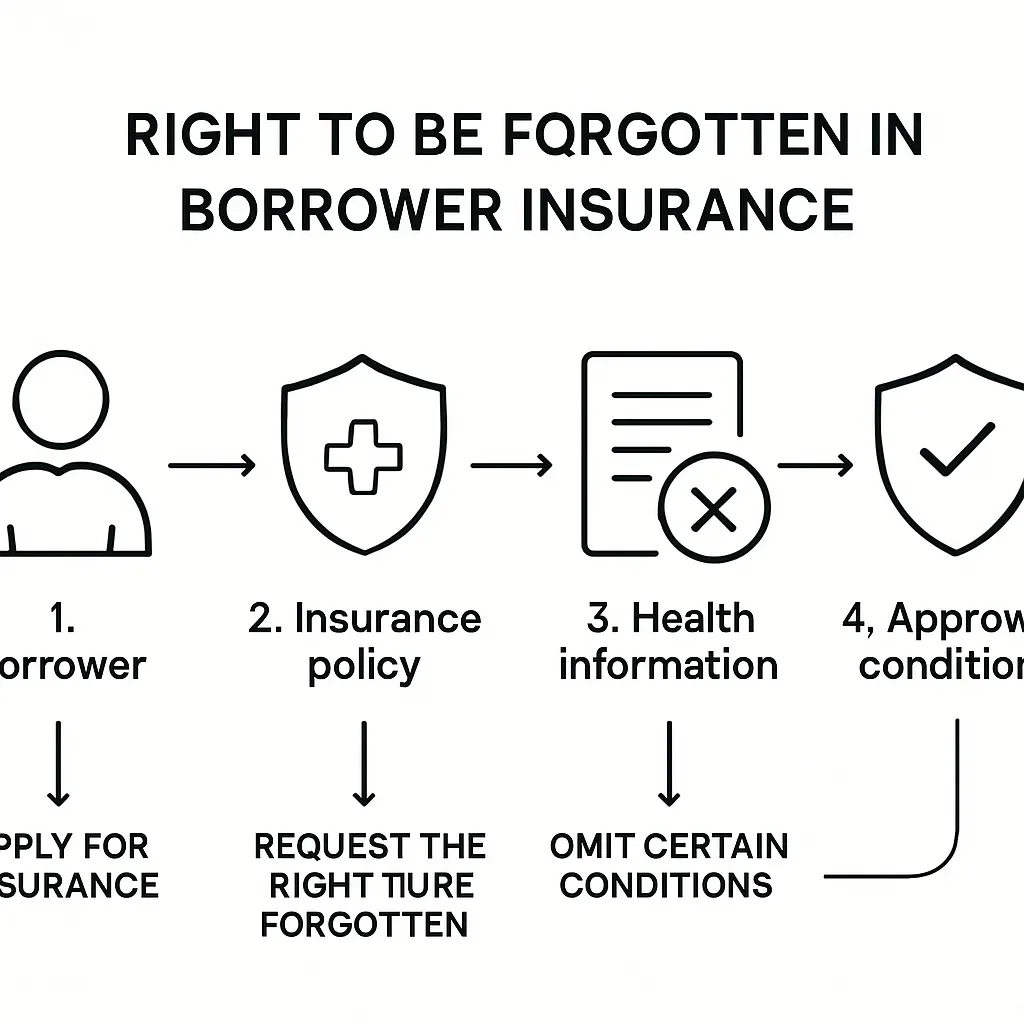
- Note the exact date of the end of the therapeutic protocol, ideally with a hospital document or medical certificate.
- Verify the absence of relapse or new treatment related to the same pathology.
- Check the loan: amount insured per person, type of credit, and contract end age.
- Answer only the questions asked, without adding irrelevant medical information.
- Keep a copy of all exchanges, especially if the bank or insurer requests further clarification.
In practice, files rarely get blocked on the principle of the right to be forgotten, but almost always on the end date of the protocol. One family reported that a simple certificate of treatment completion was enough to end the discussion about the surcharge. The right reflex is therefore to align the dates before sending the form.
What to do if the bank or insurer disputes?
If the bank or insurer disputes, you must first request the written basis for the refusal. In many cases, the blockage comes from an overly cautious reading of the questionnaire or a misinterpretation of the deadline. It is therefore better to verify the disputed point in black and white, then calmly resume the discussion with the texts in hand.
Next, compare the refusal to the AERAS agreement and your medical timeline. If the conditions are met, you can request a review of the file, then escalate to the complaints department if necessary. It is always appreciated to maintain a firm but polite tone: there is no need to antagonize everyone to assert your rights.
- Request a written motivated refusal.
- Review the end date of the protocol and supporting documents.
- Recall the framework of the right to be forgotten and, if needed, the logic of AERAS.
- In case of persistent blockage, use the insurer’s or bank’s complaints service.
- Keep all records: emails, letters, acknowledgments of receipt, and the version of the completed questionnaire.
If the file remains disputed despite everything, the official AERAS page and the Ministry of Health’s statement provide useful support points because they clearly recall the spirit of the system: to prevent an old medical history from obstructing access to credit.
FAQ on the right to be forgotten in borrower insurance
Does the right to be forgotten apply if I had cancer before age 21?
The determining factor remains the end of the therapeutic protocol and the absence of relapse, not the age when you review the questionnaire. Age may matter in other AERAS mechanisms, but for the right to be forgotten, it is mainly the 5-year period that serves as a reference.
Is hepatitis C still covered by the system?
Yes, hepatitis C is among the pathologies classically targeted by the right to be forgotten, provided that the protocol ended 5 years ago and there has been no relapse. In practice, it is better to keep proof of treatment completion, as this is often the document that unlocks the file.
What happens if I have a relapse before the end of the 5 years?
The condition of no relapse is no longer met, so the right to be forgotten does not apply. The insurer can then re-examine the file according to the usual rules, or even according to the AERAS grid if your situation fits. This is not necessarily a refusal, but it is no longer an automatic erasure.
Can I benefit from the system for a loan exceeding €200,000?
The right to be forgotten can still be useful, but the removal of the health questionnaire generally does not apply beyond the limits of the Lemoine law. If the insured amount exceeds €200,000 per person, the insurer can therefore continue to request medical information.
Do I have to provide a certificate of cure?
Not necessarily. Most often, what matters is proof of the end date of the protocol or an equivalent medical document. The idea is not to recount the whole story, just to prove that the legal delay has indeed passed and that the situation falls within the system.
If I change insurance during the loan, do I have to start all over?
No, but the new company will apply its own forms within the regulatory framework in force. The right to be forgotten remains enforceable if the conditions are met at the time of subscription or insurance change. So keep your supporting documents; they are still useful.