
Insurance for NAC (rabbit, ferret, reptile): what coverage, exclusions, and rates in 2026?
A NAC insurance is judged less by its monthly price than by what it covers at the first real problem. For a rabbit, a ferret, or a reptile, the bill can quickly exceed a simple visit: a specialized veterinary consultation often costs 40 to 80 €, ferret surgery can reach 300 to 600 €, and only 6 to 8 insurers actually offer suitable contracts in France. In this context, the right contract is not the most flattering on paper, but the one that remains useful when the animal really needs care.
Sommaire
In brief
🐾 More than 5 million NACs live in French households: the need for coverage is no trivial matter.
💶 The premium often ranges between 8 € and 30 € per month, with an observed average of 14.80 €.
⏳ Waiting periods can range from 0 to 60 days, which completely changes the contract’s short-term value.
🧾 The real issue is not only reimbursement, but also annual limits, exclusions, and the maximum subscription age.
Why does NAC insurance really make a difference?
Because a NAC is inexpensive to buy but can be very costly to care for. Insurance mainly serves to smooth the financial shock of an emergency, hospitalization, or surgical procedure. It becomes relevant as soon as you want to avoid a several-hundred-euro expense forcing you to make urgent compromises.
The market is also narrower than one might think. NACs do not form a homogeneous group: rabbits, ferrets, reptiles, birds, rodents, and amphibians do not have the same risks, veterinary needs, or subscription constraints. This is precisely why a standard “pet” contract often poorly fits the reality on the ground.
The right contract is not the one that promises the most, but the one that reimburses when the bill becomes hard to absorb.
In other words, the useful question is not “how much does insurance cost?”, but “how much will I really have to pay the day my NAC needs heavy care?”. This is where limits, deductibles, and exclusions take on their full meaning.
What coverage really protects a rabbit, ferret, or reptile?
The basis of a useful NAC insurance rests on three pillars: veterinary consultations, emergency care, and hospitalization. If these items are well covered, you protect the essentials. Then, the contract can gain interest with surgical procedures, broader coverage of illnesses, and, in some offers, complementary guarantees such as liability insurance.
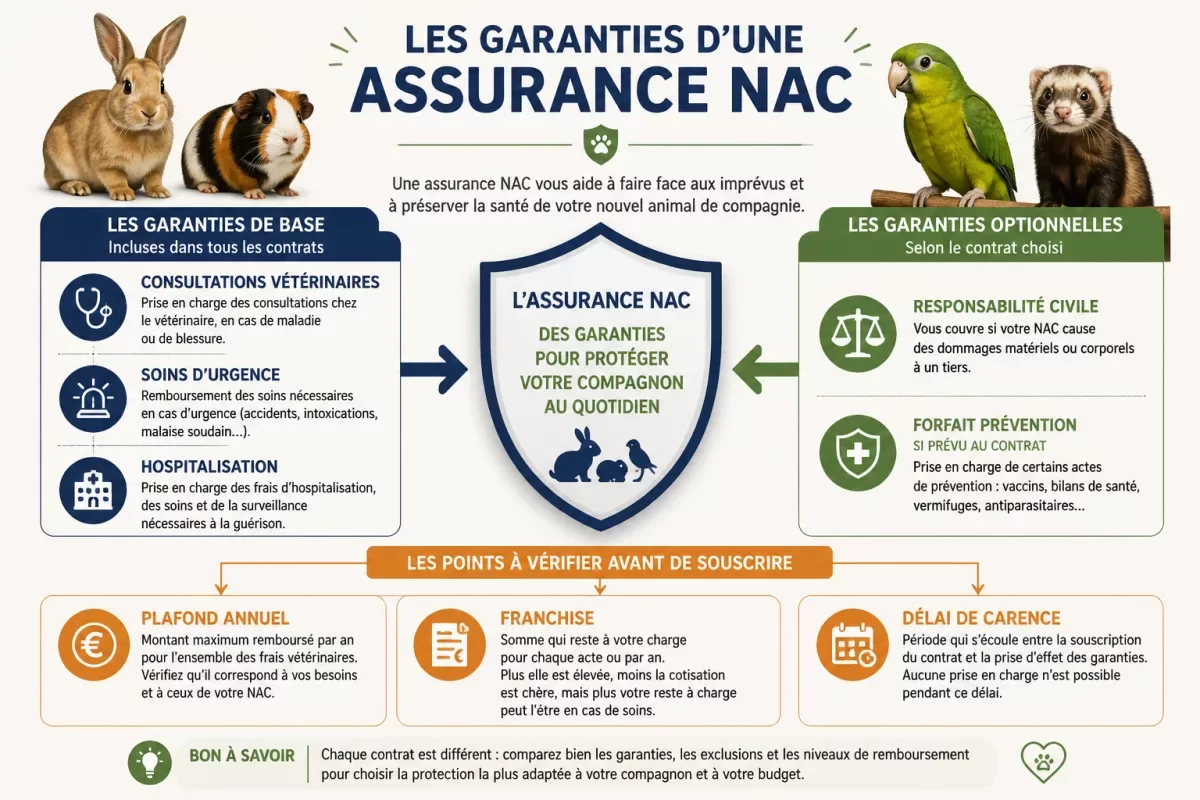
To quickly compare coverages, you need to distinguish what is actually reimbursed from what is only a marketing argument. A solid offer is not limited to an attractive reimbursement rate: it specifies the scope of care, the annual limit, any deductible, and the waiting period before coverage activates.
- Specialized consultations: useful from the first symptom or for follow-up.
- Emergencies: essential if the animal’s condition deteriorates quickly.
- Hospitalization: often decisive for high bills.
- Surgery: to watch closely, as this is where the budget explodes.
- Liability insurance: interesting if the contract truly includes it, especially for certain animal profiles.
| Expense item | 2026 benchmark | What this changes for your contract |
|---|---|---|
| Exotic pet veterinary consultation | 40 to 80 € | Even a simple visit can justify active coverage. |
| Ferret surgery | 300 to 600 € | The contract must absorb a real spending peak, not just minor treatments. |
| Treatment of digestive stasis in rabbits | 200 to 500 € | The annual ceiling becomes a major criterion, especially if the animal has digestive fragilities. |
| Abscess surgery in a reptile | 200 to 600 € | It is necessary to verify coverage of major procedures and associated hospitalizations. |
| Exotic pet insurance premium | 8 to 30 € per month, average 14.80 € | The premium remains moderate if the coverage truly meets the needs. |
For exotic pets, a low monthly price can hide a ceiling that is too low or a deductible that neutralizes the benefit of the plan.
The right approach is therefore to start from the most costly possible treatments, not the most attractive reimbursements. If your contract only covers consultations, it will poorly protect you against truly penalizing expenses: surgery, hospitalization, or prolonged emergency care.
Which exclusions should be read before subscribing?
Exclusions often make the difference between truly useful insurance and theoretical coverage. The most important thing is to check what is not covered from the outset, because a contract can seem comprehensive while precisely excluding the items that cost the most for an exotic pet.
Exclusions must be read line by line, without settling for the marketing summary. A waiting period of 0 to 60 days can, for example, delay the contract’s effective start, and an animal that is too old may fall outside the subscription window, often between 3 and 7 years depending on the species.
- Pre-existing conditions before subscription.
- Waiting periods during which no reimbursement is possible.
- Annual ceilings too low for major procedures.
- Deductibles that greatly reduce the benefit of small claims.
- Preventive care not included if not integrated into a specific package.
- Subscription age limit exceeded.
For exotic pets, the sensitive point is often the gap between the animal’s real needs and the displayed coverage. A rabbit may require costly digestive care, a ferret may undergo an expensive intervention, and a reptile may require rapid care. If these cases are not clearly included in the guarantees, the contract loses its appeal.
How much does exotic pet insurance cost in 2026?
In 2026, the cost of exotic pet insurance generally remains contained, but it varies according to species, age, and level of coverage. A common range of 8 to 30 € per month is observed, with an average price around 14.80 €. For a rabbit or a ferret, an intermediate plan may be around 20 € per month.
| Financial benchmark | Observed amount | Practical reading |
|---|---|---|
| Exotic pet insurance, market average | 14.80 € / month | Break-even point to compare offers without focusing solely on price. |
| Common range | 8 to 30 € / month | The price varies greatly depending on species and included guarantees. |
| Intermediate plan for rabbit or ferret | About 20 € / month | A good benchmark to judge an offer that is neither too basic nor oversized. |
| Exotic pet veterinary consultation | 40 to 80 € | A single visit can represent several months of premium. |
The key point is simple: a low premium is only interesting if the coverage follows. Conversely, a more expensive plan can be very cost-effective if it raises the annual limit, reduces out-of-pocket expenses, and covers major procedures. Reading the contract should therefore take precedence over the commercial promise.
How to choose a contract truly suited to your pet?
The right choice depends first on the profile of your exotic pet, then on your ability to anticipate likely care. A relevant contract for a rabbit is not necessarily the best for a ferret or a reptile. You need to cross-reference the risk level, the animal’s age, and how quickly expenses can escalate.

Before signing, keep a very simple logic: you pay to transfer a concrete risk, not to collect options. If you don’t know whether a coverage item is included, or if the waiting period sidelines you during the first weeks, the offer should be dismissed.
- Check the annual limit before the reimbursement rate.
- Compare waiting periods to avoid an unpleasant surprise at the start.
- Look at the age limit if your animal is no longer young.
- Ask for the list of exclusions for diseases and major procedures.
- Check for the presence of a deductible which can reduce the actual gain.
The market being limited, it’s better to compare few offers but read them well. It is often here that the difference lies between insurance that secures your budget and insurance that just gives an impression of protection.
To remember
- 🔎 Good exotic pet insurance primarily covers major care, not just routine visits.
- 💶 The cost remains moderate, but limits and deductibles make all the difference.
- ⏳ A long waiting period can neutralize the contract’s benefit at the worst time.
- 🐇 Rabbit, ferret, and reptile do not have the same needs, so not the same ideal contract.
- 🧾 The subscription age limit must be checked before any decision.
FAQ
Does exotic pet insurance cover a pre-existing illness?
Generally, no. Conditions existing before subscription are often excluded, which is logical to avoid a contract being used to cover a known problem. This is precisely why you must subscribe before the first symptoms or major exams.
Is it more expensive to insure a reptile than a rabbit?
The price depends mainly on the species, the coverage, and the risk level chosen by the insurer. What really changes is often how the contract handles major procedures, hospitalizations, and specific exclusions. So you need to compare useful coverage, not just the price.
What is the difference between deductible and annual limit?
The deductible is the part that remains your responsibility for each claim or each year depending on the contract. The annual limit corresponds to the maximum amount the insurer reimburses over twelve months. A limit that is too low can make a plan almost useless on a large bill.
Should a ferret be insured as a priority?
Yes, if you want to limit the financial risk related to surgery or an emergency. A procedure on a ferret can cost €300 to €600, which quickly justifies well-structured coverage. The real issue remains the quality of the guarantees more than the premium level.