
In Brief
📌 In shared housing, the dwelling must be insured at least against rental risks: fire, explosion, and water damage. This is the baseline the owner has the right to expect.
🧾 With a single lease, a common contract is often the simplest. With frequent arrivals and departures, individual contracts can avoid many headaches.
🔎 The point that most often causes trouble is not the price: it’s the updating of the contract when a roommate leaves or arrives. One oversight, and the coverage becomes shaky.
💡 The basic rules are recalled by Service-Public.fr and by the practical sheets of the ANIL, two useful references before signing.
Who Should Get Insured in Shared Housing?
In shared housing, at least one home insurance contract must cover the dwelling. The simplest is that one roommate subscribes for all, provided that everyone is properly declared on the lease or on the contract. With separate leases, each occupant often must insure their own room and their liability.
The fundamental rule comes from law no. 89-462 of July 6, 1989: the tenant must be insured for rental risks. In shared housing, this does not mean that everyone must necessarily have a separate contract. It mainly means that no one should remain without coverage when the lease starts, and then through renewals.
Depending on the housing configuration, the answer changes slightly:
- Single lease: a common contract can cover all roommates, if their names are correctly listed in the file.
- Separate leases: each roommate insures their private space and, depending on the contract, their share of the common areas.
- “Main” roommate: one person can sometimes sign for the whole group, but it must be verified that the contract properly mentions all occupants.
The important detail is liability. In case of a claim, the insurer looks at the contract, declarations, and the link with the lease. If an occupant is neither declared nor covered, the coverage can become partial or even contested. In other words, shared housing likes arrangements… until the first incident.
How to Choose Between a Common Contract and Individual Contracts?
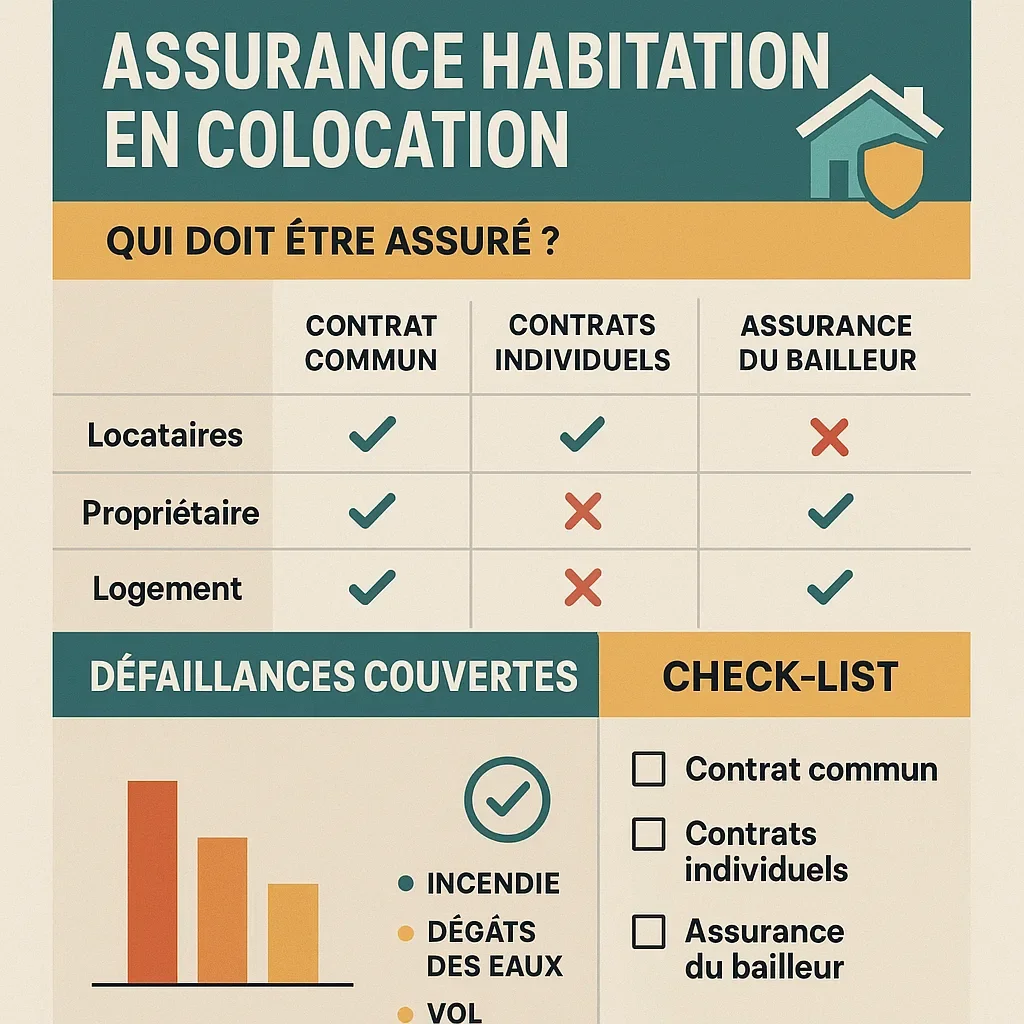
The common contract is practical for a single lease and roommates who change little. Individual contracts are more flexible if arrivals and departures are frequent. The right choice mainly depends on the lease, budget, and how the landlord accepts to receive certificates.
The choice mainly depends on the stability of the group and on how the lease is written. If you live four in an apartment with a single lease, one contract may suffice and simplify everyone’s life. Conversely, in a house with regular rotations, several individual contracts may be clearer, even if they require a bit more administrative follow-up.
| Option | Advantages | Limits |
|---|---|---|
| Joint contract | Easy to manage, often more economical, only one certificate to track | Requires diligence when a roommate leaves the accommodation |
| Individual contracts | Flexibility in case of turnover, each manages their share | Multiple certificates, more coordination needed |
| Insurance taken out by the landlord | Avoids lack of coverage at the start | Cost passed on to tenants, little freedom on coverage |
In practice, two profiles are often seen. On one side, the “stable” student shared housing where everyone moves in at the same time, with a more comfortable joint contract. On the other, the “dynamic” shared housing, where departures follow one after another and individual contracts avoid redoing the file at each change. The right formula is not the most “trendy,” but the one that fits the rhythm of the accommodation.
Which coverages should really be checked?
The basics are obviously civil liability and rental risks. But in shared housing, stopping there would be a bit short. Between common furniture, shared appliances, and frequent comings and goings, a contract that is too minimalist quickly leaves blind spots. The idea is not to tick all the boxes just for show, but to cover what can really upset the household’s balance.
Here are the coverages worth a look:
- Civil liability: it covers damages caused to others, for example water damage affecting the apartment below.
- Fire, explosion, water damage: the basic trio to protect the rented accommodation.
- Theft and vandalism: useful if the shared housing is on the ground floor or in a more exposed area.
- Claims from neighbors and third parties: often included, but should be checked to avoid unpleasant surprises.
- Movable property: essential if the shared housing has some somewhat expensive common equipment.
The classic trap is to confuse home insurance with simple civil liability. The latter is not enough to cover a rented accommodation. It mainly protects against damages caused to others, not against the minimal coverage required from the tenant. In short: civil liability is useful, but it does not replace a real home insurance contract.
What are the risks of not having home insurance in shared housing?
Without insurance, the roommate is exposed to a formal request from the landlord, then to coverage taken out on their behalf if the absence persists. In case of damage, costs can rise very quickly, especially if several accommodations are affected. The “I’ll wait a bit” often costs more than a basic contract.
The first risk is administrative: the landlord can request the certificate and follow up if it does not arrive. The second risk is financial: in case of fire, leak, or explosion, the uninsured roommate may have to bear all or part of the damages. And here, we are no longer talking about a small monthly premium, but sums that can quickly become hefty.
The key point to remember is that lack of insurance does not remove responsibility. On the contrary, it leaves it intact. According to the rules recalled by Service-Public.fr, shared housing does not change the principle: the accommodation must remain covered, whether one is alone, two, or five.
What to do when a roommate arrives or leaves?
In a shared apartment, the real test is not the signing of the lease, but the moment when the composition of the housing changes. This is often where oversights accumulate: name not updated, certificate not sent back, deductible misunderstood, or coverage that no longer fits the new group. The contract must follow the real life of the housing, not the other way around.
Here is the cleanest method:
- Notify the insurer as soon as a roommate moves in or out.
- Check the names of the insured on the certificate and on the contract.
- Verify the distribution of belongings: common furniture, appliances, shared equipment.
- Update the lease or the addendum if the rental contract provides for it.
- Archive the new certificate for the landlord and for the roommates.
In practice, a property management agent observes that blockages mainly appear when a new roommate moves in on a Friday night and no one thought to send the addendum to the insurer. The housing is occupied, the keys are handed over, but the contract remains out of sync. This is exactly the kind of detail that complicates a simple claim.
A good habit is to create a mini shared folder with three documents: the lease, the insurance certificate, and the insurer’s contact details. It’s not glamorous, but it avoids having to manually search for documents when water starts dripping from the ceiling.
Common mistakes to avoid in shared housing insurance
Although shared housing is a flexible arrangement, insurance does not forgive approximations. The most common mistakes are rarely spectacular, but they all have the same flavor: they seem harmless at first, then they become costly when compensation is required. That’s why it’s better to spot them early.
- Declaring only one name when several people live in the housing.
- Forgetting the common areas and only covering the signatory’s room.
- Confusing joint contract and individual liability.
- Not notifying the insurer when a roommate leaves or arrives.
- Settling for liability insurance only thinking it replaces home insurance.
In shared housing, the best contract is not necessarily the cheapest. It is the one that matches the lease, the actual use of the housing, and changes in roommates without creating gray areas.
Another misconception: believing that a furnished apartment or a student shared housing would automatically be easier to insure. In reality, the more the housing contains common belongings and the more occupants rotate, the cleaner the contract drafting must be. The smartest contract is often the one that anticipates silly cases, not the one that just promises a very attractive starting price.
What if the landlord has already taken out insurance?
If the landlord subscribes to insurance on behalf of the tenants, it does not exempt from thinking about the proper sharing of responsibilities. The cost can be re-invoiced, and the guarantees remain those provided in the contract. It’s better to check the exact coverage before considering the file settled.
This case can be a stopgap when no one organizes in time, but it is not ideal for long-term shared housing. The policy subscribed by the landlord is rarely designed for the precise needs of the occupants: it protects the base, not necessarily the common furniture, valuables, or small everyday arrangements.
According to the practical sheets of the ANIL, it is always preferable that the roommates keep control over their own insurance. Why? Because they are the ones who know the real life of the housing, the turnover of occupants, and the concrete needs of the household.
FAQ on home insurance in shared housing
Can a single roommate insure the entire housing?
Yes, it is possible in many cases, especially with a single lease. However, the contract must correctly mention the occupants and properly cover the rental risks. Otherwise, the landlord may request an update, or even a new certificate.
Is a different insurance needed for a bedroom and for the common areas?
Often, yes, if the contract is individual or if the shared apartment operates by private space. The bedroom may require its own coverage, while the common areas demand appropriate guarantees. It all depends on the wording of the lease and the insurance contract.
Does a roommate who leaves remain responsible after their departure?
In principle, their responsibility is limited to what they caused during the period they occupied the housing. However, if they have not been removed from the insurance contract, the situation must be corrected quickly. Otherwise, dealings with the insurer become more complicated than they should be.
Is theft coverage useful in a shared apartment?
Often, yes, especially if several people own equipment in the common areas. A shared apartment concentrates more objects, more foot traffic, and sometimes more comings and goings. It is not a mandatory guarantee, but it can prevent a very unpleasant surprise.
And in student shared housing, is it different?
The principle remains the same: the housing must be insured. The difference mainly lies in the budget, the more frequent turnover of occupants, and the level of equipment in the housing. In practice, a simple and flexible plan is often the most comfortable.
What proof must be shown to the landlord?
The insurance certificate remains the most requested document. It proves that the housing is properly covered at the time of moving in and during renewals. Keeping a digital copy can avoid an unnecessary round trip on the day when everyone is in a hurry.