
In brief
💡 A hospitalization insurance mainly serves to cover the costs that remain your responsibility after Social Security: daily flat rate, private room, excess fees, and sometimes assistance.
🧾 Price differences are real: according to contracts observed on the market, an entry-level plan can start around €10 to €25 per month for a single adult, but it all depends on age and limits.
🏥 The right reflex is not to aim for “the cheapest,” but to check daily limits, waiting periods, exclusions, and coverage of real cases: surgery, outpatient care, psychiatry, companion.
What costs can a hospitalization mutual insurance really cover?
A hospitalization mutual insurance primarily serves to absorb the costs that add to the basic coverage: daily flat rate, private room, excess fees, sometimes transport or home help. It does not reimburse everything, but it significantly reduces the out-of-pocket expenses if the contract is well tailored.
The core issue is the difference between what the Health Insurance reimburses and what you pay out of pocket. For a standard hospitalization, Social Security covers a large part of the care, but there are almost always additional costs. This is precisely where the hospitalization mutual insurance acts as a buffer.
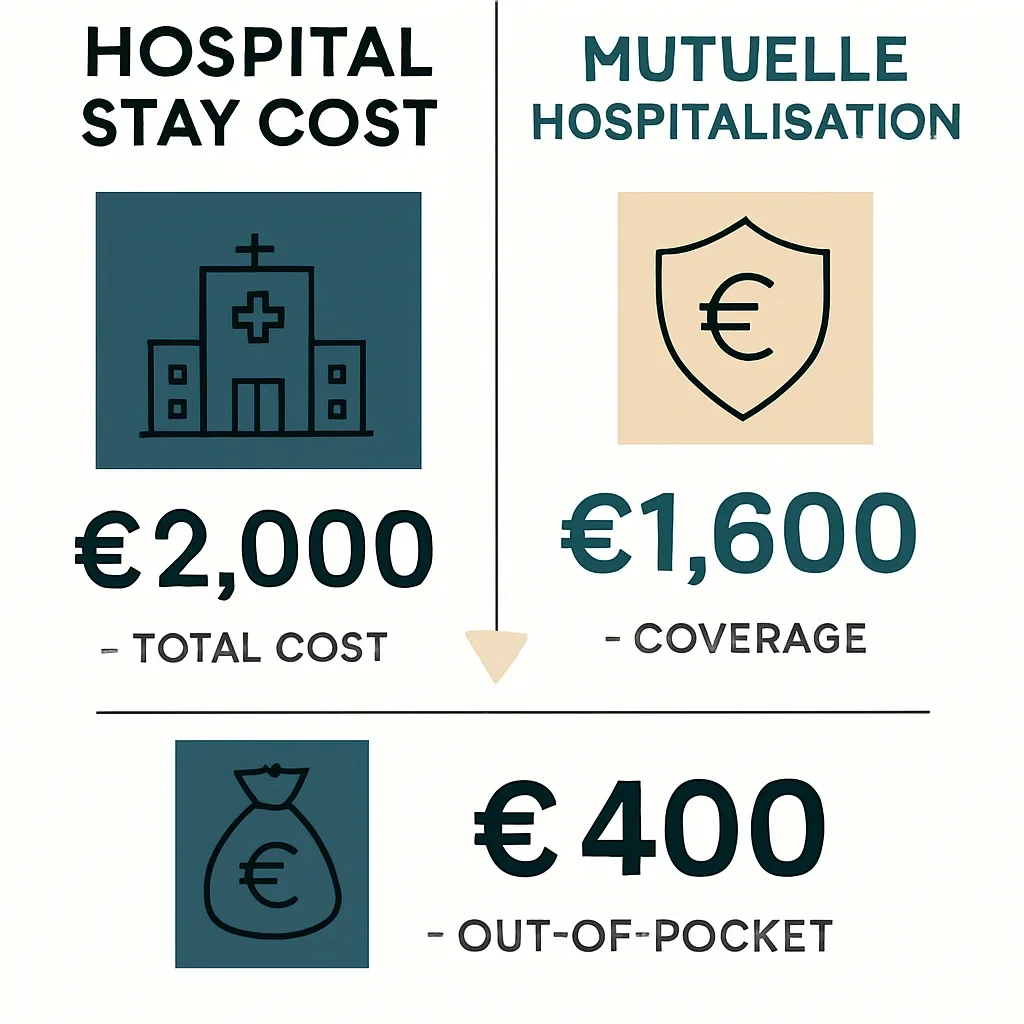
The most common items are easy to identify: the daily flat rate, the private room, the excess fees charged by some specialists, and sometimes comfort costs such as television, accompanying bed, or telephone. In practice, a useful contract is one that fits your usage, not one that lists vague promises.
To clearly visualize the mechanism, the Health Insurance on hospitalization costs reminds that coverage does not cover everything, while the rules on the DREES website allow placing these costs within the actual volume of hospital stays in France. In other words: the bill does not always explode, but when it rises, it rises quickly.
| Cost item | What the base often reimburses | What the mutual insurance can supplement |
|---|---|---|
| Daily flat rate | Generally not reimbursed | Full or partial coverage |
| Private room | Rarely covered | Reimbursement per day, with a ceiling |
| Excess fees | Partially or not depending on the practitioner | Supplement depending on the level of coverage |
| Medical transport | Regulated reimbursement | Often complementary, depending on the contract |
| Home help / accompaniment | No | Sometimes included in assistance services |
How to choose your hospital insurance plan without making a mistake?
The right contract depends more on your profile than on your age alone. If you are rarely hospitalized, aim for useful and inexpensive coverage; if you anticipate surgery or already have a complex care pathway, prioritize high limits, a short waiting period, and real assistance benefits.
The smart approach is to start from your actual situation. A single person who rarely consults does not need the same level of coverage as a senior, a parent with a young child, or a self-employed person who cannot afford a long immobilization. The hospital insurance plan should therefore be seen as a risk management tool, not as a standard product.
| Profile | Real priority | First thing to check |
|---|---|---|
| Active person rarely hospitalized | Controlled budget | Daily allowance and room |
| Senior | More frequent or longer stay | Room limit, assistance, fees |
| Parent | Daily life organization | Accompanying bed, childcare, home help |
| Self-employed | Limit activity stoppage | Waiting periods and assistance allowances |
| Scheduled surgery | Avoid unpleasant surprises | Waiting period, fees, and per-stay limits |
The right hospital insurance plan is not the one that promises everything. It is the one that covers the real cost items, at the right level, without making you pay for coverage you will never use.
It is also helpful to look at the assistance logic. Some plans provide home help after discharge, childcare, or accommodation for a relative. This is not “marketing bonus” if you live alone, if your partner works far away, or if your family is not readily available. In these cases, this aspect is almost as valuable as pure reimbursement.
Hospitalization only or full mutual insurance: what should be compared?
The difference mainly lies in the extent of reimbursements. A hospitalization-only mutual insurance targets expenses related to hospital stays, whereas a full mutual insurance adds coverage for optics, dental care, consultations, and sometimes wellness. If you just want to secure against a heavy but rare risk, the hospitalization-only version may suffice; otherwise, the comprehensive contract remains more coherent.
The trap is mixing up the terms. Sometimes people talk about hospital guarantee, hospitalization guarantee, or health complementary insurance as if they were the same thing. In reality, the mechanisms differ: a hospital option can complement an existing contract, while a full mutual insurance also covers everyday medical needs. In Nantes, for example, outpatient surgery does not generate the same bill as an overnight stay in a private clinic in Lyon: the contract must follow your actual usage.
| Product | What it covers | Who it is relevant for |
|---|---|---|
| Hospitalization-only mutual insurance | Stay, package, room, fees | People who want to target a specific risk |
| Hospital guarantee | Often a module or an option | Insured persons already covered elsewhere |
| Full mutual insurance | Hospitalization + routine care | Families, workers, seniors with varied needs |
The right choice also depends on your current contract. If your company mutual insurance already covers part of routine expenses, adding a hospitalization option may be smarter than stacking a second full coverage. Conversely, if your base coverage is light, it’s better to avoid patching together three overlapping layers of guarantees without real coherence.
What pitfalls should you check before signing?
The contract may seem simple, but some details change everything. The real sticking point often remains the waiting period, followed by daily limits, exclusions of certain procedures, and limits on the duration of coverage. A hospitalization mutual insurance is useful only if it activates when you need it, not six weeks later.
In practice, a couple who subscribes to a hospital guarantee “to be safe” sometimes discovers too late a waiting period of 60 to 90 days. The contract seemed light on paper, but it was useless when the operation was already scheduled.
Here are the points to read word for word before signing:
- The waiting period: it can range from 0 to 3 months depending on contracts and profiles.
- The daily ceiling: a private room may be reimbursed, but only within a specific limit.
- The number of days covered: some contracts limit the duration, especially in psychiatry or rehabilitation.
- Exclusions: uncovered procedures, stays abroad, non-contracted establishments, or comfort care.
- Assistance services: childcare, home help, transport, accompaniment of a relative.
- Compatibility with your current mutual insurance: no need to pay twice for the same item.
In large cities like Paris, Lyon, or Bordeaux, it is also noted that comfort services are requested more quickly because stays in private clinics are more frequent and single rooms are highly sought after. That’s where a too low ceiling becomes immediately apparent. In short, a cheap contract can become expensive in use if the limits are tight.
What is the out-of-pocket cost after hospitalization?
The out-of-pocket cost depends on three levels: the portion covered by Health Insurance, the daily flat rate, and any extras such as a private room or additional fees. Without supplementary insurance, you can quickly accumulate several lines on the bill. With good coverage, the same stay becomes much more financially manageable.
Simple example: for a 3-night stay in a public hospital, the daily flat rate already amounts to €60. If you add a private room charged at €50 per day, you reach €210, not counting any additional fees. And this is just a basic scenario, not an extreme exception.
In a private clinic or during scheduled surgery, additional fees can weigh even more. Effective hospitalization supplementary insurance then reimburses either a percentage of the base rate or a capped amount per procedure or per day. In practice, the difference is especially noticeable when the facility, the practitioner, and the length of stay all increase the bill together.
A family who arrived in Toulouse in 2023 recounts having taken out hospitalization coverage “to be at ease,” then encountering a private room ceiling after a procedure in a clinic. The stay was well reimbursed, but the comfort around it was only partially covered.
The good reflex is therefore to do a quick calculation before subscribing: how many nights, which room, what level of fees, and what portion your contract actually covers? Once this table is set, you immediately see if the premium is worth it or if it mainly serves to look good in a comparison tool.
FAQ — Health Insurance and Hospitalization
Does hospitalization supplementary insurance cover an emergency without an overnight stay?
Not always in the same way. An emergency without full hospitalization may fall under a consultation or an emergency room visit, thus a different reimbursement. The point to check is the exact definition of the stay in the contract: outpatient, observation, or hospitalization with an overnight stay.
Can you supplement company insurance with hospitalization-only coverage?
Yes, it is often possible through additional supplementary coverage or a hospitalization option, depending on the contracts. This is an interesting option if the company insurance already covers daily expenses but leaves a gap on heavy stays, private rooms, or certain additional fees.
Does the waiting period also block scheduled operations?
Yes, if the hospitalization occurs during the waiting period, the coverage may not apply at all. This is precisely why you need to sign before the operation, not after the diagnosis. A 60-day waiting period can be enough to make a contract useless in the short term.
Are psychiatry and rehabilitation treated like standard hospitalization?
Not necessarily. Many contracts apply specific ceilings, a limited number of days, or different conditions for psychiatry and rehabilitation. Always check the dedicated line, as reimbursement may be lower than for standard surgery.
Should you keep discharge and billing receipts?
Yes, without hesitation. Keep the status report, the detailed invoice, and receipts for additional expenses, especially if there is an accompanying bed, transport, or home help. In case of an audit or a claim for additional reimbursement, these documents save valuable time.
Are accompanying person expenses reimbursed?
Only in certain contracts. This can include accommodation for a relative, the accompanying bed, or a contribution to meals, but it is never automatic. If you have children or a dependent person, this criterion really deserves to be checked before signing.