Gas, oil, or hybrid condensing boiler: what are we talking about?
In practice, the gas or oil condensing boiler replaces a conventional boiler while keeping a fairly simple logic: burner, exchanger, condensate evacuation, and regulation. The hybrid adds a smarter brain, capable of switching between two sources depending on the weather, heating demand, and operating cost. That’s where the match becomes interesting.
According to the ADEME, the performance of a heating system depends not only on the generator but also on the quality of regulation and the match between the machine and the home. Meanwhile, Service-Public.fr reminds that replacing a heating appliance must be thought of in the long term, especially when it is part of a global renovation.
In short, we are talking about three ways to produce heat, but with a common logic: to do better than the old non-condensing boiler, without necessarily upsetting everything in the house. For a broader framework on prices, efficiency, and selection criteria, also see this resource on the condensing boiler, price and efficiency.
Gas, oil, or hybrid condensing boiler: what are the concrete differences?
The real difference is not just the fuel. It is also how the system manages useful power, outdoor temperature variations, and compatibility with the existing installation. In the field, a heating engineer from western France often observes that a home already equipped with steel radiators can very well benefit from a condensing boiler… provided the supply temperatures are lowered.
| Solution | Main advantage | Common limitation | Most logical case |
|---|---|---|---|
| Condensing gas | Simple installation if existing connection | Depends on the gas network and energy trajectory | Quick replacement of a gas boiler |
| Condensing oil | Continuity in non-served areas | Less coherent in a transition project | Detached house without gas access |
| Hybrid | Flexibility and automatic control | Higher initial cost, finer adjustments | Renovation with sobriety goal |
In practice, condensation on gas or oil is based on a simple mechanical point: the fumes contain hot water vapor. If the return water from the circuit arrives cold enough in the exchanger, this vapor condenses and releases recoverable heat. The boiler then “recovers” part of the energy that would have been lost through the chimney.

It should be noted that this mechanism does not work magically. The more the emitters heat at low temperature, the longer the boiler condenses. Conversely, if the radiators require very hot water, the gain decreases significantly. That is why low-temperature installations play such an important role.
The principle of condensation on gas and oil
On a condensing gas or oil boiler, combustion heats a main exchanger, then the fumes pass through a second zone where part of their residual heat is recovered. Efficiency rises especially when the return circuit remains cold. According to the INSEE, the French housing stock remains very heterogeneous, which explains why heating needs vary so much from one region to another.
In summary, condensation is all the better when the home has been renovated or when the emitters have been designed to operate at moderate temperatures. An old house in Metz with oversized radiators can lend itself to this, whereas a small very hot network in a recent extension will benefit less. So it is not the boiler alone that does everything, but the boiler + installation duo.
If you want to explore the installation part, this guide on installing a condensing boiler details the most common technical constraints, notably condensate evacuation and duct adaptation.

The principle of a hybrid boiler
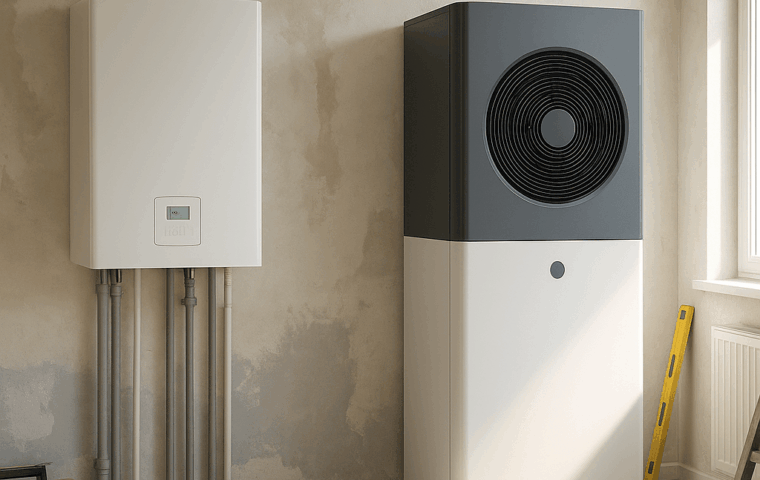
The hybrid boiler combines a condensing boiler and a heat pump, or sometimes a second complementary generator. The system automatically switches to the most relevant source depending on the outside temperature, the actual demand, and the cost of energy. This is the kind of solution that appeals to homes seeking a compromise between comfort and efficiency.
Practically speaking, the heat pump often takes over when the outside air is mild, because it then operates under good conditions. The boiler comes into play during cold snaps or when the power demand suddenly rises. This “dual engine” logic avoids oversizing a single device, but it requires properly adjusted regulation. Otherwise, the icing on the cake falls a bit flat.
A common field feedback is: in renovated houses on the outskirts of Rennes or Dijon, the hybrid system works well when the radiator network is compatible with low temperature, but it becomes less interesting if the emitters require too much heat. This is precisely where automatic control makes all the difference.

The role of low-temperature emitters
Underfloor heating, low-temperature radiators, or well-sized existing radiators: these are the true allies of condensation. The colder the water returns to the boiler, the more heat the exchanger recovers from the flue gases. This simple detail can turn an average system into a truly efficient installation.
From a practical standpoint, it is observed that many older homes do not need a complete replacement of the emitters, but rather a finer adjustment of the heating curve. A family living in a 1980s house often reports that comfort remains good after lowering the temperature by a few degrees, while gaining temperature stability. It’s not spectacular, but it’s tangible.
In other words, before choosing between gas, oil, or hybrid, you need to ask the tough question: can your radiators really operate at low temperature? If the answer is yes, the condensing boiler already breathes easier. If not, you need to budget for a partial adaptation, or even consider a different setup.
What criteria to compare before choosing your condensing boiler?
Before deciding, you must look at the home as it is, not as you imagine it after renovation. A gas-connected apartment, an insulated house in central Bordeaux, or a house with an oil tank in the countryside do not imply the same constraints. It’s as simple as that, even if catalogs love to make you believe otherwise.
The home and the energy already in place
If gas is already available, the gas condensing boiler often benefits from a smoother transition: few major works, easier compatibility with the existing system, and maintenance known by installers. However, if the dwelling is not connected, the interest in gas will depend on the cost and feasibility of the connection, not just the machine’s performance.
Oil remains mainly a continuity solution in houses not served by gas. This is the case in some rural areas of Morvan, Cantal, or Creuse, where the network does not always make other options easy. The hybrid system, meanwhile, makes full sense when the project accepts a somewhat more sophisticated mechanism to gain flexibility.
The Desired Level of Energy Transition
If your priority is to modernize without disrupting the site, the condensing gas boiler often remains the most direct route. If the goal is to reduce the share of fossil fuels without switching entirely to electric all at once, the hybrid offers more flexibility. And if you are looking to extend the life of an oil installation while waiting for something better, the oil solution can still do the job… without being the most ambitious option.
The best system is not always the most “green” on the brochure, but the one that truly fits the home, the budget, and the renovation trajectory. It’s less glamorous, but much more reliable.
Operating Temperatures and Condensation
The crux of the matter is the return temperature. The lower it is, the better the condensation works. This explains why some homes make excellent use of a condensing boiler while others, even equipped with the same model, only see part of the benefit. The difference often comes down to a few degrees, not a technological miracle.
If your project includes a broader upgrade, the page on condensing boiler and criteria helps to decide between power, emitters, and daily uses.
User Comfort and Maintenance
A condensing boiler requires regular maintenance, and this point weighs even more in a hybrid installation where regulation must remain coherent. The goal is simple: maintain efficiency, secure combustion, and prevent fouling from eroding gains. On this subject, also see the page dedicated to condensing boiler maintenance.
According to configurations observed in private homes, the annual maintenance of a gas boiler is often around €100 to €180, that of an oil boiler rather between €150 and €250, and a hybrid solution can be somewhat higher depending on the level of control and the presence of a heat pump. These orders of magnitude vary according to region, brand, and accessibility of the device.
Gas Condensing Boiler: In Which Cases Is It the Best Choice?
When gas is already in place, the logic is often relentless: keep the available energy, replace the old generator with a more efficient condensing boiler, and limit the work. This is particularly relevant in urban apartments or townhouses in Nantes, Strasbourg, or Lille, where the gas network and space constraints favor a compact solution.
User comfort is also a strong argument. The temperature rise remains quick, domestic hot water production can be integrated, and maintenance is well known to professionals. For a “no surprises” replacement, it is often the clearest path, especially if the existing installation is already compatible with not too high temperatures.
On the other hand, gas becomes less attractive if you want to sustainably move away from fossil fuels or if the home is not connected. In this case, the economic interest of the connection, any flue work, and operating costs must be seriously weighed. A small calculation over ten years is better than a too-quick crush.
Oil Condensing Boiler: When Does It Remain Relevant?
Oil follows a very “continuity” logic. If the house already has a tank, a compatible network, and no easy access to gas, replacing it with an oil condensing boiler can be the most pragmatic short-term choice. In some rural areas, this still avoids heavy work or a complete overhaul of the heating system.
The downside, you know it: more volatile fuel prices, less favorable environmental image, and often a tighter transition horizon. An oil condensing boiler can be technically good, but it fits less well with a project seeking to green the home in the medium term. It’s a practical choice, not a conviction-based one.
Practically speaking, the best results come with a well-maintained tank, precisely adjusted combustion, and low-temperature emitters. Budget-wise, keep in mind that an oil replacement often falls within a range of €5,000 to €9,000 including installation depending on the configuration, with significant variations depending on power and circuit adaptation.
Hybrid Condensing Boiler: How Does the Mixed Solution Work?
The hybrid boiler is a bit like the Swiss army knife of heating. It doesn’t replace everything; it orchestrates. In practice, the heat pump often covers the most favorable needs, while the condensing boiler handles power peaks, hot water, or backup during severe cold. The whole system works well when regulation is serious and the emitters keep up.
The entry cost is higher, generally around €9,000 to €15,000 depending on brands, power, and additional work. But this solution can be interesting if it avoids oversizing a single system or if it supports a renovation in several stages. It’s not the simplest, but it’s often the most flexible.
For those hesitating between hybridization and all-heat-pump, this comparison on the condensing boiler or heat pump shows where the boundary lies between gas/electric logic and mixed strategy.
How a Hybrid Boiler Works Daily
On a daily basis, the regulation chooses the most relevant source according to several parameters: outside temperature, instantaneous need, kWh cost, and sometimes time programming. In a well-adjusted house, the boiler doesn’t run unnecessarily. It takes over only when it is more efficient than the heat pump, or when comfort requires it.
The gain depends greatly on sizing. An oversized installation consumes more and condenses less well. Conversely, a well-calibrated system can reduce the bill without sacrificing comfort. That’s why it’s often advised to compare the overall cost, not just the efficiency shown in the brochure.
Return Temperature, Condensation, and Efficiency
On a hybrid as on a classic condensing boiler, efficiency increases when the water returning to the exchanger is cold enough. It’s mechanical. A house with underfloor heating, or with radiators working at low temperature, therefore helps the system stay in its useful zone longer.
Conversely, if the installation requires high temperatures, hybridization loses part of its interest. The system still works, but it doesn’t “score” as well. It’s a bit like putting rain tires on a racing motorcycle: it works, but the context limits the potential.
Compatibility with Low-Temperature Emitters
Underfloor heating is almost the ideal playground. Low-temperature radiators also work very well, provided their exchange surface is sufficient. If your radiators are old, they are not necessarily to be discarded, but their ability to heat properly with cooler water must be checked.
For those who want to go further on possible renovation aids, the page condensing boiler aids provides a useful overview of the schemes that can lighten the bill depending on the type of work.
Gas, Oil, or Hybrid Condensing Boiler: Which Choice for My Home?
If you want a short answer: gas often stands out as the simplest choice in already connected homes, oil remains a continuity solution in non-served areas, and the hybrid becomes interesting when you are looking for room to evolve energetically without switching all at once to a completely different system.
The right decision depends on four things: the energy already in place, the emitters, the level of insulation, and your medium-term project. For a like-for-like replacement, gas or oil can be logical. For a renovation that anticipates the coming years, hybrid often offers the best flexibility, even if its initial cost is higher.
In practice, it is often advised to start from the home and then move up to the technical solution. This method avoids choosing a machine “on paper” and then discovering that it is not suitable for the radiators, the technical room, or the renovation trajectory. Good installations are rarely the most flashy; they are those that go unnoticed.
To refine your decision, the guide on 7 criteria for choosing a condensing boiler remains a good support, especially if you hesitate between simple modernization and a real system evolution.
FAQ on Gas, Oil, or Hybrid Condensing Boilers
Can old radiators be kept with a condensing boiler?
Yes, sometimes. It all depends on their size, condition, and the required supply temperature to properly heat the home. Old radiators can remain compatible if they are powerful enough to operate at lower temperature, but adjustment or balancing may be essential.
Can a hybrid boiler operate without the heat pump?
Yes, the boiler takes over if the heat pump is absent, stopped, or insufficient during extreme cold. However, the solution then loses its main interest, which is precisely to share the workload between the two sources to improve overall efficiency.
Is condensing oil still a good idea in an insulated house?
It can remain relevant if the house does not have access to gas and if you need a quick replacement. But if you plan to renovate the heating in the medium term, it is better to seriously compare with a hybrid solution or another energy trajectory.
Is a hot water tank necessary with a condensing boiler?
Not necessarily. Many boilers also produce domestic hot water instantly or via an integrated tank. The right choice depends on the number of occupants, simultaneous uses, and available space. In a large family, a separate tank can provide more comfort.
Is a condensing boiler cost-effective in a well-insulated home?
Often yes, but the gain depends on the return temperature and the heating regime. In a well-insulated home with low-temperature emitters, the boiler operates under very good conditions. If the existing system is already very efficient, the profitability mainly comes from replacing an old generator.
What is the most common mistake when making a choice?
Choosing the technology before evaluating the existing installation. In real life, it is the emitters, available space, connection, and actual needs that should guide the decision. Marketing promises a universal solution; the construction site quickly reminds of the limitations.