In brief
⚡ A solar installation attached to the dwelling is often treated as part of the property, but it almost always must be declared to the insurer.
🧾 Multi-risk home insurance can suffice in many cases, provided the fire, hail, theft, vandalism, and electrical damage guarantees are checked.
🔌 As soon as there is resale of electricity or injection into the grid, civil liability and the connection file take a central place.
✅ The right reflex is not necessarily to change insurer, but to update the contract before commissioning.
Is home insurance enough for solar panels?
Yes, in many cases, multi-risk home insurance can cover solar panels attached to the dwelling, but not automatically. Everything depends on three points: the declaration of the installation, the installation method, and the guarantees provided in the contract. As soon as there is injection into the grid or special equipment, exclusions must be reviewed.
Multi-risk home insurance often covers solar panels attached to the building, but only if they are declared and integrated into the contract. A ground installation, a pergola, or electricity sales can change the situation. In case of doubt, review the guarantees and exclusions before commissioning.
The simple rule is this: the more integrated the installation is into the dwelling, the more likely it is to be included in the MRH. But the contract does not like ambiguity. A solar pergola in Montpellier, a carport in Rennes, or a battery installed in the garage are not read the same way by the insurer.
Service-Public.fr also reminds that insurance obligations vary depending on whether you are an owner-occupant, tenant, or co-owner, which changes the reading of the contract and basic guarantees. Consult the Service-Public fact sheet on home insurance.
What must be declared to your insurer before installation?
Before installation, the insurer must know the power, the installation method, the presence of an inverter or a battery, and the intended use: simple self-consumption, surplus sale, or total sale. Without these elements, the contract may be poorly calibrated, especially if the roof, carport, or connection changes the risk level.
- The type of installation: overlay on roof, integration into the building, ground, on pergola or carport.
- The installed power: in kWc, with total power and number of modules.
- The use of the electricity: self-consumption, surplus sale, or broader injection into the grid.
- Ancillary equipment: inverter, micro-inverters, battery, protection box, external wiring.
- Supporting documents: quote, invoice, photos of the installation, technical manual, and if possible, installation certificate.
In the field, it is often observed that files get stuck less because of a “bad contract” than because of a too vague declaration. An insurer may accept the principle, then request the invoice, the inverter’s technical sheet, or proof of attachment to the frame.
An installer accustomed to single-family homes also notices that omissions often concern the battery and the electrical box, yet essential in case of a claim.
If your installation injects even the slightest energy into the grid, the issue does not stop at insurance. The Enedis connection file requires technical information on the power, configuration, and operation of the installation; the connection process for an electricity production installation may also involve documents related to civil liability.
Which guarantees to check in the contract?
The right contract is not necessarily the most expensive one, but the one that matches the reality of your installation. For solar panels, you especially need to check guarantees against fire, weather events, theft, vandalism, electrical damage, and, if necessary, civil liability related to injection into the grid.
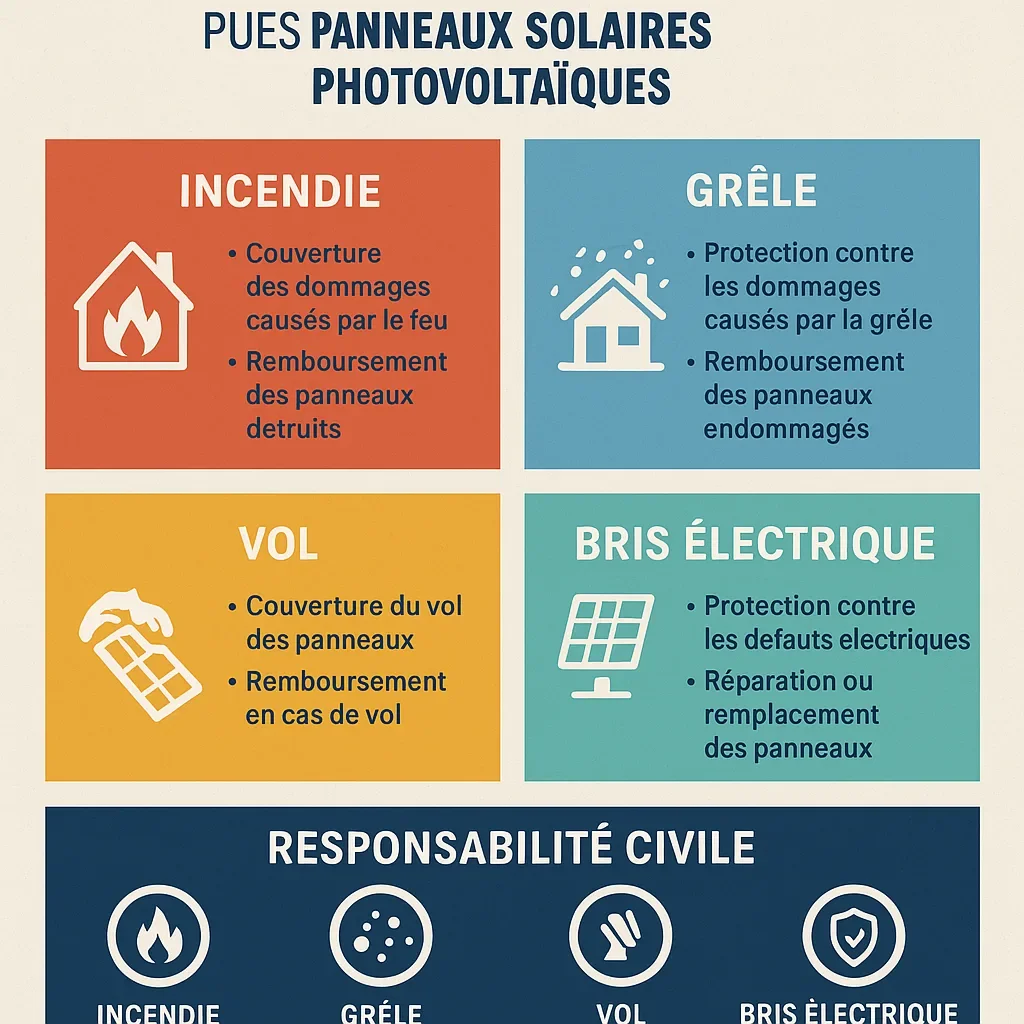
What matters is not only the presence of a guarantee but its real scope. For example, a “storm” coverage does not always specify whether it includes hail on the panels, nor if it covers dismantling and reassembly after assessment. The same logic applies to theft: a module torn off a pergola is not treated like a broken tile.
Another point to look at closely: the deductible. A low deductible seems reassuring, but it sometimes comes with a higher premium. Conversely, a deductible that is too high can make compensation uninteresting if the damage is limited to one or two panels.
- Fire and overvoltage: useful if the inverter or wiring causes a fire.
- Weather events: hail, strong wind, falling branch, heavy snow.
- Theft and vandalism: especially for installations accessible from the ground.
- Electrical damage: inverter, micro-inverters, battery, and protection panel.
- Civil liability: essential if the installation injects into the grid or causes damage to a third party.
The real dividing line is not “solar or not,” but “declared and integrated into the contract, or left vague.” This is often where files get complicated.
Panels on roof, on the ground, or in co-ownership: cases that change everything
The situation mainly depends on the support. A panel fixed on the roof is not treated like a panel placed in a garden, and an installation in a co-ownership in Lyon often raises the question of common areas, the agreement of the property manager, and the building’s contract.
| Situation | What the insurer looks at | Point of caution |
|---|---|---|
| Integrated or overlay roof | Real estate, professional installation, waterproofing | Prior declaration and proof of compliance |
| On the ground, pergola or carport | Outdoor equipment, outbuilding or annex according to the contract | Theft, vandalism, storm and ground anchoring |
| Co-ownership | Common areas, agreement of the property manager, co-ownership regulations | Who insures what, and under which contract? |
| Tenant | Owner’s authorization and coverage of the installed property | Do not confuse home insurance with equipment insurance |
In practice, a project on a roof terrace in Toulouse or on a house in Nantes does not involve the same considerations. In a detached house, the discussion often revolves around the MRH contract and extensions. In co-ownership, it quickly shifts to the written agreement, the allocation of responsibilities, and the insured value of the concerned parts.
What happens in case of a claim?
In case of hail, fire, or power surge, the right reflex is to act quickly and properly: secure the installation, photograph the damage, keep the replaced parts, then report the claim within the contract deadlines. According to the usual rules recalled by Service-Public.fr, the declaration is generally sent within 5 working days, or 2 days in case of theft.
In a well-managed claim process, the insurer then sends an expert or requests additional evidence: original invoice, before/after photos, serial numbers of the modules, description of the weather event, sometimes a replacement estimate. The cleaner the file, the smoother the compensation process.
- Cut off the installation if electrical safety is at risk.
- Take wide and close-up photos, without moving the broken parts.
- Keep the references of the panels, the inverter, and the accessories.
- Notify the insurer immediately, even if the damage seems limited.
- Request a repair or replacement estimate to facilitate the expertise.
It is observed on the ground that the smoothest files are those where the owner has kept every piece of paper: invoice, manual, confirmation email, construction photos, commissioning date. Conversely, when everything is done “by guesswork,” compensation often drags on and discussions become tougher.
How to avoid unpleasant surprises at the time of installation?
The best time to secure your home insurance for solar panels is not after the hailstorm. It is before installation, when you can still compare guarantees, have a clause modified, and request in writing what is included. It’s a bit less fun than a brand-new panel, but much more profitable.
The winning trio looks like this: a serious installer, a contract reviewed line by line, and proofs kept from day one. ADEME regularly emphasizes that a solar project is also planned upstream of the worksite, considering available surface, orientation, and building constraints; insurance is part of this preparation.
- Ask if the guarantee covers the inverter and, if applicable, the battery.
- Check the deductible applicable to weather events and theft.
- Have it specified whether the panels are considered real estate or personal property.
- Keep the serial numbers, the invoice, and installation photos.
- If you sell the property, remember to pass the file to the buyer to avoid a coverage gap.
If you are a tenant, caution is even more useful. You need the written consent of the owner, verify that the installation does not contradict the co-ownership regulations, then ask the insurer how the equipment will be handled in case of damage. In other words: it is better to have a clear answer before the work begins than a big moment of solitude at the first storm.
FAQ: home insurance and solar panels
Do solar panels need to be insured if I do not sell electricity?
Yes, because the risk does not disappear with self-consumption. Hail, fire, vandalism, or power surges can still affect the installation. The difference is that selling electricity often adds a layer of civil liability and network formalities.
Is a solar battery covered like the panels?
Not necessarily. Some insurances treat it as an ancillary electrical equipment, others require an explicit mention in the contract. This is precisely the kind of element that must be reported before installation, especially if the battery is installed in the garage or in a technical room.
Are ground-mounted panels less well protected than those on the roof?
Often, they are more exposed to theft, vandalism, and direct impacts because they are more accessible. However, they can sometimes be easier to replace. It all depends on the contract, the mounting system, and how the insurer classifies the installation.
What should be done immediately after a hailstorm?
Start by checking that there is no fire or electrical hazard, then photograph the damage from several angles. Do not try to dismantle the panels alone if the structure has shifted. The claim to the insurer should then be sent quickly, ideally with the invoice and equipment references.
Can a tenant install panels and have them insured?
Yes, but they need the owner’s authorization, and often a written agreement on installation, maintenance, and future dismantling. The home insurance does not always cover the equipment itself. The contract must specify who insures what, to avoid grey areas.