
In Brief
🧭 The PNO is used to cover a property you own but do not occupy yourself: unfurnished rental, furnished rental, rental vacancy, or free loan.
🏢 In condominium, the minimum base is more serious than one might think: since the ALUR law, the civil liability of the non-occupant co-owner is central to the matter.
💶 On the budget side, contracts are often seen around 90 to 250 € per year for a standard apartment, but the deductible and the surface area quickly increase the cost.
🔍 The truly useful reflex: compare the guarantees, the exclusions, the compensation limits, and the covered vacancy duration. This is where the difference between a good and a bad surprise lies.
PNO Home Insurance: What Is It Really For?
PNO home insurance is designed to cover the owner when the property is not occupied by them: material damage, civil liability, and, depending on options, rental vacancy, theft, or loss of rent. It takes over where the tenant’s insurance stops, without replacing it.
In practice, PNO acts as a safety net between several contracts. If the tenant is insured, their coverage mainly concerns their own liabilities and certain damages they cause. If the property is vacant, the owner becomes the primary exposed party again. This is where PNO becomes useful, even frankly indispensable, to avoid a protection gap between two occupants.
This insurance also targets less visible but very frequent situations: a leak starting during a re-rental period, damage in a secondary residence lent to a relative, or damage caused by a fixed equipment of the property. In other words, it protects the real estate assets where the resident’s standard home insurance is no longer sufficient.
Do you really need a PNO insurance in your case?
Yes, almost always in co-ownership, where the civil liability of the non-occupying co-owner has been mandatory since the ALUR law. Outside of co-ownership, it is not always required, but it remains very useful as soon as a property can remain vacant, be poorly insured, or suffer damage between two leases.
The answer mainly depends on your status and the type of property. For an apartment in a collective building, the framework is stricter, and the civil liability obligation has been reinforced since 2014. For an individual house, insurance is not systematically mandatory, but the savings made by removing it can quickly seem insignificant compared to a somewhat serious claim.
The right approach is to reason by scenario, not just by principle. If the property is rented continuously, the PNO complements the tenant’s insurance. If the property is vacant between two leases, it often becomes the only real coverage. If you rent furnished, in shared accommodation or seasonally, the risk level changes, so do the guarantees to choose.
- Apartment in co-ownership: at a minimum, check the civil liability and the rules of the property management.
- Rented individual house: PNO remains strongly recommended, especially in case of rental vacancy.
- Furnished accommodation or shared housing: beware of handovers between occupants and damage to fixed parts.
- Vacant property: this is often where the absence of PNO costs the most.
It is observed in practice that a landlord often underestimates the risk during the “small” vacancy periods. A family who left an apartment in June, before the arrival of the new tenant in August, recounts that a simple infiltration caused two interventions, a repair estimate, and several weeks of discussion. Without PNO, the case would have been much more painful.
Which coverages to compare before signing?
The coverages to closely examine are not the same depending on whether the property is rented, vacant, or in a condominium. The basics are liability insurance, fire, and water damage. The rest — theft, vandalism, loss of rent, legal protection — should be chosen according to the reality of the property, not according to a well-polished brochure.
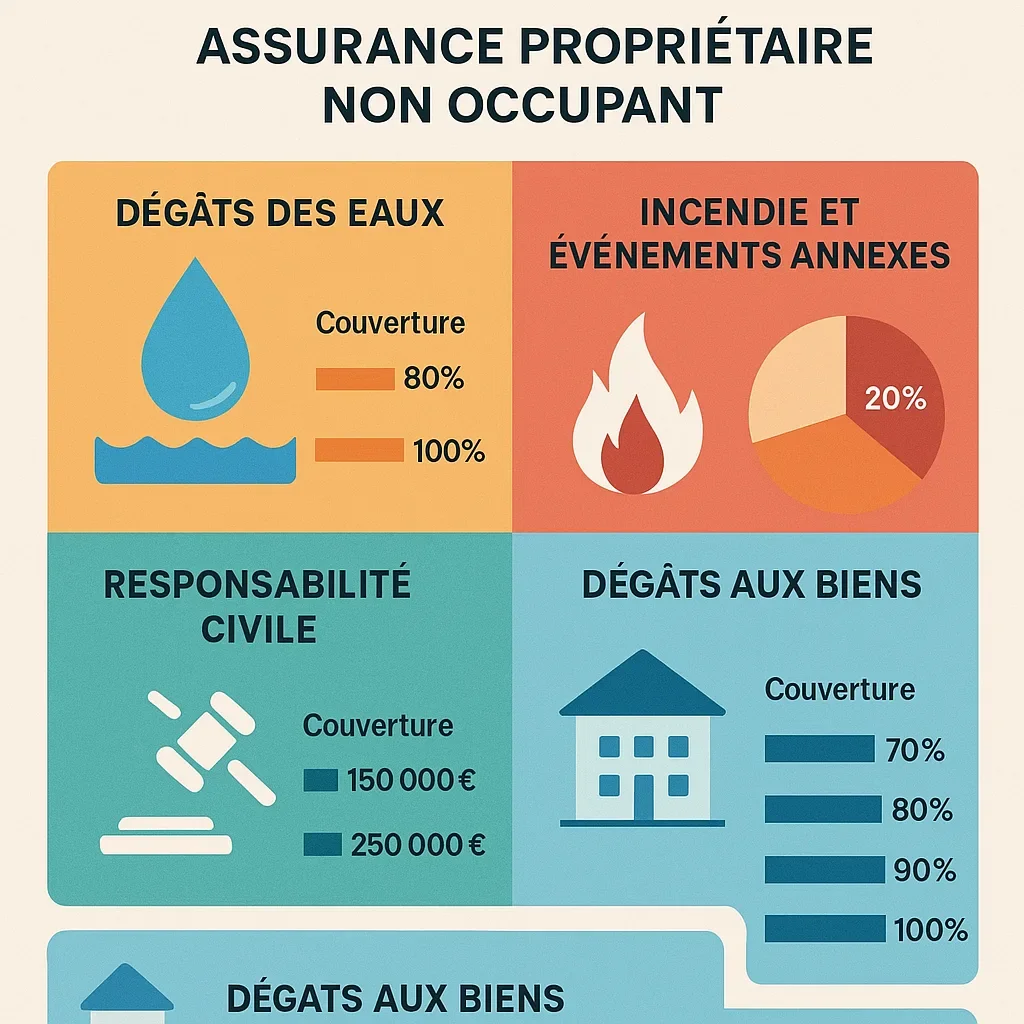
The contract should not be purchased “at the lowest price,” but according to the actual level of coverage. A landlord who owns a studio rented year-round does not have the same needs as an owner of a furnished apartment, nor as an investor who sometimes leaves their property vacant for several weeks. This is precisely where differences in deductibles, limits, and exclusions become meaningful.
| Coverage | What it covers | When it becomes useful |
|---|---|---|
| Liability insurance | Covers damages caused to third parties by the owner. | Essential in condominiums, useful everywhere. |
| Water damage / fire | Covers the most frequent property claims. | Very useful if the property is sometimes vacant. |
| Theft / vandalism | Protects against break-ins and intentional damage. | To be prioritized for vacant or rarely occupied properties. |
| Loss of rent | Compensates part of the lost income after a claim. | Interesting for landlords who rely on rental income. |
| Legal protection | Helps manage disputes with a tenant, neighbor, or the property manager. | Useful as soon as there is a condominium or tense rental management. |
Good to know: the “loss of rent” coverage does not cover everything and does not trigger automatically. You must check the triggering conditions, the duration of compensation, and the limits. This is often where entry-level contracts show their limits.
How much does non-occupant owner insurance cost?
The price of non-occupant owner insurance mainly varies with the surface area, the city, the age of the property, the level of deductible, and the added options. A small apartment in a medium-sized city will not have the same rate as a house with outbuildings or a property located in an old building subject to more frequent claims.
On the market, you often see plans presented around €144 per year on average on some comparison sites, but this figure is not a universal truth. It gives an idea of the order of magnitude, not the final price. On the high side, optional coverages and a low deductible can quickly increase the bill; on the low side, too thin coverage often ends up costing a lot at the first problem.
To make a good decision, always compare the following trio: annual premium, deductible, and compensation limit. A slightly higher premium can be a good deal if it avoids having to pay several hundred euros in case of a claim. Conversely, a very cheap offer with tight exclusions sometimes looks like a false good idea.
PNO, tenant insurance and co-ownership: who covers what?
The logic is simple on paper, but it quickly gets mixed up in real life. Tenant insurance primarily covers risks related to their occupancy, the co-ownership manages the common areas, and the PNO takes over for the property itself and the owner’s liability. The tenant’s framework is outlined by Service-Public.fr on tenant home insurance, while the ANIL clearly details the issues of co-ownership.
| Situation | Who covers first? | Point of attention |
|---|---|---|
| Insured tenant | The tenant for their own risks; the PNO complements the rest. | Check the insurance certificate upon moving in. |
| Uninsured tenant | The PNO can help, but it does not cover everything. | The landlord must act quickly, as the coverage gap becomes very real. |
| Vacant property | The PNO often takes over the property and the owner’s liability. | Beware of undeclared or excessively long vacancy periods. |
| Common areas | The co-ownership or its insurance. | An incident can nonetheless involve the non-occupying co-owner. |
| Incident caused by the owner | The owner’s civil liability. | Damages to neighbors or within the building may be engaged. |
In collective buildings, the boundary between contracts matters a lot. A water damage originating from an apartment can be traced back to the property manager, the tenant, the owner, or the PNO depending on the exact source of the problem. That is why landlords managing several properties always keep copies of certificates, inventories, and incident communications. It’s less glamorous than an apartment visit, but much more useful on the day it leaks.
Taxation, incident and pitfalls to avoid
The good news is that the PNO premium is not just an “extra” expense: in many cases, it can fit into the logic of rental income. The rule mainly depends on your tax regime. For an official reading of the framework, the dedicated section of impots.gouv.fr remains the reference to keep handy.
The crucial point is not to mix regimes. Under the micro-rental regime, you benefit from a flat-rate allowance, but you do not itemize your expenses one by one. Under the actual regime, the PNO, like some other rental-related expenses, can be part of the deductible expense mechanism. The chosen regime therefore changes the final calculation, sometimes quite significantly.
The real mistake is not paying for a PNO. It is believing that a minimal contract will always suffice, whereas the actual incident almost always occurs where there were not enough guarantees.
At the time of an incident, the most common pitfalls are very down-to-earth: no photos, missing invoice, late declaration, deductible too high, or guarantee excluded due to prolonged vacancy. To avoid the classic “oh, that’s not covered,” always keep the contract, inventories, quotes, and exchanges with the tenant or property manager. These are your best proofs, well before the contract’s commercial pitch.
FAQ on non-occupying owner insurance
Is PNO insurance mandatory for a house outside co-ownership?
No, not systematically. The obligation mainly concerns co-ownership, where the civil liability of the non-occupying co-owner has been regulated since 2014. For an individual house, the PNO remains primarily a common-sense protection, especially if the property is rented out or remains vacant for periods.
Does the PNO cover unpaid rents?
Not automatically. Loss of rent is not always included in the basic plan and is often subject to an option or a separate guarantee. If your goal is to secure your income, you need to check the ceiling, the compensation period, and the exact triggering conditions.
What happens if the property is vacant for several weeks?
The risk simply increases. Some contracts provide vacancy limits or special conditions beyond a certain duration. It is better to reread the dedicated clause before leaving the property unoccupied, as it is often during this period that the PNO reveals its true usefulness.
Is the PNO useful for furnished rentals?
Yes, because the change of occupant does not eliminate material risks. In furnished rentals, appliances, fixed equipment, and turnover periods can even complicate claims management. In LMNP under the actual regime, the tax logic is not the same as for rental income, so you also need to look at the applicable regime.
What to do if the tenant is not insured?
You need to act quickly and demand a certificate. The PNO can limit the damage, but it should not be used as an excuse to leave a tenant uninsured. In practice, the tenant’s lack of insurance can trigger formal actions by the landlord, especially if the lease includes an appropriate clause.
Is the PNO sufficient in co-ownership?
No, it does not replace everything else. It covers the part that falls under the non-occupying owner, but the co-ownership retains its own level of responsibility for common areas. That is precisely why the co-ownership regulations, the property manager’s contract, and the PNO must be read together.