
In Brief
🔹 After 12 months of contract, the Hamon law allows you to leave at any time, without fees or penalties.
🔹 At renewal, generally count on 2 months’ notice and watch carefully for the renewal notice sent by the insurer.
🔹 In case of moving or a change in situation, the request must often be made within 3 months following the event.
🔹 For a tenant, continuous insurance coverage is non-negotiable: no gap in coverage is allowed.
Can you cancel your home insurance with the Hamon law?
Yes, but only after 12 months of contract. The Hamon law authorizes cancellation at any time, without fees or penalties, with effect generally 1 month after the request. If you are a tenant, the key point remains simple: you must avoid any gap in coverage between two contracts.
The Hamon law allows you to leave a home insurance policy after one year of contract, without penalty. Cancellation takes effect 1 month after the request. In practice, the new insurer can often take over to avoid administrative back-and-forth.
The Ministry of Economy recalls this rule in its fact sheet on cancellation of insurance contracts. The idea is simple: once the first year has passed, you are no longer bound by the initial schedule. This is one of the major contributions of the consumer law, often called the Hamon law in everyday language.
This mechanism is particularly useful if you have found a clearer, cheaper, or better-suited offer for your home. But beware of false good deals: if you cancel too early or without a new contract ready to start, you expose yourself to a period without coverage. And seriously, that can be costly.
The right reflex is not to send a letter at random. It’s to align the end of the old contract with the start of the new one. Otherwise, the small expected savings can quickly turn into big stress.
How to cancel your home insurance, concretely?
To cancel home insurance without complicating your life, always start with the same sequence: identify the reason, check the deadline, then keep proof of sending. The process is simpler than a claim, but it must remain precise, especially when coverage is mandatory for a tenant.
- Step 1: reread your contract and note the renewal date or the date of the first anniversary.
- Step 2: if you invoke a move, a sale, or another change in situation, gather the appropriate supporting document.
- Step 3: send the request by registered letter with acknowledgment of receipt, by email if the contract allows it, or via the client area.
- Step 4: keep the receipt, a copy of the letter, and the insurer’s response.
- Step 5: verify the contract end date and any refund of the unused premium.
It is observed in practice that the files that drag on the most are those where the insured announces their departure too early, without a new contract lined up behind. An agent from a neighborhood agency notes that errors often come from a simple date mismatch, not a refusal in principle.
The Ministry of Economy and Service-Public also remind that proof of the request is as important as the substance of the file. You can consult the Service-Public fact sheet on terminating home insurance in case of moving to see the required documents and the right time to send them.
What deadlines must be respected according to the reason?
Deadlines vary depending on the reason invoked, and this is where many get caught out. The rule is not the same at the contract renewal, after one year with the Hamon law, or when moving. The correct calculation therefore depends on the contractual date, not on a theoretical calendar set to December 31.
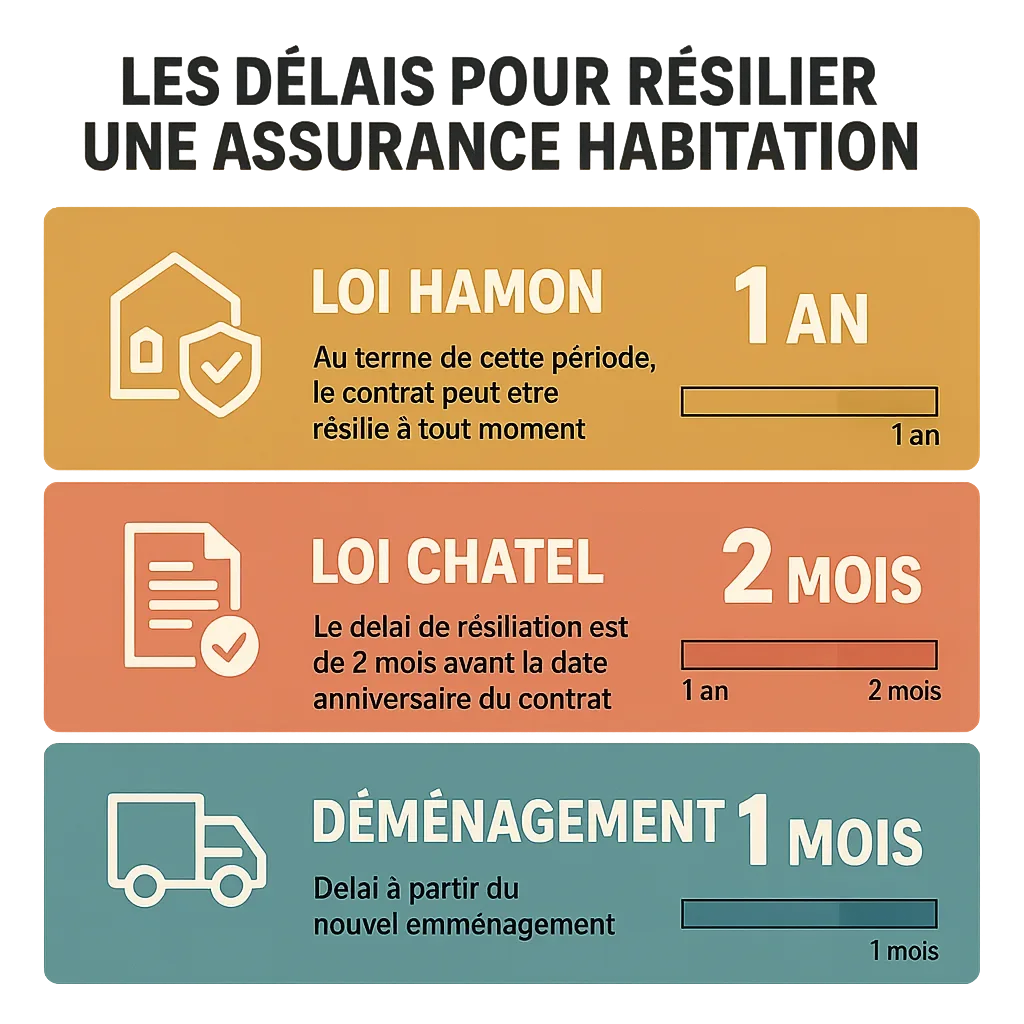
| Reason | Deadline to remember | Who acts? | Useful proof |
|---|---|---|---|
| Hamon Law | After 12 months, effective with 1 month notice | You or the new insurer | No reason to prove |
| Annual renewal | 2 months notice | You | Copy of letter / email |
| Late renewal notice | Specific deadline linked to the Chatel law | You | Envelope, date of receipt, notice received |
| Moving or change of situation | Request to be made within 3 months following the event | You | Lease, inventory report, sales deed, proof |
In practice, the simplest reason is often the Hamon law, because it avoids having to justify your departure. The most delicate is the renewal: you must aim precisely at the date of receipt by the insurer, not just the sending date. This is where registered mail retains all its value.
Is the Chatel law enough to terminate at renewal?
Yes, but only if the insurer sent you the renewal notice too late, or not at all. The Chatel law is designed to prevent a client from missing the termination window due to lack of clear information. According to ABE Infoservice, the renewal date is not necessarily December 31: it depends on the contract.
Practically, if the notice arrives less than 15 days before the termination deadline, you generally have 20 days from the sending of this notice to act. If the notice arrives after the date or does not arrive, you can terminate without being subject to the usual renewal lock. This is a useful safeguard, but it requires keeping proof.
In this case, it is better to send your request quickly and attach a copy of the notice received. If you have doubts, the safest is to check the dates on the envelope or the sending email. In other words, it is not the prettiest letter that counts, but the one that can be dated without dispute.
Tenant, owner, shared accommodation: who does what?
The answer depends on each person’s status. For a tenant, home insurance remains mandatory in most cases, so termination must be followed by a new contract without interruption. For an owner-occupier, termination is freer. In shared accommodation, it is especially important to check who is named on the contract and who covers what.
- Tenant: they must be continuously insured, otherwise the landlord can request a certificate, or even take out insurance themselves at the tenant’s expense in certain cases.
- Owner-occupier: termination is possible according to the contract rules, but changing insurer must not leave the dwelling unprotected.
- Landlord owner / PNO: insurance is not always mandatory, but it is strongly recommended for a rented or vacant property.
- Shared tenancy: a single contract or multiple contracts can coexist, but ambiguity about each person’s responsibility should be avoided.
In shared tenancies, two situations are often seen: either a common contract covers the entire dwelling, or each has their own coverage. The classic trap is to think that “one of the tenants is insured, so everything is fine.” In reality, you must verify in black and white the scope of the guarantees, especially for personal belongings.
What mistakes to avoid before sending the request?
The core of the file is rarely complicated. Problems usually arise from details: wrong date, wrong recipient, or lack of proof. To terminate home insurance smoothly, you must think like a somewhat meticulous accountant: date everything, keep everything, cross-check everything.
- Do not confuse the sending date with the insurer’s receipt date.
- Do not forget the supporting document when the reason requires it: moving, sale, change of situation.
- Do not terminate too early if you are a tenant and the new contract is not yet ready.
- Do not throw away the renewal notice, confirmation email, or acknowledgment of receipt.
- Do not assume that the refund will be automatic without verifying the uncovered period.
The Ministry of Economy insists on a simple point: termination is a right, but it must follow the correct procedure. If your insurer wrongly refuses or delays confirmation, the written proof of submission and the trace of the reason become your best allies. It’s not glamorous, but it’s incredibly effective.
Finally, if you change insurer to pay less, also compare the guarantees: deductible, value of goods, theft, water damage, civil liability. A policy that is a bit cheaper on paper may prove less comprehensive at the first problem. And then, the savings vanish very quickly.
FAQ: terminating home insurance in practice
Can I terminate my home insurance before one year?
In principle, no, except in cases provided by the contract or by law, such as moving, sale, or change of situation giving the right to termination. The Hamon rule starts after 12 months of contract. Before that, a valid reason is required, otherwise the insurer can refuse.
Is registered mail mandatory?
Not always, but it is the safest method. Some insurers accept email, client space, or an online form if the contract provides for it. However, the proof of receipt remains the real issue: if you can track it, you sleep better.
What happens if I have already paid the annual premium?
You do not lose the part of the premium corresponding to the unused period. The insurer must refund you the portion not earned after the effective termination. The departure date therefore matters as much as the price paid, especially when the contract was prepaid.
Can my landlord impose a specific insurer on me?
No, they can require compliant insurance, but not force you to choose a particular company. However, they can request a valid and up-to-date certificate. If you are a tenant, coverage must simply remain continuous, without interruption between two contracts.
If I move, do I have to wait until the expiry to leave?
No. Moving can open a right to termination before expiry, provided the applicable deadline is respected and the appropriate supporting document is provided. The Service-Public fact sheet details this practical case and the documents to attach.
Does the Chatel law allow me to leave if I missed my mail?
Yes, in certain cases, especially if the notice of due date was sent too late or not at all. If you received it late, a specific deadline may apply. The important thing is to keep proof of the dates, as this is what counts in case of a dispute.