
Home insurance and pets: what coverage?
Pet home insurance is often one of those topics we think are simple… until the day the neighbor’s dog gets bitten, the cat knocks over an object at someone else’s place, or an exotic pet escapes and leaves damage behind. Joking aside, the real question is not just “am I insured?”, but rather “what is really covered, and within what limits?”
The key point is that most multi-risk home insurance contracts mainly protect your civil liability. In other words, they intervene when your pet causes damage to someone else. However, your companion’s care, damage inside your own home, or certain specific situations may remain outside the scope. Here’s how to read your contract without getting caught. 🐶🐱
Sommaire
In brief
🧾 The civil liability of home insurance often covers damage caused by an animal to a third party, not its veterinary fees or its messes at your place.
⚠️ Category 1 and 2 dogs are a special case: insurance becomes essential and lack of coverage can cost a €450 fine.
📌 In case of a claim, the right reflex is to act quickly: photos, testimonies, invoice, then declaration to the insurer usually within 5 working days.
What does home insurance really cover with pets?
In the vast majority of contracts, pet home insurance primarily covers damage caused to third parties by your companion: bite, fall, scratch, broken object, injury in a building hallway or at a neighbor’s. It is the civil liability that applies, not a “magical” guarantee for everything that moves on four legs. 🐾
Home insurance most often covers the civil liability related to your animal: if a dog bites a passerby, if a cat breaks a property at a neighbor’s, or if a rabbit causes damage to someone else, the guarantee may apply. However, veterinary care and damage inside your own home are generally excluded.
The simplest way is to think in scenarios. If the animal causes damage to someone else, home insurance may intervene. If the problem concerns your own sofa, your own walls, or your own veterinary bill, it generally falls outside the scope. This detail may seem trivial, but it changes everything at the time of the claim.
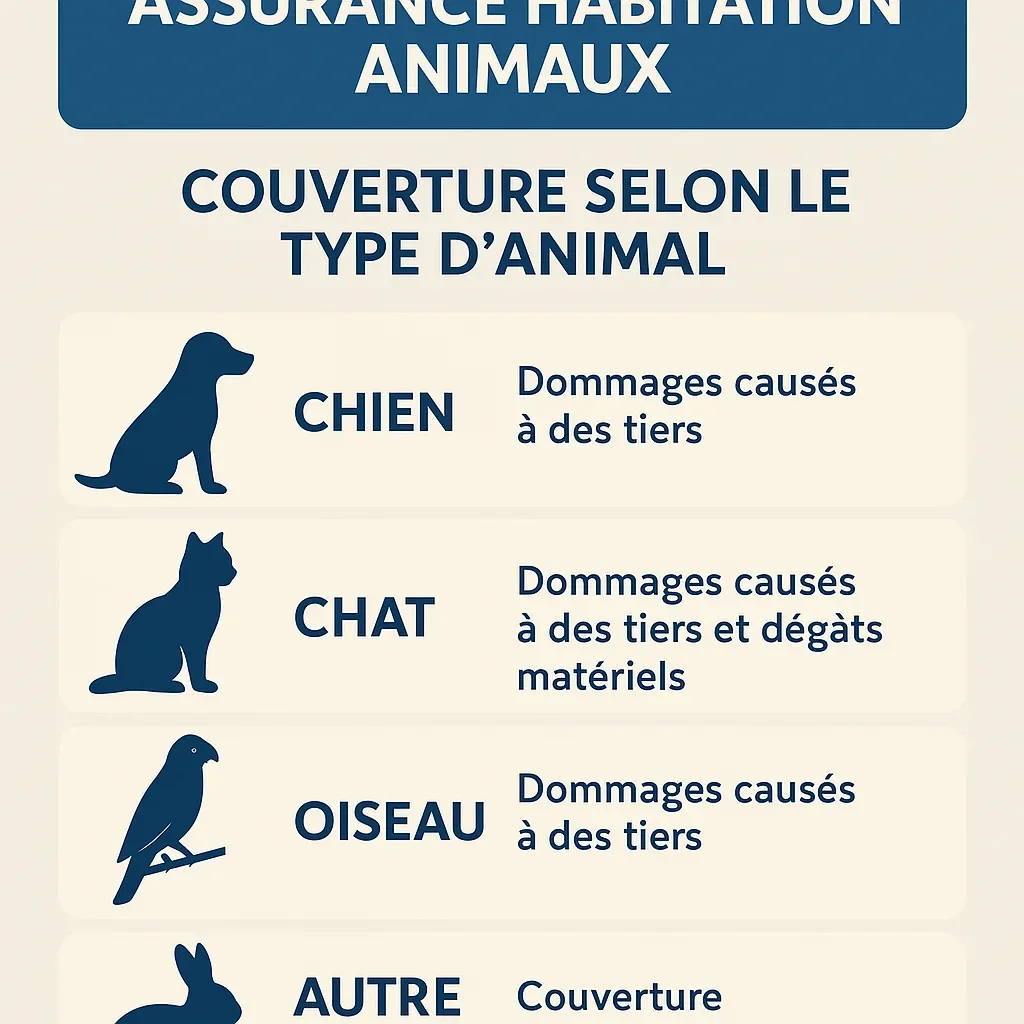
| Type of animal | Home liability coverage | Point of attention |
|---|---|---|
| Dog or cat | Often yes | Check exclusions and compensation limits |
| Exotic pet (rabbit, ferret, rodent, bird) | Sometimes yes | The contract may require prior declaration |
| Category 1 or 2 dog | Yes, but with specific obligation | Insurance essential and supporting documents to be provided |
| Horse or farm animal | Often no | Generally covered by a dedicated contract |
According to the Public Service, the owner of an animal remains responsible for the damage it causes, even if it escapes. This is exactly why the civil liability guarantee is central: it does not remove responsibility, but it prevents paying alone for the damage when the contract is properly arranged.
Should you declare your pet to the insurer?
As a general rule, no, not systematically for a typical dog or cat. But the key phrase here is “as a general rule.” Some insurers require a declaration for exotic pets (NAC), hunting dogs, animals considered sensitive, or any animal presenting a particular risk. In short, you need to read the contract, not just the sales brochure. 📄
You don’t always have to declare a pet, but this lack of formality doesn’t mean there are no limits. For certain exotic pets, hunting dogs, or risky animals, the insurer may require a declaration. If you keep a category 1 or 2 dog, the declaration becomes practically unavoidable.
The real issue with the declaration isn’t just administrative. It’s also about the deductible, exclusions, and coverage level. An insurer may accept the animal but with a lower limit or an additional premium. This is where many people get caught out because they think they are covered “like everyone else.”
In practice, a family who moved into an apartment in Bordeaux in 2023 thought their cat’s mutual insurance also covered damage to neighbors. The health contract did reimburse the care, but not the repair of a broken object in the hallway. This confusion between animal health and liability insurance happens very often.
- To declare without delay: categorized dog, non-standard exotic pet, animal kept for occasional guarding for payment.
- To check before anything else: exclusions, deductible, limit, need for certificate.
- Not to confuse: home insurance, animal health insurance, housing damage guarantee.
In other words, if your contract remains unclear, ask the insurer in writing. It’s much simpler to clarify before rather than after a claim. And yes, keeping a written record is less charming than a cute dog photo, but it can save your case.
What damages are compensated, and which remain your responsibility?
The line is quite clear: pet home insurance mainly covers damages caused to others. If your dog bites a neighbor, if your cat knocks over a screen at a friend’s house, or if an exotic pet damages property that isn’t yours, the liability coverage can apply. However, your own damage is not its preferred area. 🧩
Concretely, what often remains your responsibility are: the scratched sofa, your kitchen door, your dog’s basket, your own pet’s veterinary fees, or damage inside your home if the contract explicitly excludes this type of loss. The key point is that liability insurance protects others, not your interior.
It should be noted that the liability coverage of home insurance does not replace animal health insurance. The first compensates a third party, the second reimburses all or part of your dog’s or cat’s medical care. In other words, these are two different components, and confusing them is like mixing car insurance and roadside assistance.
The right contract is not the one that promises to pay for everything, but the one that clearly defines what is covered, what is not, and under what conditions the claim goes smoothly.
According to the Ministry of Economy, you should always check guarantees and exclusions before signing. This is even more important when an animal is involved, because the real risk depends as much on the type of animal as on your lifestyle.
What to do in case of a bite or damage caused by an animal?
The right reflex is to secure the animal, inform the affected person, preserve the evidence, and report the claim quickly. In practice, the cleaner the file, the faster the insurer can process it. The general rule remains to act within 5 working days, with photos, testimonies, and invoices as support. ⏱️
The most effective method looks like this:
- Eliminate the risk: remove the animal, prevent worsening.
- Gather evidence: photos, testimonies, report, written exchanges.
- Keep receipts: care, repair, replacement, transport.
- Report the claim to your insurer with a clear and dated account.
- Do not minimize anything: a small bite or a broken window can quickly become a full case.
In cases handled in cities, notably in Lyon or in the inner suburbs of Paris, we often see the same mistake: the declaration is made too late, with vague details, then the exchanges drag on. Yet, a precise description of the scene and well-organized supporting documents save a lot of time.
What special cases should be watched out for?
Sensitive cases are those that deviate from the model “calm dog or cat in a typical household.” This notably concerns 1st and 2nd category dogs, exotic pets (NAC), temporarily kept animals, hunting dogs, or animals that often roam outside the home. Here, the standard contract can fall a bit short. 🐕
The first special case is categorized dogs. The second is animals kept for a relative, neighbor, or for payment. In these situations, the insurer may consider that the risk level changes. And if you live in a condominium, the regulations may also add their own constraints, even if the home insurance covers liability.
Another often overlooked point: livestock animals, horses, or certain exotic animals rarely fall under standard coverage. For them, a separate contract is often required. That’s why a simple “yes, it’s fine, we are insured” means nothing until you have read the exact line about exclusions.
- Categorized dog: check the insurance obligation and required documents.
- Exotic pets (NAC): ask explicitly if they are included or excluded.
- Temporary care: specify if the animal is entrusted to you or if you keep it in exchange for payment.
- Condominium: reread the regulations, especially for movements and common areas.
How to choose a contract without unpleasant surprises?
The right pet home insurance contract is not necessarily the cheapest. It must above all be clear, stable, and suited to your profile. Whether you are a tenant, co-owner, or owner-occupier, the constraints are not the same. And if you have an animal that is somewhat off the beaten path, vigilance must be heightened. 🔎
Before signing, compare five simple points: liability coverage, compensation ceiling, deductible, exclusions, and declaration obligation. This is exactly where contracts differ. Two offers that look similar in price can tell very different stories at the time of a claim.
It is always advisable to request a written statement from the insurer on ambiguous cases: exotic pets, categorized dogs, animals kept by a third party, temporary stays with relatives, or pet-sitting activities. This small reflex avoids endless discussions at the worst moment. Cherry on the cake, you keep clear proof in case of dispute.
For a tenant, the issue is not limited to the animal. It is also necessary to check the home insurance of the dwelling itself, which remains practically essential. The ANIL also reminds that coverage of the dwelling and protection related to the animal do not address the same need. It is not the same box, nor the same logic.
- If you are a tenant: insure the dwelling, then check the liability insurance related to the animal.
- If you have a pet (NAC): have the coverage specified, even if the animal is small.
- If you are looking after an animal for someone: ask if the activity is covered.
- If you have a categorized dog: check the legal obligations above all.
FAQ — Home insurance and pets
My cat broke an object at a neighbor’s: am I covered?
Most often, yes, if the contract indeed includes civil liability related to animals. The guarantee can apply for an item broken at a third party’s place, provided the event is accidental and covered by the contract. Keep the receipt, a photo of the damage, and an exact account of the facts.
What if my animal injures a family member?
Coverage is often more limited when the victim is part of the household. Many contracts exclude or restrict damages between insured persons living in the same dwelling. Therefore, it is necessary to check the exact clause, as an injury to a close relative may be treated differently from damage caused to a neighbor.
Are exotic pets (NAC) always covered by home insurance?
No, not always. Some contracts include them, others do not, and some require prior declaration. A pet rabbit or ferret may be covered without issue in one policy but excluded in another. A simple confirmation email to the insurer can avoid many disappointments.
Does pet health insurance for dogs or cats replace home insurance?
No. Pet health insurance mainly reimburses health expenses, such as a veterinary consultation, surgery, or medication. Home insurance, on the other hand, mainly applies when the animal causes damage to a third party. They are two complementary protections, not two versions of the same product.
Do I need to inform the insurer if I change animals?
Yes, especially if the new animal is very different from the previous one in terms of risk. Switching from a cat to a large dog, or from a common pet to a particular exotic pet, can change the interpretation of the contract. A written update is always safer than a simple oral call.
What are the risks if a categorized dog is not declared?
The risk is twofold: an administrative penalty, with a fine that can reach up to €450, and above all a refusal or limitation of compensation in case of a claim. For this type of dog, declaration and contract compliance are not details, but the foundation.