
Mutual health insurance portability after dismissal: rights, duration, and procedures
A dismissal does not always immediately cut off mutual health insurance portability after dismissal. If you were covered by the company’s mutual insurance and you qualify for unemployment benefits, you can often keep your coverage without paying additional contributions, sometimes for 12 months. The real issue is the reason for termination, the deadlines, and having the right documents at the right time.
Sommaire
In brief
🔎 Mutual insurance portability extends health coverage after contract termination, provided you are entitled to unemployment insurance.
⏱️ The continuation is free for the former employee and is capped at 12 months, according to the Social Security Code and the Service-Public fact sheet.
🧾 The useful reflex: check the work certificate, the employer’s certificate, and the exact end date of rights, especially if the dismissal is for serious misconduct or unfitness.
Am I entitled to mutual insurance portability after dismissal?
The legal framework is based on the practical fact sheet from Service-Public and on article L.911-8 of the Social Security Code on Légifrance. Simply losing your job is not enough: the termination must also give entitlement to compensation from France Travail. This is the key point that shifts the case from a simple contract termination to a real continuation of coverage.
In other words, portability is neither a favor from the employer nor a bonus to negotiate upon departure. It applies by law as soon as the conditions are met. The employee normally does not have to pay contributions after leaving, since the funding is pooled with employees still in position and the employer.
- You were covered by the collective mutual insurance before termination.
- The termination entitles you to ARE or an equivalent unemployment benefit.
- Gross misconduct excludes the scheme; serious misconduct alone does not exclude portability.
- Continuation is automatic in principle, but you should check the documents provided by the employer.
Which types of dismissal entitle you to portability?
The most commonly misunderstood point is the difference between serious misconduct and gross misconduct. In practice, serious misconduct does not prevent portability if the employee meets the other conditions. Gross misconduct, however, cuts off the right to continuation. That is why it is important to read the reason for termination carefully, without stopping at the simple word “dismissal.”
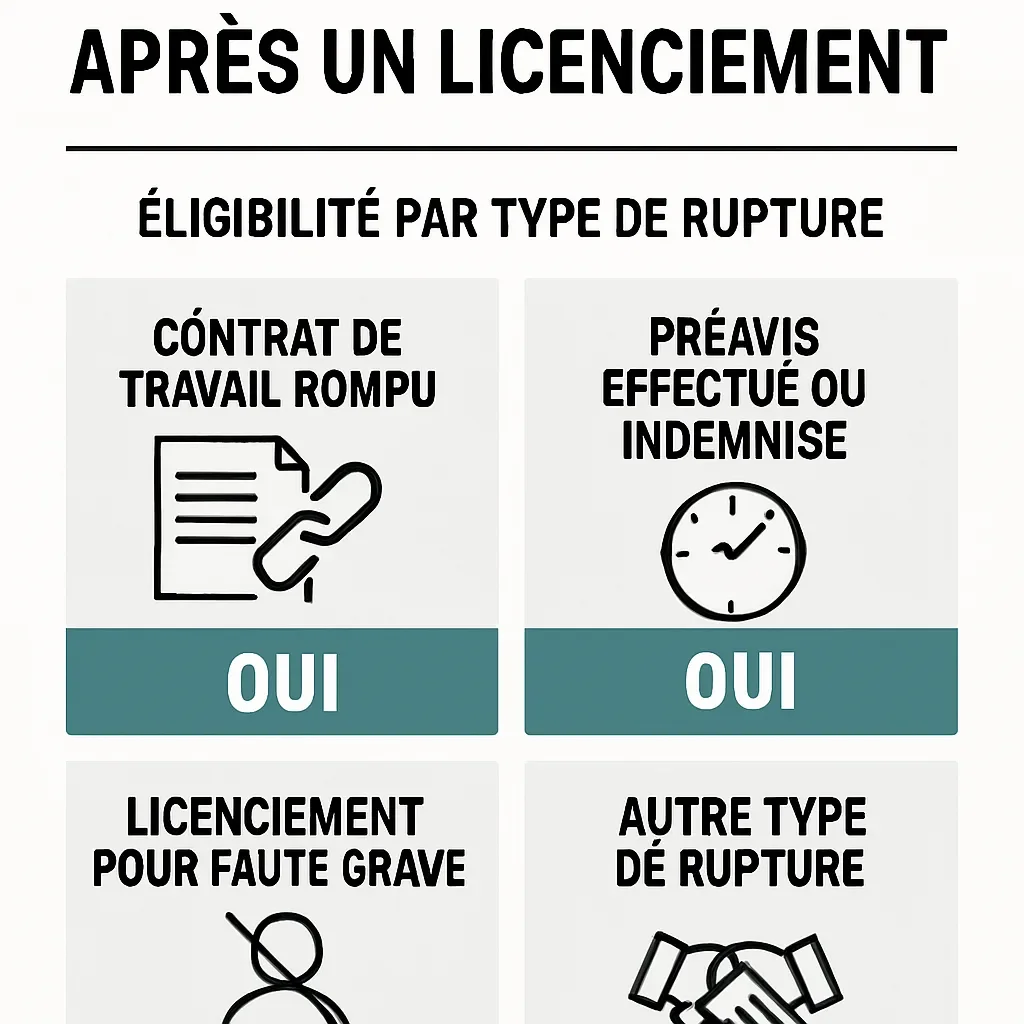
| Type of termination | Portability possible? | Key points to remember |
|---|---|---|
| Economic dismissal | Yes | Coverage continues if the unemployment benefits (ARE) are open. |
| Dismissal for personal reasons | Yes | The reason matters less than the right to unemployment benefits. |
| Dismissal for serious misconduct | Yes, in principle | Serious misconduct alone does not exclude portability. |
| Dismissal for gross misconduct | No | This is the clearest exclusion from the scheme. |
| Mutual agreement termination | Yes, if unemployment rights exist | It is not a dismissal, but coverage can still continue. |
The case of dismissal due to unfitness deserves a brief clarification. Whether it is work-related or not, it can open portability if unemployment compensation follows. However, if the collective contract did not cover the family, portability will not suddenly create additional beneficiaries: it extends what already existed.
How to calculate the duration of mutual insurance portability after a dismissal?
The duration follows your unemployment rights and can never exceed 12 months. If you are compensated for 8 months, the mutual insurance is maintained for 8 months; if your rights last longer, the 12-month cap applies. An employee leaving after 24 months in the company therefore does not get 24 months of portability.
In practice, the end date of the contract, the effective opening of rights at France Travail, and the continuity of compensation are mainly considered. If you are compensated continuously, coverage follows this period up to the cap. If your rights end earlier, portability also stops.
- Contract end: portability starts at the end of the employment contract.
- Unemployment compensation: it conditions the actual duration of coverage.
- Legal cap: 12 months, even if rights last longer.
- Early termination: resuming employment with coverage, stopping unemployment benefits, or reaching the maximum period.
What steps should be taken to keep your mutual insurance?
Most often, portability is set up without complex procedures, but it is still necessary to check the documents and dates. Concretely, the employer must provide the end-of-contract documents, notify the insurer of the continuation, and allow you to verify that coverage continues properly. If a document is missing, you must follow up quickly.
The healthiest process is this one: check the work certificate, the certificate intended for France Travail, then read the mutual insurance notice or letter. In some cases, the insurer requests confirmation of rights opening. The more complete the file is from the start, the less risk you have of facing a coverage gap at an inconvenient time.
- Verify the contract end date and the start date of coverage.
- Keep all receipts provided by the employer.
- Notify the insurer if a document is missing or if portability does not appear clearly.
- Check the coverage for routine care, hospitalization, optics, and dental.
Does portability also cover provident insurance and dependents?
Yes, if the group contract already covered these guarantees and if they are maintained in the insurer’s notice. Portability does not create new rights: it extends what already existed. Children or the spouse remain covered only if they were already affiliated before the termination.
It is also necessary to distinguish mutual insurance and provident insurance. Mutual insurance serves to supplement health reimbursements, while provident insurance often covers more serious risks such as incapacity, disability, or death. Both mechanisms can follow portability, but not necessarily under the same conditions, as it all depends on the wording of the group contract.
The right question is not just “am I entitled to portability?”, but “what is actually maintained, and until what date?”. This is where the cases are decided.
In practice, many employees confuse the maintenance of guarantees with the creation of new guarantees. In other words, portability protects what already existed, but it does not turn a basic individual contract into a premium plan. It’s a detail, certainly, but a detail that avoids very concrete disappointments.
What to do at the end of portability?
The best strategy is to prepare the next steps before the end of the coverage, not after. If you find a job with mandatory mutual insurance, the transition is often simple. Otherwise, you need to compare an individual mutual insurance or check if another coverage becomes more advantageous, for example through a new group contract or the Complementary Health Solidarity depending on your situation.
The safest is to anticipate at least one month before the deadline. This allows time to request quotes, compare reimbursements, and check for any waiting periods. The end of portability is precisely the moment when unpleasant surprises like to slip into the file, like a little bitter cherry on the cake.
- New job: check the enrollment date for the new employer’s mutual insurance.
- No new job: compare an individual complementary health insurance before the cutoff.
- Tight budget: see if the Complementary Health Solidarity is possible.
- Ongoing treatments: request written confirmation of the end date of the guarantees.
FAQ
Is mutual insurance portability automatic?
In principle, yes. You do not have to “request a right” as with classic social aid: if the conditions are met, coverage continues after the contract ends. In practice, however, you still need to check the documents provided by the employer and the insurer’s notification.
Can I lose portability if I take a part-time job?
Yes, as soon as you no longer meet the conditions entitling you to continued coverage. If you take a job with mandatory collective coverage, portability is no longer intended to continue. The most useful thing is therefore to compare the start and end dates of both coverages.
Do my children remain covered if I was already insured with them?
Yes, if the dependents were already attached to the group contract at the time of termination. Portability extends the existing situation; it does not broaden it. If a child was not on the contract before the dismissal, they will not be automatically added during the continuation period.
What happens if the employer forgets to send the documents?
You must promptly follow up in writing. Keep the work certificate, the attestation intended for France Travail, and all exchanges with the mutual insurance. In case of blockage, a dated written request can prove that coverage was supposed to apply and from when.
Does portability also apply in the case of dismissal for unfitness?
Yes, generally, if the unfitness entitles you to unemployment insurance. The type of dismissal is not the only criterion: the real key is access to benefits. That is why you must always look at the exact legal reason and not just the label “dismissal”.
Can I combine portability and Complementary Health Solidarity?
Portability and Complementary Health Solidarity respond to different logics, so combining them depends on your situation. If your income drops significantly after termination, the CSS may become more relevant. The most reasonable approach is to compare the two solutions before the end of the coverage.