
In brief
🧭 A chronic illness does not mean automatic refusal: the insurer mainly looks at the stability of the treatment, possible complications, and the amount covered.
📌 The Lemoine law can remove the medical questionnaire for certain real estate loans: €200,000 per insured and repayment before age 60.
🔎 If the file remains sensitive, the AERAS agreement triggers a multi-level examination, sometimes with a real chance to bypass an initial refusal.
Does chronic illness really block borrower insurance?
No, not automatically. In practice, the insurer mainly seeks to assess the probability of a claim over the loan period: prolonged work stoppage, disability, repeated hospitalization, or worsening health condition. In other words, the more stabilized and well-documented the pathology is, the more defensible the file remains.
What complicates things is less the label of “chronic illness” than its concrete consequences. Balanced diabetes, mild asthma, or stabilized IBD are not evaluated as a pathology with renal, cardiac, or respiratory complications. The insurer does not just see a diagnosis: they see a risk, dates, tests, and medical history.
Which chronic illnesses attract the most attention from insurers?
The most sensitive files are often those related to pathologies that can evolve in flare-ups or with complications. We think of diabetes, severe asthma, chronic inflammatory bowel diseases, rheumatoid arthritis, multiple sclerosis, or certain autoimmune diseases. This does not mean systematic refusal, but often a more detailed questionnaire, surcharge, or reduced coverage.
| Common situation | Insurer’s interpretation | Possible effect | Good practice |
|---|---|---|---|
| Stabilized diabetes | Variable risk depending on complications and monitoring | Surcharge or specific conditions | Provide recent report and treatment |
| Mild to moderate asthma | Assessment based on frequency of attacks | Frequent acceptance, sometimes reservation | Show stability over 12 months |
| Exonerating ALD | Administrative status, not insurance verdict | No automatic advantage | Do not confuse ALD with right to be forgotten |
| Cancer in remission | Very regulated medical history | Facilitated access if AERAS delay reached | Check the AERAS reference grid |
| Disease with complications | Higher risk on ITT/IPT | Exclusion or increased pricing | Compare several insurers before signing |
It is also necessary to distinguish two things that are too often mixed up: the death coverage and the coverages related to incapacity or disability. A chronic illness may allow a “decent” death coverage while causing an exclusion on ITT or IPT. This is where reading the contract becomes crucial, because the devil is often in the small print.
What are your rights with the Lemoine law and the AERAS agreement?
The Lemoine law and the AERAS agreement form the basic duo for a borrower with a chronic illness. The first lightens or removes the medical part in certain cases; the second organizes a re-examination of the file when the risk is considered aggravated. Together, they prevent a first “no” from closing the door permanently.
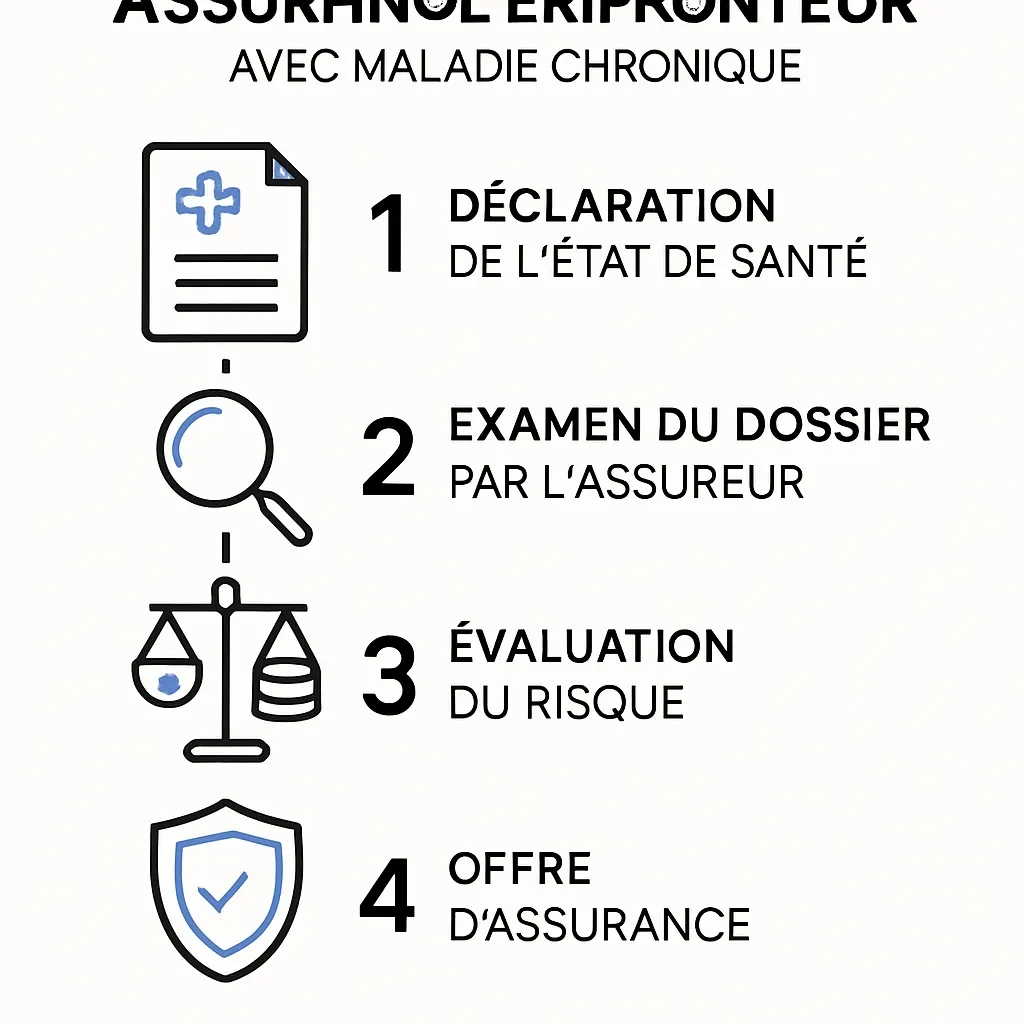
The AERAS agreement serves as a safety net when the insurer considers the file too risky at first glance. It does not guarantee automatic approval, but it opens the door to a more thorough review, often decisive for stabilized pathologies and well-calibrated real estate projects.
Practically, the AERAS review works in stages. The file first goes to the standard insurer. If it is blocked, it can be re-examined at a second level, then at a third, more specialized level. So it is not a magic window, but a re-examination process that increases your chances if your file is clean and your guarantees are consistent.
The right to be forgotten also plays an essential role for certain pathologies, notably some cancers and hepatitis C, under conditions. The principle is simple: after a defined period without relapse or active treatment, you no longer have to declare the previous illness within the framework provided by the AERAS reference grid. It is a real relief for the borrowers concerned.
For official texts, you can consult the Ministry of Economy’s page on the AERAS agreement and the Lemoine law text on Légifrance. For a practical view, the Service-Public search on borrower insurance is also useful.
What must be declared in the health questionnaire?
You must declare what the questionnaire asks for, and nothing less. In practice, this means answering precisely about ongoing treatments, hospitalizations, sick leaves, possible complications, and the medical history targeted by the form. The watchword is coherence: an approximate answer can cost much more than an accepted surcharge.
The real trap is not the illness itself, but the omission or minimization. An omission can be interpreted as a false declaration, with serious consequences at the time of a claim. In short, it is better to properly report a medical history than to hide it partially, especially if the questionnaire asks for specific periods.
- Keep your reports: prescriptions, recent assessments, hospitalization reports, follow-up exams.
- Answer factually: date of diagnosis, treatments, evolution, possible complications.
- Do not confuse ALD and insurance severity: an ALD is not automatically synonymous with refusal.
- Check the timeframes: some questionnaires focus on recent years, others on a longer history depending on the contract.
It is observed in practice that a well-balanced diabetes file, with annual follow-up and recent assessments attached from the start, often passes faster than a hastily completed file. Conversely, vague answers trigger more document requests and unnecessarily lengthen delays.
If a medical advisor or the insurer asks you for additional information, take it as a necessary step, not as a punishment. The goal is to calibrate the contract, not to trap you. And if the questionnaire seems too intrusive, remember that the legal framework has precisely reduced data collection in some cases thanks to the Lemoine law.
How to compare offers to pay less?
Comparing offers is not just about looking at the contribution rate. You need to compare the coverage percentage, the guarantees, the exclusions, the waiting periods, the deductibles, and how the insurance actually covers your medical situation. An offer that is slightly cheaper on paper can turn out to be a bad deal if it specifically excludes the risk that concerns you.
The right approach is to look at the contract as a whole. An insurance delegation can be more flexible than a bank group contract, but only if the guarantees are equivalent or accepted by the bank. For a chronic illness file, the battle is often won on the details, not on the commercial slogan.
| Option | Main advantage | Possible limitation | For whom? |
|---|---|---|---|
| Bank group contract | Simplicity and quick subscription | Rate less adaptable to medical profile | Standard file, need for speed |
| Insurance delegation | Finer pricing and targeted guarantees | Requires serious comparison | Borrower who wants to optimize cost |
| Reduction of coverage percentage | Direct reduction of insured cost | Less broad protection for the sick borrower | Couple with complementary incomes |
The classic trap is not the surcharge itself; it is accepting an exclusion without really measuring it over the duration of the loan. In borrower insurance, the real price is read in the coverage, not just in the monthly payment.
In practice, a broker can help save time, especially if the file includes several medical histories or a long-term condition (ALD). It’s not magic, but a better reading of the market: who accepts what, with what surcharge, and on which guarantee. Joking aside, this step sometimes avoids having to submit ten requests for a single final agreement.
What to do in case of surcharge, exclusion, or refusal?
The first thing to do is not to stop at the first negative letter. A surcharge can sometimes be negotiated, an exclusion can be compensated by another offer, and a refusal can be reconsidered within the AERAS framework or via an insurance delegation. The most important thing is to keep a clean file and to play on several levers at once.
In case of refusal, insurance delegation and adjusting the coverage percentage are often more effective than simply submitting a new request at the same place. The idea is not just to sign, but to obtain acceptable coverage without blowing up the total cost of the loan.
If the contract excludes incapacity related to your chronic illness, you can sometimes keep decent death and total permanent disability (TPD) coverage, then complement your financial security otherwise. A better-insured co-borrower, a differently distributed coverage percentage, or a slightly adjusted real estate project can change the game. It’s not very glamorous, but it’s often pragmatic.
The usual sequence generally looks like this:
- reread the guarantees and exclusions line by line;
- request a reassessment of the file if the health condition is stabilized;
- request an insurance delegation or a broker;
- check eligibility for AERAS and the right to be forgotten;
- adjust the coverage percentage or, if necessary, slightly revise the financing project.
One last point to keep in mind: the lowest rate is not always the most protective. When you have a chronic illness, the real victory is to get a contract that remains usable the day life puts on the brakes. And that, frankly, is worth a few hours of comparison.
FAQ — Borrower insurance and chronic illness
Can you get borrower insurance with diabetes?
Yes, often. It all depends on glycemic control, possible complications, and the type of guarantees requested. Well-managed diabetes can be accepted with a surcharge, whereas a complicated file can lead to exclusions on incapacity or disability.
Does ALD allow avoiding the medical questionnaire?
No, not by itself. ALD is an administrative status related to the coverage of care, not an insurance shortcut. What matters for the contract is the legal framework applicable to the loan and the rules of the health questionnaire.
Does the right to be forgotten apply to all chronic diseases?
No. It mainly concerns certain cancers and hepatitis C, under specific conditions and according to the deadlines provided by the AERAS framework. Other chronic diseases are subject to a standard medical analysis, even if they have been stable for a long time.
Can two people borrow if only one co-borrower is ill?
Yes, and it is even a common strategy. The share can be divided to better protect the borrower who is better insured, which often reduces the overall cost while maintaining credible coverage for the bank.
Can a bank refuse my insurance delegation because of my health?
It cannot refuse for this sole reason if the guarantees are equivalent. However, it can require that the alternative contract meets the expected level of coverage. The crux of the matter remains the comparison of guarantees, not just the price.
Should an old illness be declared if it is stabilized?
Yes, if the questionnaire asks you and if you are not in a case where the removal of the questionnaire applies. It is better to answer clearly with dated and verifiable elements than to risk a false declaration that could jeopardize the entire contract.