
In brief
📌 Job loss insurance is an optional guarantee of borrower insurance, mainly designed for mortgage loans.
🔎 It primarily targets involuntary dismissal. Resignation, mutual termination, and self-employed statuses are often excluded or very strictly regulated.
💸 The real issue is not just the price, but the trio of waiting period / deductible / indemnity duration. Without these, the coverage can remain theoretical.
✅ It can make sense if your monthly payments weigh heavily and if you have little savings. Otherwise, it is sometimes better to keep the margin for a more flexible safety cushion.
Job loss insurance: what is it really for?
Job loss insurance mainly serves to cover part of the monthly payments of a loan if you involuntarily lose your job. It is neither mandatory nor universal. In practice, it mainly protects certain permanent contract employees, but its usefulness depends on the cost, exclusions, and your safety margin.
Legally, it is referred to as an optional guarantee attached to borrower insurance. The framework is recalled by Service-Public.fr: the coverage primarily targets employees, and the triggering event is most often a dismissal. In other words, it is not “unemployment” insurance in the broad sense, but a very targeted protection.
This is also where many get caught out. The name suggests broad coverage, whereas the contract often limits the scope to specific cases, with conditions regarding seniority, age, and contract type. In the end, the bank protects itself, yes, but not magically: the contractual mechanism remains king.
Why do banks still offer it?
Because a loan runs for a long time, and a setback can quickly derail a budget. For a highly exposed borrower — a single income, dependent children, high rent or monthly payment — the guarantee can prevent dipping too quickly into savings. Cherry on the cake: it can reassure the lending institution at the time of file approval.
How does job loss insurance work when you are dismissed?
In practice, job loss insurance only activates after a dismissal covered by the contract, then only after a waiting period and a deductible. It generally pays part of the monthly payment for a limited duration. It is therefore a useful protection, but very far from a full replacement income.
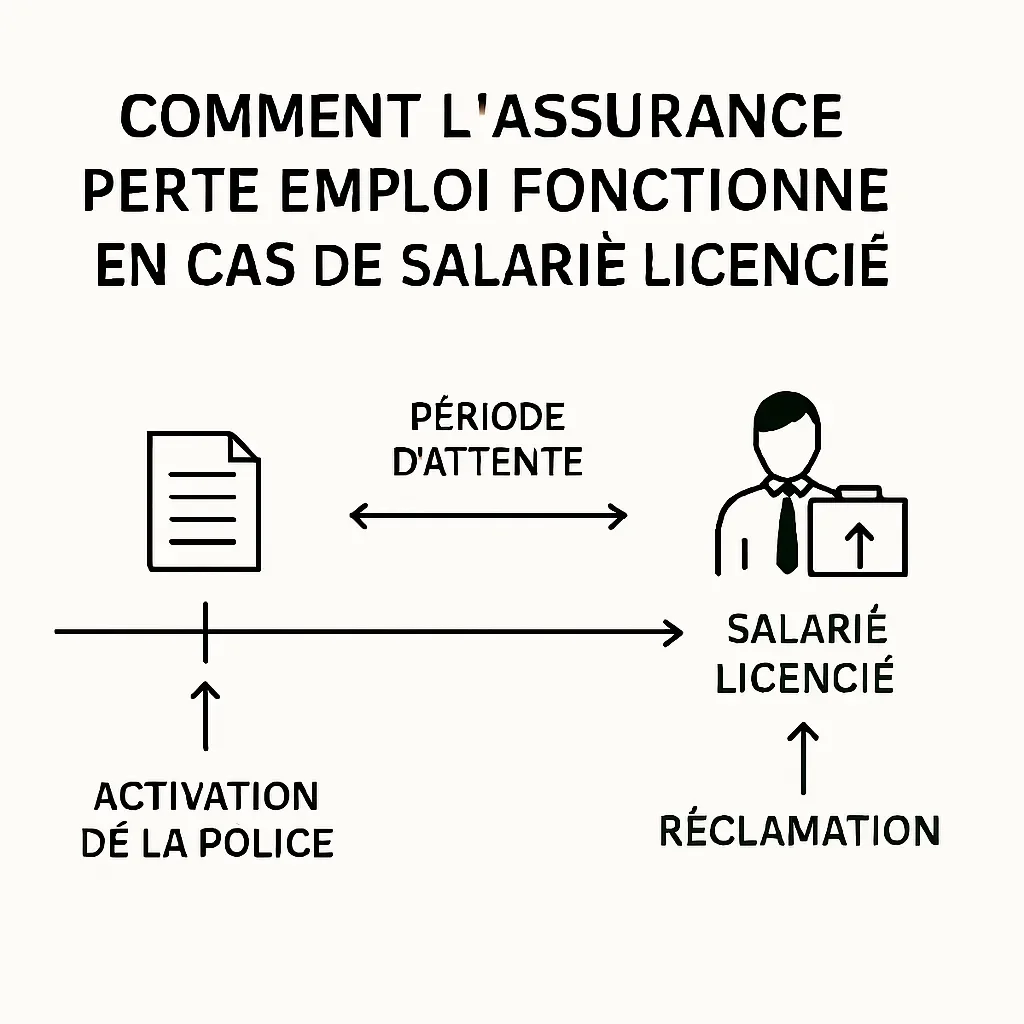
The key point is that not everything starts at the same time. First, the contract may provide for a waiting period at subscription, that is to say a period during which the coverage exists on paper but does not yet apply. Then often comes a deductible after job loss: you must remain unemployed for a minimum period before the first reimbursement.
Once the coverage starts, it generally remains partial and capped. Some contracts reimburse a fraction of the monthly payment, others set a monthly ceiling or a maximum duration per claim. In other words, you have to read the notice as you would read the fine print of a phone contract: that’s where the real story hides.
The three key points to know before signing
- The waiting period: it protects the insurer against subscription just before a foreseeable dismissal.
- The deductible: it delays compensation and can make the coverage useless if your unemployment is short.
- The ceiling: it limits the amount actually paid, even if your monthly payment is higher.
In practice, a rejected file is often due to a silly reason: late declaration, missing proof, or misinterpretation of the clause. An anonymized bank agent often sums up the problem like this: many borrowers buy an “imagined” security, not the one actually stated in the contract.
Should you take it depending on your profile and budget?
The coverage becomes interesting when your monthly payment weighs heavily, your emergency savings are low, and your professional situation matches the contract’s criteria. Conversely, if you have two stable incomes, a solid financial cushion, or the possibility to adjust the loan, its interest quickly decreases.
The right calculation is not just “how much does it cost?”, but “what am I really buying in return?”. On a mortgage, this option often increases the premium by a few euros to several tens of euros per month, depending on age, capital, duration, and deductible. If the protection remains theoretical due to exclusions, the bill quickly becomes bitter.
| Profile | Interest of the coverage | Quick overview |
|---|---|---|
| Employee on a permanent contract, single income | Rather high | Useful if monthly payments weigh heavily and emergency savings are low. |
| Couple with two stable incomes | Medium to low | The risk of total loss of income is lower, especially with several months of savings. |
| Self-employed, auto-entrepreneur, freelancer | Often low | Many contracts exclude these statuses or cover them very poorly. |
| Fixed-term contract, temporary work, trial period | Often not relevant | The contract is rarely adapted to these situations, as the employment is not “stable” enough in the insurer’s eyes. |
| Solid savings and adjustable loan | Rather low | Internal alternatives to the loan can do better for less. |
In short, the right question is not “am I afraid of unemployment?”, but “do I already have a credible plan B if my income drops?”. If the answer is yes, the option loses much of its interest. If the answer is no, it can play a cushioning role, provided the contract really covers your risk scenario.
What are the limits and edge cases to watch out for?
The real trap is not just the exclusions written in small print, but the cases where the contract seems reassuring while it covers almost nothing. Resignation, mutual termination, self-employed status, probation period, or retirement can be enough to void the compensation.
In many contracts, coverage mainly targets involuntary dismissal. Some plans accept broader cases, but this is rare and very regulated. You therefore need to check the exact definition of “lost job,” because two insurances with similar names can operate very differently.
- Resignation: almost always excluded, except for very specific special cases.
- Mutual termination: a frequent gray area, often excluded, sometimes covered if the contract explicitly states so.
- Gross misconduct: generally excluded, as the insurer considers the risk not to be random.
- Fixed-term contracts, temp work, freelance: often out of scope or subject to conditions so strict that coverage becomes marginal.
- Age limit: subscription is often closed around 55 or 60 years, with coverage ending near retirement.
In my opinion, a job loss insurance should be judged less by its name than by its mechanics. If it only buys a false sense of security, it’s better to keep your money for a real safety cushion.
How to compare contracts without getting misled?
Comparing job loss insurance requires looking at the cost, but especially the actual level of protection. If the contract imposes a long waiting period, a high deductible, and a low cap, you are mostly paying to sleep a little better, not to secure a real setback.
The smartest approach is to simulate a real scenario: how much would be paid, from when, for how long, and for what type of termination? There, the magic quickly disappears. And that’s a good thing, because a comprehensible contract is better than a brochure full of promises in the metadata.
The comparison checklist
- Covered event: dismissal only, or also certain negotiated terminations?
- Amount covered: part of the monthly payment, monthly cap, insured portion.
- Delays: waiting period at subscription, deductible after job loss.
- Duration: 6, 12, 18, or 24 months?
- Exclusions: probation period, gross misconduct, independent status, end of fixed-term contract.
- Declaration procedure: reporting deadline and documents to provide.
If you need to activate it, here is the process to follow
- Report the claim as soon as possible, without waiting until the last minute.
- Gather the requested documents: dismissal letter, proof of registration with France Travail, amortization schedule, bank details, identity document.
- Check that you are outside the waiting and deductible periods.
- Send the file in writing and keep a copy of each document.
- Follow up on reminders, as a delay can postpone or block compensation.
In practice, the same mistakes are often seen: missing a document, misreading the contract, or declaring too late. A family recently going through a dismissal said they thought they were covered “automatically”; in reality, administrative delay postponed the payment by several weeks.
If you are still unsure, the logic is simple: the tighter your budget, the harder your job is to replace, and the lower your savings, the more the guarantee deserves attention. Conversely, if you have a good cushion and real flexibility on your loan, the money can often work more usefully elsewhere.
What are the alternatives if you don’t take it?
Giving up unemployment insurance does not mean staying without a plan. There are solutions that are sometimes more flexible, sometimes cheaper, and above all clearer. The idea is to build your protection around your reality, not around a standard contract that poorly fits your needs.
- Build an emergency savings fund equivalent to several months of fixed expenses.
- Choose a flexible loan, with the possibility to lower or temporarily suspend monthly payments.
- Reduce the initial monthly payment by adjusting the term or the initial down payment.
- Check other guarantees of the borrower’s insurance, notably incapacity and disability, often more useful on a daily basis.
- Do not confuse credit security and income protection: these are two related but not identical topics.
In many cases, the best protection is not the most sophisticated. It is the one you can activate without a fight, understand without a magnifying glass, and finance without regret. In other words: a good cash cushion and a flexible loan can do better than some insurance policies that are too nicely packaged.
FAQ — Unemployment Insurance
Does unemployment insurance cover a mutual termination?
Often not, or only under very specific conditions. Many contracts reserve it for involuntary dismissal, while mutual termination remains a gray area. You need to read the exact definition of the covered event, as two insurers can have opposing rules.
Can you take out unemployment insurance with a consumer loan?
Yes, sometimes, but the product is rarer and generally less advantageous than for a mortgage loan. Eligibility rules and limits can be very different. Before signing, especially compare the total cost with the monthly payment actually protected.
How long does it take to be compensated?
Never immediately. You must first respect any waiting period, then the deductible after the claim. On the market, the deductible is often between 30 and 180 days, which can delay the first payment by several months.
Is it useful if I already have a large savings?
Not always. If your reserve already covers several months of expenses and you can adjust your loan, the interest in the option drops significantly. In this case, you often pay for a risk you already know how to absorb otherwise.
Can this coverage be canceled during the loan term?
Often yes, but it depends on the contractual support and the insurer’s conditions. If the coverage is integrated into the borrower’s insurance, you need to check the modification or cancellation procedure provided in the contract. The right reflex: ask for a written confirmation before canceling.
What should you check before saying yes?
At least three things: the exact type of unemployment covered, the delay before compensation, and the coverage limit. Without this information, it is impossible to know if the guarantee really protects your budget or if it only reassures on paper.