
Outsourced Telephone Answering Service for SMEs: Price, Benefits, and Selection Criteria
The outsourced telephone answering service involves entrusting the management of incoming calls to a specialized provider who answers on behalf of your company, filters requests, takes messages, transfers relevant calls, and, depending on the offer, can also manage the calendar or commercial qualification. For an SME, it is a flexible way to maintain a professional telephone reception without bearing the fixed cost of a full-time internal switchboard.
The benefit is especially clear when calls come in overflow, during holidays, outside business hours, or when the team is already busy with production, sales, or appointments. But before signing, you need to understand what the service actually includes, compare the tele-secretarial price according to the pricing model, then check the provider’s quality, their service commitments, and confidentiality guarantees.
Sommaire
In brief
📞 An outsourced telephone answering service acts as an interface between your clients and your team: it limits missed calls, improves the answer rate, and secures reception when your employees cannot answer.
💶 The price mainly depends on call volume, covered hours, the level of qualification required, and options such as outsourced appointment scheduling, call transfer, or CRM integration.
🔎 For an SME, the right choice is not just the lowest price: you must compare the SLA, welcome scripts, transparency of setup fees, GDPR compliance, and the capacity to handle activity peaks.
Understanding the outsourced telephone answering service
In its simplest form, the outsourced telephone answering service replaces or complements your internal reception during defined time slots. The provider answers on behalf of your company, follows a welcome script, identifies the purpose of the call, takes a message, or directs the caller to the right person. It is the difference between “letting it ring” and offering a structured telephone journey, even when your team is unavailable.
What the service really covers
A serious offer is not limited to “answering the phone.” It can include message taking, call qualification, transfer to the right contact, emergency management, appointment scheduling, instruction reminders, and sometimes updating a calendar or CRM. The clearer the scope, the more you avoid misunderstandings at billing or overrun times.
- Outsourced telephone reception with personalized script.
- Management of incoming calls during chosen hours.
- Call overflow in case of absence, meeting, or activity peak.
- Outsourced appointment scheduling according to your availability rules.
- Emergency transfer, commercial filtering, message taking, or written summary.
Differences with an internal switchboard or tele-secretarial service
An outsourced telephone switchboard is not always identical to an outsourced secretarial service. The switchboard focuses on answering, filtering, and directing, while tele-secretarial often adds more advanced administrative tasks. For an SME, the distinction matters: a basic reception service is cheaper, but a need for appointments, request reformulation, or calendar integration requires a more complete service.
| Solution | What it covers | Main advantage | Common limitation |
|---|---|---|---|
| Internal switchboard | Physical reception and incoming calls within the company | Full control and immediate proximity | High fixed cost, low flexibility in case of absence |
| Outsourced telephone answering service | Answering, messages, filtering, transfer, overflow | Flexibility and service continuity | Requires precise framing of scripts and rules |
| Tele-secretarial service for SMEs | Reception + administrative tasks, calendar, appointments, follow-up | Broader time savings | Higher tele-secretarial price if scope is extended |
What is the price of an outsourced telephone answering service?
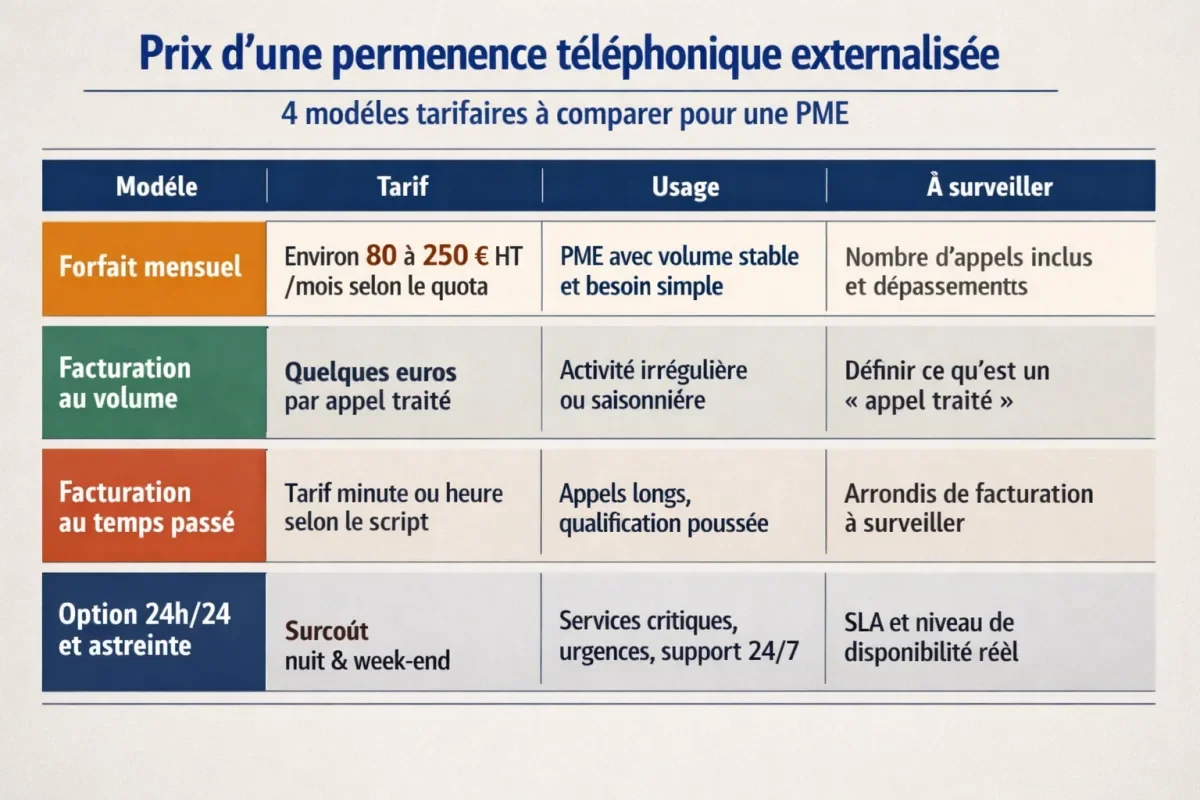
The price of outsourced telephone answering services varies greatly depending on the call volume, time slots, level of qualification, and included options. In practice, an SME can find entry-level offers for a few dozen euros per month, but the budget quickly rises as soon as extended hours, a more personalized outsourced telephone switchboard, or a 24/7 telephone answering service are added.
| Pricing model | Indicative range | For what use? | Points of caution |
|---|---|---|---|
| Monthly flat rate | About €80 to €250 excl. tax/month for a small business, sometimes more depending on the quota | SMEs with stable volume and simple needs | Monitoring the number of included calls and overages |
| Volume-based billing | Often a few euros per handled or qualified call | Irregular or seasonal activity | Clearly define what a “handled call” is |
| Time-based billing | Minute or hourly rate, depending on script complexity | Long calls, advanced qualification, technical cases | Billing rounding can increase the cost |
| 24/7 option and on-call duty | Frequent surcharge, especially at night and on weekends | Critical services, emergencies, extended customer support | Check SLAs and actual availability level |
Additional fees that make a difference
The real cost is not limited to the monthly subscription. You also have to look at setup fees, the creation of welcome scripts, line transfer, integration with calendar or CRM, reporting options, and sometimes early termination fees. Some providers display a very competitive rate, then charge for each adjustment or additional time slot.
- Activation: initial setup, forwarding numbers, instructions.
- Options: calendar, SMS, email, CRM, priority messages.
- Overconsumption: exceeding call or minute quotas.
- Contract: commitment, notice period, termination or migration fees.
What makes the bill vary
The number one factor remains the call volume. A small artisan SME with a few urgent calls per day will not pay the same rate as a consulting firm, a clinic, or an e-commerce service receiving continuous requests. Then come the covered hours: daytime only, evenings, Saturdays, or true 24/7 coverage. The more immediate and complex the demand, the higher the price.
The requested level of qualification also weighs heavily. A simple message left by the prospect does not cost as much as an exchange capable of identifying the reason, urgency level, concerned service, and the correct escalation level. As soon as call qualification or outsourced appointment scheduling is added, it moves away from a simple answer towards a higher value-added service.
What concrete benefits for an SME?
For an SME, outsourced telephone answering is only profitable if it truly improves commercial or operational availability. The main advantage is simple: fewer missed calls, therefore fewer lost opportunities. At the same time, the team gains time, interruptions decrease, and the reception becomes more consistent, even during peak activity or absences.
Reduce missed calls without hiring
In many small businesses, the phone rings when everyone is already in meetings, on site, or in production. A well-configured outsourced reception can absorb this call overflow and maintain a good answer rate during critical periods. In practice, this avoids losing leads, client emergencies, or quote requests that cannot wait.
Concrete example: a B2B service firm that was missing about ten qualified calls per week often gains more by outsourcing peak hours than by hiring a part-time position. If each lost call represents a sales or appointment opportunity, the savings are not only in salary costs but in revenue saved.
Improving Brand Image and Customer Satisfaction
A quickly answered call inspires more trust than an answering machine or endless hold music. The customer perceives a structured company, capable of managing priorities and calling back when necessary. This is particularly useful for SMEs that want to appear more solid than they actually are in volume, without losing the closeness that makes their difference.
- Faster response to prospects and customers.
- Consistent reception, even in the absence of the manager.
- Less frustration on the interlocutor’s side, thus less unnecessary escalation.
- More professional image during initial business contacts.
Gaining Productivity in Daily Operations
The hidden value of outsourcing is the time regained. Each call interrupting a technical task, a site visit, or a business negotiation costs more than it seems. By filtering requests, the provider prevents teams from spending their day “reconstructing the thread” after each ring. Over a week, the gain in concentration can be very significant.
For an SME, this gain is often visible in three scenarios: off-hours, holidays, and periods of commercial tension. During these times, 24/7 or targeted time slot telephone answering acts as a buffer. It protects the activity without imposing a permanent payroll burden.
How to Choose the Right Provider?
The right provider is not the one who promises the lowest price, but the one who provides a clear SLA, welcome scripts adapted to your business, real billing transparency, and solid confidentiality management. For an SME, the decisive criterion is often the quality of call handling, not just the volume of responses.
Essential Selection Criteria
| Criterion | What to Check | Why It’s Important |
|---|---|---|
| Availability | Exact hours, public holidays, 24/7 telephone answering or not | Avoids gray areas on urgent calls |
| Script Quality | Customization, business vocabulary, level of formalization | Determines the quality perceived by your clients |
| Qualification | Filtering, urgency, reason, callback, transfer, appointment scheduling | Measures the real commercial and operational contribution |
| Integration | Calendar, CRM, email, SMS, internal tools | Reduces double entries and errors |
| Confidentiality | Process, training, data management, contractual clauses | Essential for sensitive information and GDPR |
On the regulatory level, the CNIL reminds that personal data must be collected for a determined purpose, limited to what is necessary, and protected by appropriate security measures. If the provider handles names, numbers, call reasons, appointments, or health information, compliance and traceability are not optional: they are part of the service.
Questions to Ask Before Signing
- What exactly does the offer include: simple answering, qualification, message taking, appointment scheduling?
- What are the overrun thresholds and associated fees?
- How are activity peaks absorbed during busy periods?
- What is the switch-over delay in case of failure or unavailability?
- Does the provider supply reports, statistics, and monitoring of the answer rate?
- Is there a trial period or a termination with short notice?
Also ask for script examples, a demonstration of the call flow, and details on the hours actually covered. An offer may seem complete on paper but prove limited in practice if urgent calls are redirected to voicemail or if transfer time slots do not coincide with your actual activity.
How to Compare Multiple Offers Without Mistakes?
Comparing an outsourced telephone answering service is not about lining up subscriptions on an Excel sheet. You must compare the real cost per handled call, the level of customization, reporting, overflow options, and contractual limits. Two offers displayed at the same price can have very different value depending on included calls and promised service level.
| Category | To compare | Simple indicator |
|---|---|---|
| Cost | Package, volume, minutes, options | Monthly tele-secretarial price and cost per call |
| Quality | Script, empathy, qualification, availability | Answer rate and correct routing rate |
| Flexibility | Covered hours, activity peaks, adjustments | Response time during call overflow |
| Integration | Calendar, CRM, email, messaging | Number of avoided double entries |
| Contractual risk | Commitment, notice period, hidden fees, trial | Ability to exit without excessive extra cost |
Recognizing a truly profitable offer
A profitable offer is one that avoids losing prospects while freeing up internal time. To evaluate it, start with your own figures: number of missed calls, average value of an appointment, time spent by your teams interrupting their work, then compare with the monthly cost of the service. This simple calculation is better than a generic sales pitch.
Mini field feedback: a service SME that receives 40 to 60 calls per day will not look for the same solution as a workshop that receives 8 to 12. In the first case, routing quality and SLA stability are paramount. In the second, a simple reception with targeted overflow may suffice and remain largely profitable.
Common mistakes to avoid
The first mistake is to look only at the displayed price. A low price may hide a tiny quota, setup fees, limited hours, or very standardized handling. The second mistake is to forget the real needs: an SME rarely needs to outsource everything, but almost always needs to properly frame what it delegates.
- Focusing on price and ignoring answer quality.
- Neglecting additional costs: configuration, options, overruns, termination.
- Forgetting confidentiality and traceability of processed data.
- Poorly defining scripts, which creates inconsistent responses.
- Underestimating activity peaks and the real need for call overflow.
Another common trap: signing without a trial period. A one-month trial or pilot phase allows you to verify the operators’ tone, qualification quality, message feedback speed, and proper adherence to schedules. This is often where a serious offer is distinguished from a theoretical solution.
FAQ on outsourced telephone answering for SMEs
Is it cheaper than an internal hire?
Yes, in many cases, especially if you do not need full-time telephone reception. An outsourced telephone answering service avoids the fixed costs of an employee position, but it becomes truly interesting if it replaces missed calls or costly interruptions. The right calculation is based on time saved and opportunities preserved.
Can it be used only for call overflow?
Yes, it is even one of the most relevant uses for an SME. You can keep reception in-house during normal hours and activate the provider only during meetings, absences, lunch breaks, or activity peaks. This call overflow logic limits cost while securing service continuity.
Does the service include appointment scheduling?
Not systematically. Outsourced appointment scheduling is often an option or a higher service level. It requires clear availability rules, a synchronized calendar, and precise instructions on exceptional cases. Check this point before signing, as it strongly changes the price and perceived value.
How to measure return on investment?
Compare the service cost to the number of calls recovered, administrative time saved, and sales or appointments generated. If an SME saves a few qualified prospects per month, the return can be quick. Also track the answer rate, the number of avoided missed calls, and customer satisfaction over several weeks.
Is GDPR compliance really an issue?
Yes, especially if the service provider processes contact details, reasons for calls, appointments, or sensitive information. The CNIL emphasizes data minimization, security, and transparency of processing. Request written commitments on confidentiality, retention periods, and access management.
Key points before requesting quotes
For an SME, outsourced telephone answering is cost-effective when it protects important calls, reduces interruptions, and maintains consistent reception quality. The right balance relies on three pillars: a well-defined scope, a clear price, and measurable service criteria. If you compare several offers, always ask for details on included calls, covered hours, options, and exit conditions.
In practice, the most reliable solutions are those that can combine outsourced telephone reception, tailored scripts, call qualification, and contractual transparency. It is this level of precision that allows an SME to transform a simple reception service into a true lever for commercial responsiveness and operational comfort.