
In brief
🔎 The share corresponds to the portion of the loan covered by insurance for each borrower. For two, the total must generally reach at least 100%, and it can go up to 200% on some contracts.
🧩 The most common distributions are 50/50, 70/30, and 100/100. The right choice mainly depends on income, the presence of children, and the co-borrower’s ability to absorb the credit alone.
💸 The higher the share, the stronger the protection. Cherry on the cake, you can sometimes adjust the distribution during the loan, but you need the lender’s agreement and an amendment to the contract.
📌 The classic mistake? Choosing a share “out of habit” without simulating the remaining amount to pay if one of the two disappears from the picture. Yet that’s where everything is decided.
What is the share in borrower insurance?
The borrower insurance share is the portion of the capital guaranteed by each insured. For two, the total must generally reach at least 100%, but can go up to 200%. Concretely, it determines how much the insurer reimburses if one of the borrowers dies or becomes disabled.
In other words, the share is not the loan amount, nor the premium amount, nor the level of contribution. It is a coverage percentage applied to the outstanding capital in case of a claim covered by the contract, such as death, total and irreversible loss of autonomy, disability, or incapacity, depending on the subscribed guarantees.
In practice, this nuance changes everything. Insurance at 100% on one person protects the entire loan for that person, whereas for two, a 50/50 distribution only covers half the debt if one disappears. According to information recalled by Service-Public.fr on borrower insurance, the bank remains free to require certain guarantees at the time of granting the credit.
It should be noted that the share applies to all guarantees of the contract, not just death. In plain terms, if the disability guarantee is triggered, it follows the same distribution as the rest of the contract, which avoids unpleasant surprises when the household already has other priorities than to dissect an insurance notice.
How to choose the borrower insurance share according to your situation?
The right balance depends on a simple point: who can continue to pay the loan if the other disappears from the picture? If incomes are close, a 50/50 split may suffice. If one person bears most of the budget, it is better to give them more weight, often 70%, 80%, or even 100% depending on the desired safety margin.
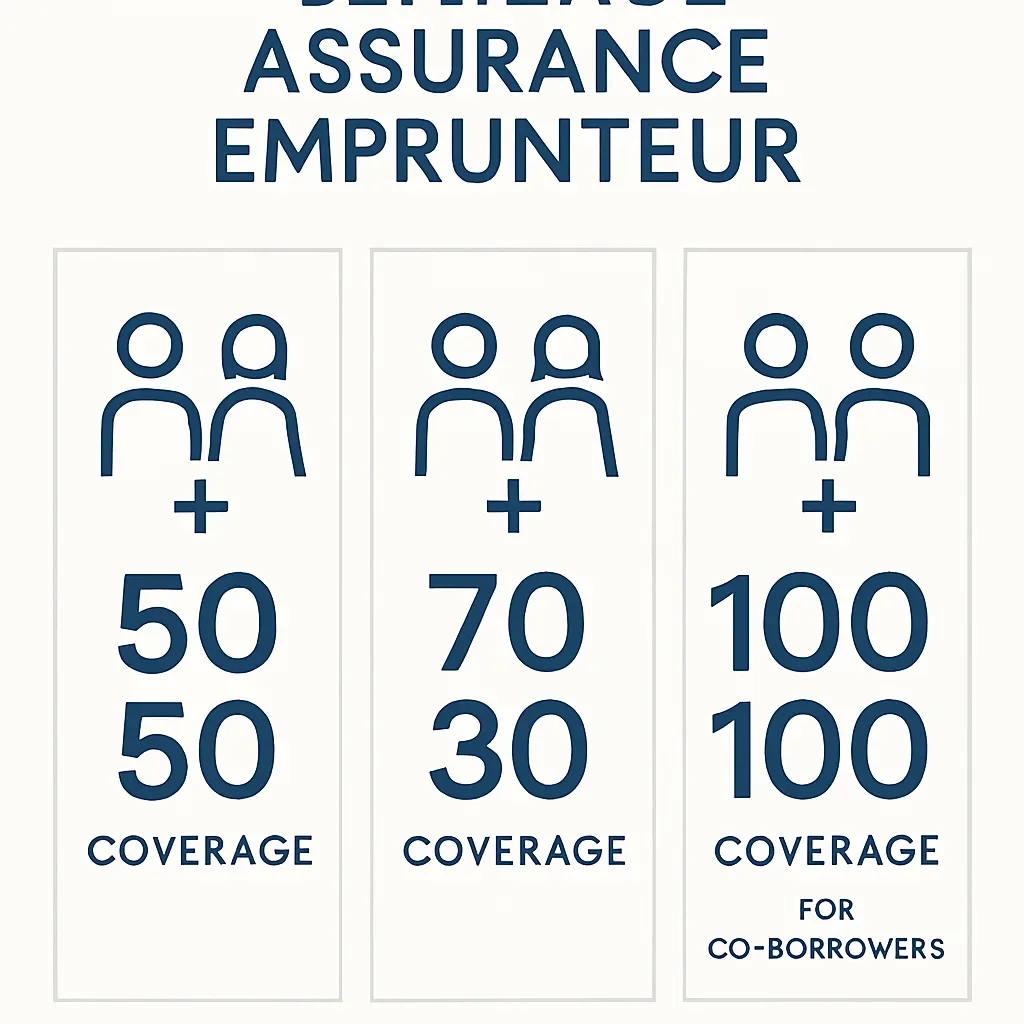
In a couple with balanced incomes, 50/50 remains consistent if each can take over the payments in case of hardship. However, if one earns significantly more than the other, a share aligned with the actual contribution to the budget limits the risk of financial collapse. For a couple with children, the reasoning is even more demanding, since the debt does not disappear with family life, which continues afterward.
For a solo borrower, the question is simpler: coverage at 100% is almost the norm, because there is no second income to take over. In the context of a rental investment, one sometimes seeks to optimize the cost, but it must be kept in mind that the financed property does not repay the loan by itself if the plan goes off track. In short, the goal always remains the same: that the loan does not become a burden.
It is observed in practice that a loan broker in Lyon often advises couples with an income gap greater than 30% to test an asymmetrical distribution, rather than reflexively sticking to 50/50. The logic is simple: it is better to have adapted protection than a false sense of security.
50/50, 70/30 or 100/100: which distribution is the most logical?
There is no universal “right” share. The real issue is the remaining charge if a claim occurs. With a 100/100 distribution, the insurance can completely extinguish the outstanding capital for the concerned borrower. With 50/50, half of the debt remains the household’s responsibility if only one insured is affected.
| Distribution | For which profile? | Main effect |
|---|---|---|
| 50/50 | Close incomes, stable budget, moderate capital | Balanced coverage but significant remaining charge if one disappears |
| 70/30 | Income gap, one spouse assumes more of the installments | Common compromise between cost and protection |
| 80/20 | Strong income asymmetry or riskier project | Enhanced protection of the main household |
| 100/100 | Seeking maximum security for two | The loan can be fully covered for each insured |
Concrete example: on an outstanding loan of €240,000, a 70/30 share means that in case of death of the insured covered at 70%, the insurer would cover €168,000. The survivor would therefore still have €72,000 to repay. This is sometimes acceptable, sometimes not. It all depends on the cash level, available savings, and the weight of other fixed expenses.
What impact does the share have on the cost of insurance?
The share influences the price, but not in a mechanical way. As a general rule, the higher the coverage, the higher the premium. However, age, health status, loan duration, and chosen guarantees often weigh as much, if not more, than the mere distribution of percentages.
This point deserves to be considered without reflex. A higher share may cost a little more, but it also reduces the risk of having to pay off a large part of the loan with your savings. Conversely, a share that is too low may seem advantageous at signing and become very costly emotionally and financially at the first setback.
The Ministry of Economy reminds, through its content on loan insurance and the Lemoine law, that the borrower can more easily modify their insurance contract over time. That said, the total price is never read alone: you must compare the monthly cost, the level of coverage, and the potential remaining charge, especially if the loan lasts 20 to 25 years.
The cheapest share is not necessarily the most cost-effective. Good coverage sometimes costs a few euros more per month, but it can avoid a five- or six-figure bill at the worst time.
For a long loan, the difference in premium is more noticeable cumulatively than monthly. Hence the interest in requesting several simulations, comparing the 50/50, 70/30, and 100/100 scenarios with equivalent guarantees. Without this, you are comparing apples, pears, and a basket that is far too optimistic.
To go further, you can also consult the Ministry of Economy’s resources on borrower insurance and the ANIL files on real estate financing, useful for checking general rules before signing.
Can the share be modified during the loan?
Yes, but not with a snap of the fingers. The share is a contractual parameter: to modify it, in practice you need the lender’s agreement and, depending on the case, an endorsement to the insurance contract. The Lemoine law mainly facilitates the termination and substitution of borrower insurance, not an automatic reconfiguration of the distribution of shares.
This type of change becomes relevant after a marriage, a birth, a separation, a significant change in income, or refinancing. If the household moves from a “we share everything” logic to a “one carries more” logic, it makes sense to rebalance the coverage. The right reflex is to request a written recalculation before going further, to see if the cost and coverage remain consistent.
In cases handled by credit intermediaries, it is also observed that some borrowers discover late that their insurance is still set on an outdated scheme. The problem is not only financial: a poorly adapted distribution can create a real protection gap at the moment when one least wants to deal with one.
What mistakes should be avoided before signing?
Most unpleasant surprises come from a poor initial decision, not from a defect in the contract. Before validating the borrower insurance share, it is therefore necessary to avoid some very common pitfalls, especially when the bank pushes towards a “standard” solution that does not necessarily fit your reality.
- Choosing 50/50 by reflex: it’s clear, but not always protective if incomes are unequal or if one of the two has a much heavier financial role.
- Confusing share and repayment capacity: a large down payment does not replace good coverage if the loan remains high over 20 years.
- Forgetting additional guarantees: death, disability, temporary incapacity, or even job loss depending on the contracts, do not all work in the same way.
- Not simulating the survivor alone: the real question is simple, almost brutal, but decisive: “What happens if only one person has to carry everything?”
- Ignoring life changes: separation, children, salary increase or decrease, moving, all this can justify a revision of the distribution.
You should also keep in mind that a share that is too low does not “save” as much as you might think if the contract remains loaded with costly guarantees. Conversely, stronger coverage can be very reasonable if it secures a household already very exposed. In other words, the right contract is often the one that protects real life, not the one that just ticks the cheapest box.
FAQ: borrower insurance share
Can the share exceed 100% for two people?
Yes. For two co-borrowers, some contracts go up to 200%, that is 100% on each head. This is the most protective configuration, as it allows full coverage of the outstanding capital for each insured person.
Is a 100/100 share mandatory?
No, but it is often recommended when the household wants to maximize credit security. Most banks mainly require that the total coverage reach at least 100%. Then, you are free to distribute the protection according to your income and risk level.
Does the share change if you are not married?
Not automatically. However, couples in a PACS or cohabiting often have an interest in looking at the distribution with even more precision, because the survivor does not always have the same financial flexibility as a couple already very structured patrimonially.
Should you aim for 100% even with a large down payment?
Not necessarily, but a large down payment does not solve everything. If the loan remains significant or if the monthly payments are tight, a higher share better protects the household. The right decision mainly depends on the outstanding capital and the ability to absorb a long-term burden.
Can the bank refuse a share that is too low?
Yes, in some cases. The lender checks that the risk is sufficiently covered at the time of the credit agreement. In practice, total coverage below 100% is rarely accepted on a standard real estate purchase, especially if the file is considered fragile.
Why is the share so important in the event of death?
Because it determines the part of the debt actually erased by the insurance. With a low share, the survivor may have to take back part of the loan even though the household budget has just lost a source of income. This is where the initial calculation makes all the sense.