
Health insurance for job seekers: how to choose well?
When looking for health insurance for job seekers, the real issue is not just paying less: it is especially important to avoid coverage gaps at a time when the budget is tightening. Between the portability of the old insurance, the Complementary Health Solidarity, and individual contracts, the choice can quickly become a headache. Good news: by examining your situation point by point, you can decide without getting lost in jargon.
Sommaire
In brief
🙂 If you have just left a job with collective insurance, first check the portability: it can last up to 12 months and prevents a sudden loss of coverage.
🧾 If your income drops significantly, the Complementary Health Solidarity may become the best option. It is assessed by Health Insurance and household resources are scrutinized, including certain unemployment benefits.
💡 If no aid fits your case, an individual insurance remains possible. The trick is to pay for what you really use: hospitalization, dental, optical, and general medicine.
How to know if you can keep your insurance after job loss?
The first question to ask is simple: can you benefit from portability? If your previous contract was covered by collective insurance, the termination is not due to gross misconduct, and you qualify for unemployment benefits, you can often keep the coverage without personal contributions. This is the most comfortable option in the short term.
Yes, if your previous insurance was collective, the contract termination is not due to gross misconduct, and you are compensated by France Travail. Portability is free for you and can last up to 12 months, depending on the length of your last contract.
In practice, portability follows a continuity logic: you do not start from scratch the day after the contract ends. The scheme generally lasts as long as your last employment contract, with a ceiling of 12 months. In other words, an employee who stayed 8 months in the company can, in many cases, keep coverage for 8 months, no more.
To activate or verify this right, keep three items handy: the end-of-contract certificate, proof of your unemployment compensation, and the letter from your insurer or former employer confirming continuity. In practice, the real trap is not the absence of rights, but processing delays: an incomplete file can create a few days of uncertainty, and it is never a good time to face a medical bill.
To check your case, the most reliable reference remains the official page Complementary Health Solidarity for job seekers, the Service-Public.fr file on CSS, and for daily health procedures, the Ameli portal.
Which solution to choose according to your job seeker situation?
The right option mainly depends on your income level, your previous status, and your upcoming medical needs. If you are coming from an employee contract with company insurance, portability is often the best reflex. If your budget is tight, CSS takes priority. And if you are not eligible for anything, you need to compare individual insurance without buying random coverage.
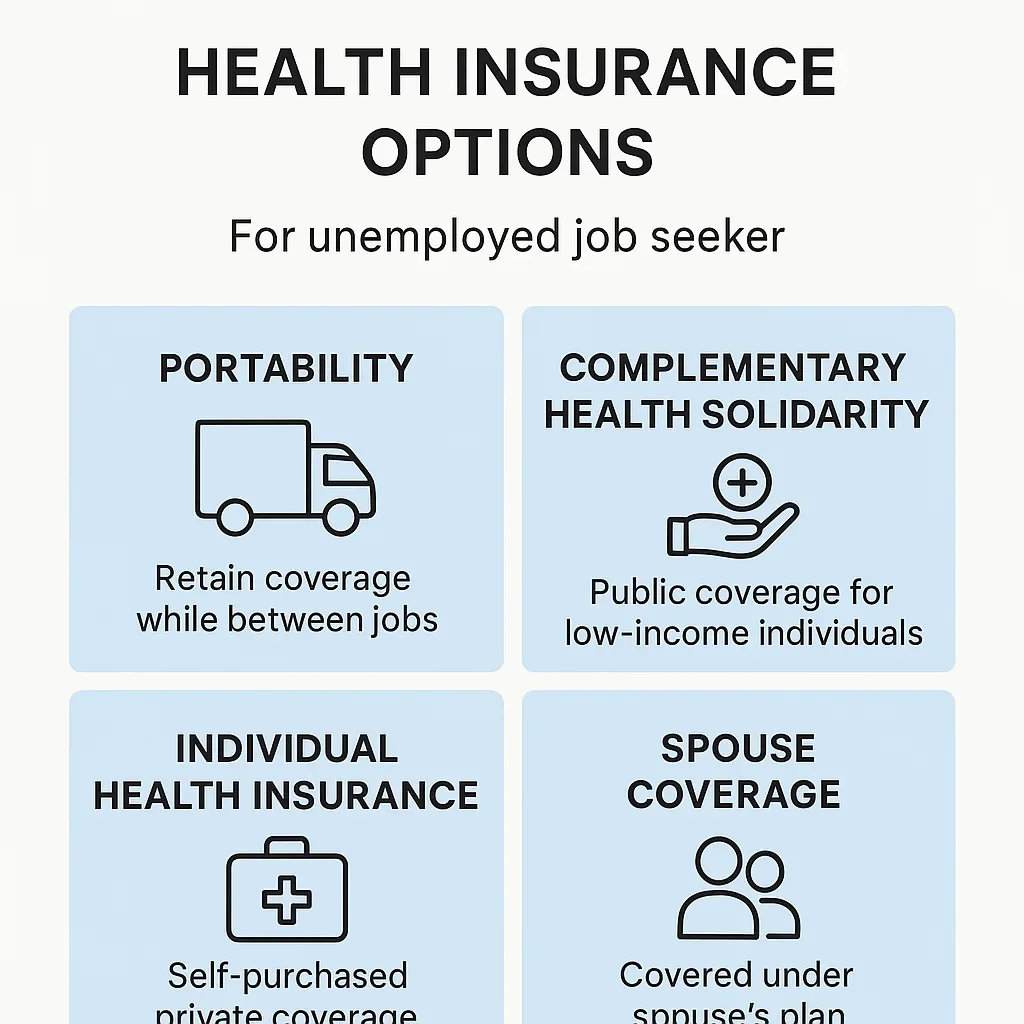
To go quickly, here is the most useful logic:
| Your situation | Solution to consider first | Strength | Point of caution |
|---|---|---|---|
| Former compensated employee | Portability | Continuity of coverage, often with no immediate out-of-pocket expense | End of entitlement after a maximum of 12 months |
| Low or very irregular income | CSS | Very advantageous protection, sometimes free | Income ceilings to be checked every year |
| No portability possible | Individual mutual insurance | Free choice of coverage | Higher rates if you add dental, optical, and hospitalization |
| Spouse already covered by a group plan | Attachment to household contract | Cost sharing | Not always possible depending on the contract |
In practice, it is observed that a job seeker who keeps portability often discovers the real issue after a few months: the contract remains valid, but the low reimbursements for optical or dental care are no longer sufficient. A family living in Nantes reported having kept portability after a layoff, then switched to the CSS when the income drop made the individual contract too burdensome. “Free” coverage is not always comfortable coverage.
It is observed that a job seeker recently registered with France Travail often keeps their company mutual insurance without paying personal contributions during portability, but discovers the real limit after a few months: the poorly reimbursed items remain their responsibility. “Free” coverage is not necessarily comprehensive coverage.
How much does health insurance cost when you are a job seeker?
The cost depends less on your status than on your coverage and your age. In practice, an entry-level individual mutual insurance can be found around 20 to 40 € per month for a single adult, an intermediate plan is often between 40 and 70 €, and more protective contracts can rise around 70 to 120 €.
What drives the cost up are mainly three items: hospitalization, dental, and optical. If you wear glasses, plan dental care, or fear an unexpected hospitalization, it is better to pay a little more each month to avoid a large out-of-pocket expense. Conversely, if you rarely consult, a light plan may suffice, provided you do not overpay for unnecessary options.
For the CSS, the logic is different: you do not buy a traditional contract, you request public assistance. According to the official page dedicated to job seekers and the file on Service-Public.fr, the assessment takes into account your income from the last 12 months, including certain unemployment benefits. The ceilings are regularly revised; for a single person in mainland France, it is often around 10,000 € per year for the most favorable access, with a higher ceiling for the version with contribution.
How to avoid paying too much for unnecessary coverage?
The best mutual insurance is not necessarily the most comprehensive, it is the one that matches your care for the next 6 to 12 months. If you mainly need security for hospitalization, there is no need to overload the contract with high-end optical coverage. And if you already know that dental care is coming, you should strengthen this coverage from the start.
The right reflex is not to take the cheapest offer, but the one that fits your care for the next 6 to 12 months. In health, false economy often comes at a high price.
Before signing, check these points without being hypnotized by an introductory rate:
- The waiting period: some contracts only reimburse after a few weeks or months.
- Ceilings for dental and optical care: this is often where the contract seems good… until the first estimate.
- Coverage of excess fees: useful if you consult specialists in sector 2.
- Attachment to the spouse: interesting if the group contract accepts dependents.
- The end of portability: better to anticipate the transition before the last covered monthly payment.
If you are in a transition phase, keep a simple rule in mind: the health insurance for job seekers must protect your cash flow as much as your health. No need to take a “premium” contract if you almost never use expensive care. Conversely, if you have ongoing treatment, it’s better to secure reimbursement than to save a few euros per month.
FAQ — health insurance for job seekers
Can you keep the company health insurance if you resign?
Not automatically. Portability is mainly linked to a termination that opens the right to unemployment insurance. If resignation does not give you compensated rights, you will generally have to switch to the CSS, an individual insurance, or your spouse’s contract.
Can health insurance for job seekers be free?
Yes, but mainly through the CSS, not through a classic insurance. The CSS can be free or require a modest contribution depending on resources and household composition. This is the solution to check first when the budget is really tight.
What happens if I find a job during portability?
Portability ends when you regain mandatory coverage through a new job. You must inform the insurer to avoid unnecessary overlap. If the new contract starts later, keep your receipts to limit coverage gaps.
Can my spouse’s health insurance cover me?
Yes, but only if the group contract accepts dependents or household extension. It’s not automatic, and the premium may increase. It’s a good option if your spouse’s contract is solid, especially to limit duplicates.
CSS or individual insurance: which is faster to set up?
Individual insurance is often faster, sometimes within a few days. CSS may take a little longer because the file review takes time. If you have urgent care, you need to balance speed and cost over several months.
Should you wait until the end of portability to compare offers?
No, and it’s actually a bad idea. The right time is to compare as soon as the end date becomes clear, to avoid a coverage gap. This way you will have time to request quotes, check deadlines, and prepare the transition.