Genesis of the Maginot Line
A cultural and military trauma
In 1918, France had more than a million dead and saw its lands ravaged
. The villages of Champagne or Lorraine still bore the scars of shells. At the end of the conflict, the idea of a static defense – which avoids the nightmare of deep offensives – was appealing. It was sensed that future war would be a repetition, perhaps more brutal, of the one just endured. Like a modern citadel, the Maginot Line was intended as a psychological barrier: to repel the enemy before they reached the industrial heart of France.
The stages of design
This colossal project did not come out of nowhere: as early as 1927, the Ministry of War entrusted the mission to General Maginot, a supporter of the idea of a rigid defense. Architects, engineer battalions, and study offices (such as the Commission for the Organization of Fortified Regions) worked on a model combining reinforced concrete, armored steel, and deep underground tunnels. They aimed to blend robustness, troop comfort, and interconnection of forts, while anticipating the future of enemy artillery.
Technical characteristics and architecture
The major “ouvrages” and their classification
Three types of ouvrages are distinguished:
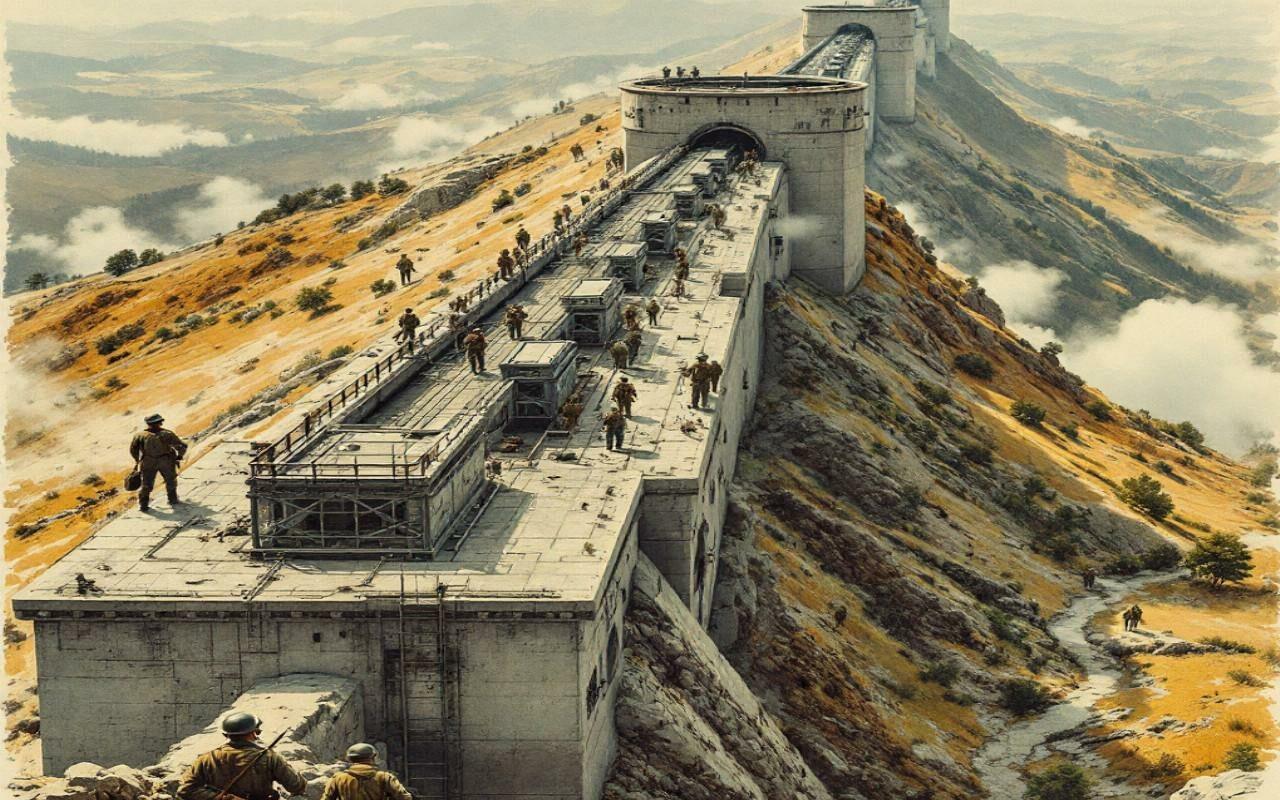
- Major ouvrages (large ouvrages): several artillery blocks connected by galleries several kilometers long. Ex.: Hackenberg, Fermont.
- Intermediate ouvrages: compact, with 2 to 4 blocks, intended to cover less threatened areas.
- Small ouvrages (casemates): infantry posts armed with machine guns and anti-tank guns, more rudimentary but effective against light infiltrations.
Underground infrastructure and logistics
Imagine an underground district as vast as a medium-sized town: concrete corridors, Decauville tracks to transport food and ammunition, kitchens, dormitories, infirmaries, even post offices. The galleries, sometimes 4 meters wide and 3 meters high, connect each block; reinforced elevators evacuate the wounded to the surface, while shafts provide ventilation, electricity, and air filtration. The icing on the cake: some casemates benefited from a central heating system and diesel engine power plants, a rather rare feature for the time.
Operational functioning
Garrison maneuvers and routine
In apparent peace, soldiers settled into a precise rhythm: firing exercises, attack simulations, maintenance of 75 mm or 135 mm guns. They worked on synchronization of crossfire, communication via wired telephony, and rotation of sentries. Joking aside, holding an ouvrage was a profession in itself: one had to handle artillery like a conductor, adjust lighting to avoid revealing one’s position, while remaining ready to draw weapons in seconds.
Training and coordination with the field army
The Maginot Line was not isolated: free corps and motorized divisions patrolled upstream, detecting infiltrations. Joint exercises simulated crossing the border, with tactical artillery and motorized cavalry. These maneuvers aimed to validate synchronization between the static fire of the line and mobile counterattacks. In other words, the strategy did not rely solely on the bunkers, but on a global system combining advanced posts and tactical reserves.
Strategic and psychological impact
A Deterrent Message for the Enemy
In the heart of the 1930s, the image of the Maginot Line extended beyond French borders: at least 20% of the military budget was devoted to it. Foreign newspapers relayed the news: “this concrete wall will prevent any rush towards Paris.” For Germany, uncertainty grew: should they bypass through the Ardennes, a terrain reputedly impassable for tanks? This doubt alone made the enemy hesitate for a few years. Overall, it was a formidable deterrent tool, deployed long before a single shot was fired.
Tactical Limits and Internal Criticisms
However, from its inauguration, voices were raised: modern war was more mobile than in 1914, and some feared the line would become a cage. Provided Germany chose to strike elsewhere, the forts could be bypassed. The Ardennes, considered impassable, poorly concealed valleys suitable for light tanks. Moreover, this costly system ended up draining human and financial resources that could have been allocated to mobile divisions.
The Judgment of History: Bypass and Breakthrough in 1940
The May 1940 debacle delivered a harsh verdict: the Wehrmacht crossed the Ardennes forest and reached the Meuse without encountering significant resistance. The line’s fortifications, perfectly sealed, remained harmless or were taken from the flank. This strategic sleight of hand highlighted a major flaw: the Maginot Line protected the main front but did not cover the entire territory. In practice, it proved to be a psychological trap for its defenders at least as much as for the invader.
The Legacy of the Maginot Line
Lessons for Contemporary Defense
Although the structure seemed obsolete as early as 1940, it initiated reflection on strategic depth. Today, it is understood that a defense cannot rely solely on fixed strong points: it must integrate mobility, intelligence, and real-time redundancies. Military engineers learned the importance of interconnected systems, wartime logistics, and the psychological dimension of a modern fortification.
Heritage Valorization and Historical Tourism
Today, visitors explore the galleries of Schoenenbourg, the Hackenberg fortification, or the Keswick battery as if wandering through a World War I museum. Sound and light reenactments restore the hushed and electric atmosphere of command posts. History and technology enthusiasts discover pioneering equipment of the Cold War: passive acoustics to detect tanks, permanently installed gas masks… A way to extend the teaching of these fortified stones beyond military manuals.
Comparative Table of Some Major Fortifications
| Fortification | Year of Completion | Number of Blocks | Main Artillery |
|---|---|---|---|
| Hackenberg | 1935 | 12 | 4× 135 mm, 6× 75 mm |
| Fermont | 1932 | 8 | 4× 75 mm, 4× mortars |
| Schoenenbourg | 1931 | 6 | 3× 75 mm, 4× machine guns |
| Keswick (casemate) | 1933 | 1 | 2× anti-tank guns, 4× machine guns |
FAQ
- Why was the Maginot Line designed?
To erect a robust and deterrent defensive barrier, drawing lessons from the trench warfare of 1914–1918. - What were its primary strengths?
Its deep, interconnected fortifications equipped with heavy artillery, as well as its psychological effect on the adversary. - What weaknesses led to its bypass?
The absence of extensive fortifications in the Ardennes and reliance on a static strategy against mobile armies. - Is the Maginot Line a total failure?
No. It held its fortifications against frontal attacks in 1940, but its strategic reach was undermined by a tactical encirclement. - What remains today?
A fascinating historical heritage, sites open to the public, and fortification expertise still studied by contemporary military forces.