In Brief
🚗 Priority #1: secure the people, then freeze the scene with photos before moving the vehicles, if possible.
📝 The amicable report remains the basis for a material accident: it must be filled out legibly, coherently, and signed by the drivers involved.
⏱️ The declaration deadline to the insurer is generally 5 working days in France. It’s better not to delay.
📱 The e-car report is convenient, but it only covers simple cases, notably an accident in France with up to 2 vehicles.
What to Do in the First 10 Minutes After a Car Accident?
The first few minutes are mainly to protect people and preserve a clear scene. As long as the cars have not moved, the situation can be reconstructed much better. If a vehicle is really obstructing traffic, you must first photograph the position of the cars, then move them carefully.
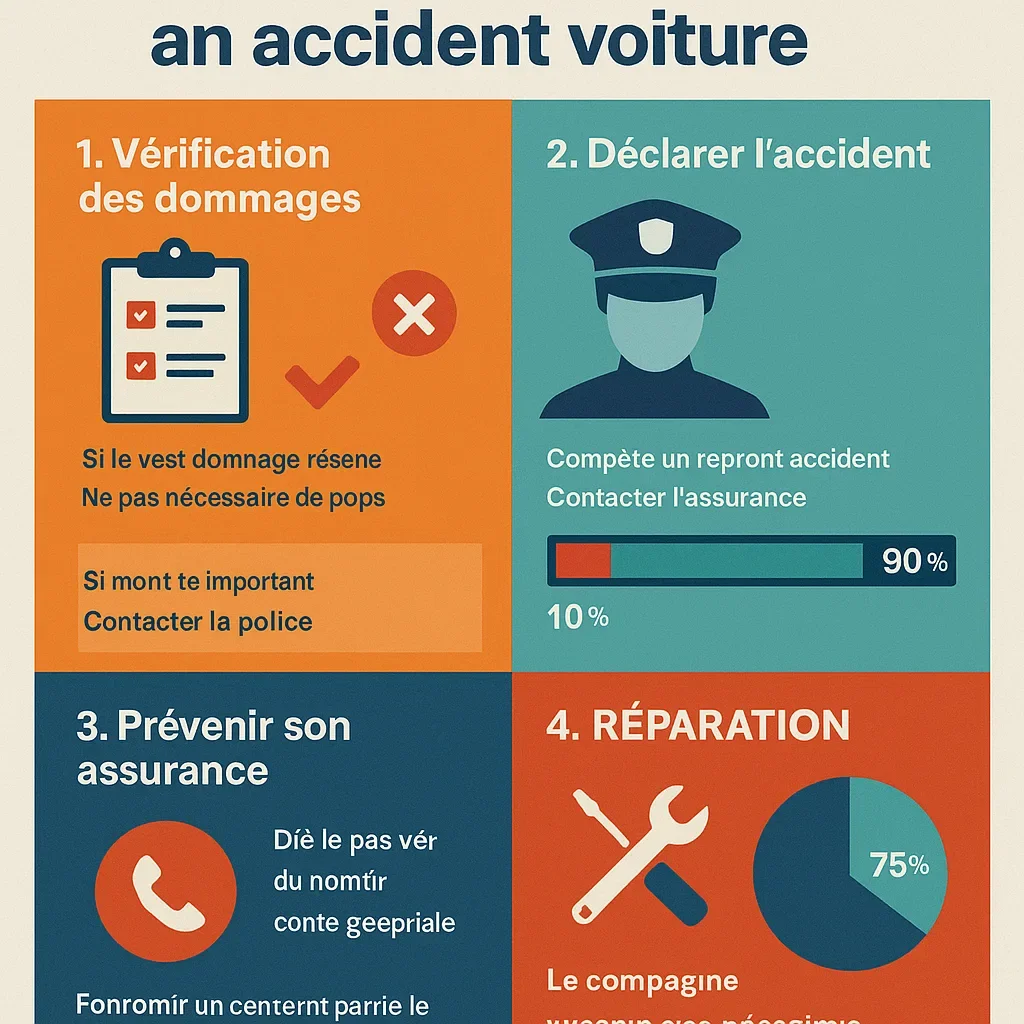
The right logic is to secure, document, then declare. Hazard lights, vest, triangle, and photos come before the pen. If there is any doubt about an injury, call emergency services before filling out anything.
Practically, you need to be simple and methodical:
- turn on the hazard lights and, if possible, put on a reflective vest;
- position yourself safely away from traffic, without taking unnecessary risks;
- check the condition of passengers and other people involved;
- photograph the vehicles, license plates, damages, marks on the ground, and signage;
- note the names and contact details of witnesses, if you have any;
- do not improvise an approximate version of the facts under pressure.
If someone is injured, even slightly, the important thing is no longer to “finish the report” at all costs. You must call 15, 112, or 17 depending on the situation, then follow the emergency services’ instructions. A simple whiplash may seem minor at the moment but can prove more serious a few hours later.
How to Fill Out the Amicable Report Without Mistakes?
The amicable report is not a novel, nor a form to fill out randomly. It must describe concrete, coherent, and verifiable facts. The front is filled out by both parties on site, on a single common copy, then each driver completes their part on the back. It’s better to write plainly than too vaguely.
The most important thing is to remain factual. The report then helps the insurer understand the accident mechanics: vehicle positions, direction of travel, ongoing maneuver, signage, visible damages. A wrongly checked box or a confusing sketch can change the interpretation of the file, sometimes for a long time.
To avoid mistakes, keep these points in mind:
- identity: name, address, policy number, registration, and insurer;
- circumstances: check only the boxes that truly correspond to the scene;
- sketch: draw the road, vehicles, signs, and point of impact;
- observations: note what you contest if necessary, without aggression;
- signatures: do not sign an incomplete or false document.
The back side allows you to detail your version individually. This is useful if you disagree on a specific point, but avoid rewriting the whole story there. The idea is to give the insurer a readable file, not a three-season soap opera.
| Element of the report | What to do | Common mistake |
|---|---|---|
| Front | Fill it out together, on the spot, with the same information | Each leaves with a different version |
| Checked boxes | Choose only the exact boxes | Check boxes “by reflex” that do not correspond |
| Sketch | Show the position of the vehicles and the signage | Make a sketch too vague to be usable |
| Observations | Report a disagreement or an important detail | Sign without noting anything when a point is contested |
For the official version, you can consult Service-Public.fr on the amicable report and the Road Safety page dedicated to road accidents. Both emphasize the importance of a precise report to speed up the processing of the file.
Can the e-auto report be used in all cases?
No, and this is precisely where shortcuts should be avoided. The e-auto report is very practical for a simple fender bender, but it remains limited to certain cases: accident in France, at most two vehicles, vehicles registered and insured in France, and agreement of the drivers on the principle of the report. As soon as the situation falls outside this framework, paper remains safer.
The e-auto report works well for a clear minor fender bender, but it is not universal. If there is an injured person, a foreign vehicle, more than 2 vehicles, or a driver who refuses the principle of the report, it is better to revert to the paper form and document everything thoroughly.
In other words, digital does not replace common sense. The application can save time, but it should never be used to bypass a complicated case. If one of the drivers gets angry, if you have doubts about the damage, or if the accident took place outside France, take the time to secure your file before validating anything.
| Situation | e-report possible? | Recommended reflex |
|---|---|---|
| Simple material accident in France | Yes | Complete the application on site if both drivers agree |
| More than 2 vehicles | No | Use a paper report and take multiple photos |
| Accident with injury | No | Call emergency services, then make a detailed file |
| Foreign vehicle | Not the ideal case | Prefer paper and keep all receipts |
What car accident procedures should be sent to the insurance?
The declaration to the insurer is not limited to sending a report. A complete, readable, and quickly processed file must be sent. In France, the usual deadline is 5 working days from the date of the accident. The cleaner the file is at the start, the faster the compensation proceeds without friction.
In practice, insurers mainly expect three things: the chronology, the evidence, and the exact contact details. An incomplete declaration wastes time, especially when the damage seems minor at first but an expert later discovers a repair heavier than expected. This is very common on a bumper, a wing, or a headlight.
Here are the documents to submit as much as possible:
- the amicable report paper form or the e-report;
- photos of the vehicles, damages, and the scene;
- the contact details of witnesses;
- if applicable, a complaint filing in case of hit and run, theft, or fleeing the scene;
- for a bodily injury accident, an initial medical certificate and any follow-up documents.
For a material accident, the declaration mainly serves to initiate the assessment and coverage. For a bodily injury accident, it also opens the way to medical evaluation and compensation for damages. The file therefore does not carry the same weight depending on whether it is a dented bumper or an injury to document.
Practically speaking, France Assureurs also reminds that the amicable report helps speed up the claims process. In short, the more organized the file, the fewer back-and-forths with the insurance.
What to do if the other driver refuses to sign or if the accident is complicated?
If the other driver refuses to sign, do not force them or fabricate a document on their behalf. Complete your part of the report, clearly note the disagreement in the observations, photograph everything that might help, and report the witnesses. The goal is to keep usable proof, even without amicable agreement.
On the ground, an assistance agent in the Lyon area observes that the most difficult files are often those where cars are moved too quickly before photos are taken, or where no witness was noted. In these cases, the sketch and license plates become almost more important than the collision itself.
In complicated cases, think in terms of scenarios:
- refusal to sign: fill out your part, keep a copy, and detail the disagreement;
- hit and run: note the license plate, call the police or gendarmerie, then declare quickly;
- single-vehicle accident: take photos, note the exact location, and keep all useful evidence;
- more than 2 vehicles: the paper report often becomes more readable than the digital one;
- foreign vehicle: keep all documents, as the compensation chain may be longer.
If the accident involves an injured person, a hospital visit, or pain that appears afterward, the injuries must also be medically documented. This is not a secondary formality: in cases of bodily injury, the initial medical certificate often serves as the starting point of the file.
How does compensation work after a material or bodily injury accident?
Compensation depends on the type of damage, the contract, and liability. For material damage, the insurer often relies on the report, photos, and any automotive expert evaluation. For bodily injury, it is also necessary to document injuries, treatments, and the concrete consequences on daily life.
The process is not the same in both cases. A damaged bumper is assessed fairly quickly; neck pain, a sprain, or temporary disability sometimes require several stages of medical consolidation. In other words, the more medicalized the file, the longer the evaluation takes, but this is essential to avoid underestimating the damage.
A well-completed report does not replace good evidence, but it already avoids half of the disputes. The rest depends on the quality of the photos, the coherence of the account, and the speed of declaration.
In smooth files, the insurer receives clear information, the expertise is done quickly, and compensation follows without too much back-and-forth. Conversely, a vague or contradictory file lengthens the delays. This is where you see that car accident procedures are not just administrative: they directly affect the rest of the file.
Should you call the police or gendarmerie after a car accident?
Yes, in certain specific cases: injury, hit and run, aggressive driver, vehicle immobilized on a dangerous road, or serious doubt about a driver’s identity. For a simple consensual material fender-bender, it is not always necessary. In case of doubt, emergency services or law enforcement can tell you what to do immediately.
Can an amicable report be corrected after signing?
In practice, it is very difficult once both parties have signed. If you notice an error before leaving, it is better to correct it immediately and have the modification initialed by both drivers. Afterwards, you should rather notify the insurance company with an explanatory letter and keep solid evidence.
What should I do if I had an accident alone against an obstacle?
A single-vehicle accident does not prevent the declaration. Take photos, note the exact location, time, and circumstances, then send everything to your insurer along with the report or the appropriate declaration. If a post, wall, or animal is involved, the images and timeline become particularly important.
Should I notify my insurance even if I am responsible?
Yes, because the contract may provide useful coverage, even when the responsibility is yours. Additionally, declaring within the deadlines avoids unpleasant surprises if the damage is more severe than expected. Failure to declare can complicate, or even block, the handling of the claim.
How long should I keep evidence and photos after an accident?
Keep them at least until the complete closure of the file, and longer if there is a disagreement. A copy of the photos, the report, and exchanges with the insurer can be useful if a dispute arises later. In practice, keeping the elements for several months is not excessive.
What if the accident involved a foreign vehicle?
The file may take longer to process, especially if the insurance is not French. Note the license plate, the country of registration, the insurance company if known, and photograph the green card or any equivalent document. The paper report often remains the simplest solution in this case.