
In Brief
🎯 The right strategy is to align the insurance with your actual health expenses, not with a commercial promise that shines everywhere.
🔎 The points to watch first are hospitalization, dental care, optics, fee overruns, and waiting periods.
🧩 The 100% Health scheme helps with certain equipment, but it does not cover everything. Caps, allowances, and exclusions remain decisive when signing.
How to Choose Your Health Insurance According to Your Real Needs?
The right health insurance is the one that covers your most probable expenses, not the one that promises the most fine print lines. First look at your recurring care, your upcoming needs, and your monthly budget. Then balance hospitalization, dental care, optics, and fee overruns.
Start with a simple self-assessment: how many consultations did you have last year, did you wear glasses, plan dental care or surgery, and do you often see specialists? This simple sorting already avoids many mistakes. Health insurance is rarely chosen “by feeling,” even less so when the coverage looks similar on the surface.
Next, rank your needs in order of importance. If you consult little but need to renew glasses, optics may take precedence over routine care. If you have children with orthodontics, dental care quickly becomes the line not to underestimate. And if you tend to see specialists in sector 2, the issue of fee overruns takes precedence.
Here is a simple method, almost silly but remarkably effective:
- Look at your expenses from the last 12 months: pharmacy, general practitioners, specialists, glasses, dentist, hospital.
- Anticipate the next 12 months: pregnancy, orthodontics, scheduled surgery, optical renewal.
- Prioritize your needs: hospitalization first, then dental and optics according to your profile.
- Set a budget cap: no need to aim for a premium contract if your healthcare consumption remains low.
In other words, you do not choose an “ideal” insurance in theory, but a contract consistent with your usage. This is where the difference between a decent offer and a truly useful offer lies.
Which Criteria to Compare Before Signing?
Compare first the premium, annual caps, the percentage of BRSS, allowances, waiting periods, and exclusions. These are the details that turn an attractive offer into a real good deal, or into a hefty bill at the first somewhat serious care.
Joking aside, a contract may seem “generous” while poorly compensating the real costs. The most important thing is to compare what is reimbursed in concrete situations: hospitalization with a private room, dental crowns, glasses, specialist consultations, and procedures poorly covered by Health Insurance.
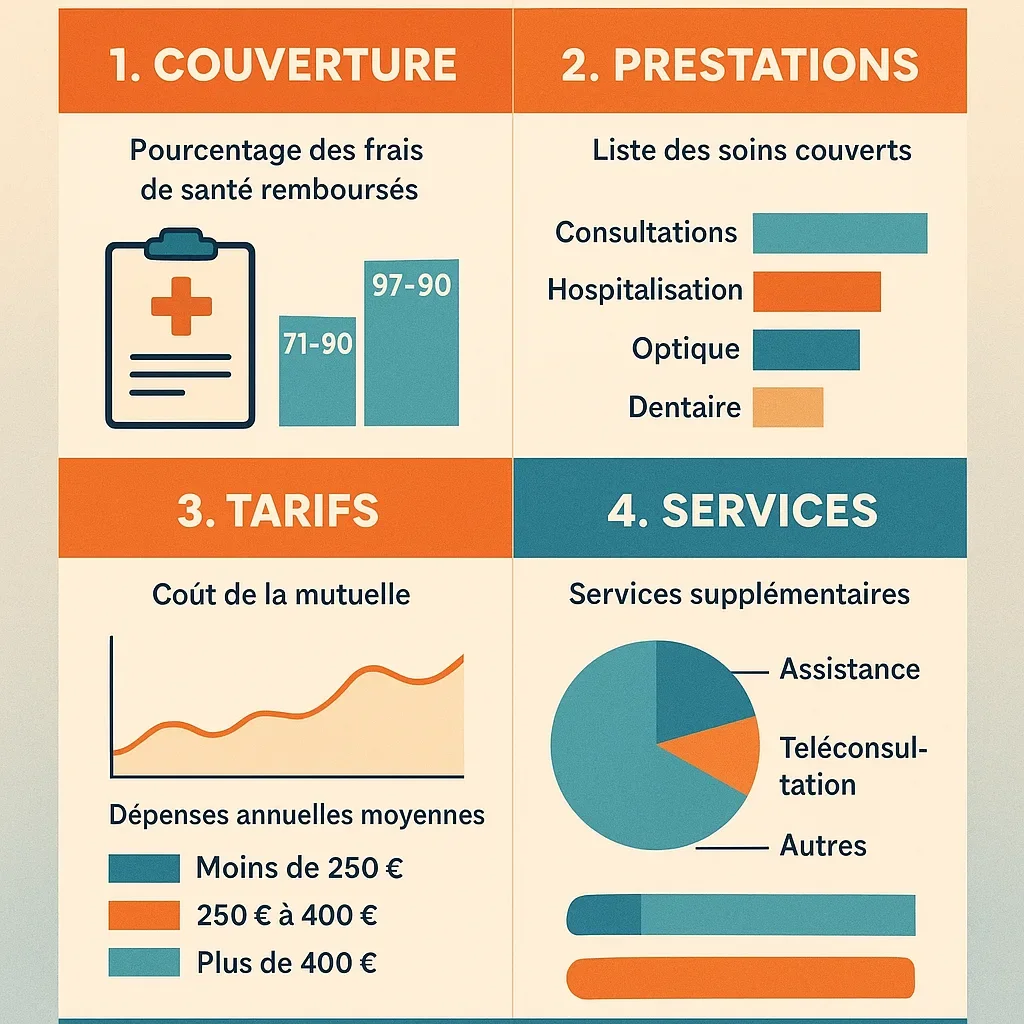
| Criterion | What to check | Warning sign |
|---|---|---|
| Contribution | Monthly amount, age-related changes, family or solo rate | Low price the first year then rapid increase |
| Hospitalization | Private room, daily flat rate, surgical fees | Coverage limited to basic reimbursement |
| Dental | Crowns, implants, orthodontics, annual ceiling | Allowance too low compared to expected treatment |
| Optical | Frames, lenses, renewal frequency, care network | Allowance unusable for your prescription |
| Routine care | Consultations, specialists, excess fees, teleconsultation | “Correct” reimbursement on paper but low in practice |
| Conditions | Waiting period, exclusions, ceilings per procedure, direct billing | Lack of clarity on non-reimbursed situations |
A detail never to be overlooked: 100% Health does not mean “everything is free”. It applies to certain care packages in optics, dental, and hearing, but only within the framework of responsible contracts and for well-defined equipment. The rest may remain your responsibility if you go beyond the package or if your needs are more ambitious.
To check the official rules, you can consult the Ameli fact sheet on complementary health insurance, the explanations from Service-Public.fr on cancellation, and the page from the Ministry of Economy on complementary health insurance.
How to read a coverage table without making mistakes?
A coverage table is read from left to right: reimbursement base, level of coverage, ceiling, and conditions. Beware, 200% BRSS does not mean full reimbursement. Without the right allowance or a care network, the out-of-pocket cost can remain high.
The acronym BRSS stands for Social Security Reimbursement Base. It is the starting reference, not the actual bill. If your contract states 100%, 200%, or 300% BRSS, you need to understand exactly what this covers, because the final bill also depends on the price charged by the professional.
Concrete example: a general practitioner consultation in sector 1 has been €30 since December 2024, according to Health Insurance. For a more expensive treatment, such as a dental crown, the bill often rises between €500 and €1,000 depending on the material and the city. And a private room frequently costs €50 to €120 per day depending on the facility.
To read a coverage table without getting lost, keep this mini user guide in mind:
- Identify the reimbursement base: it serves as the anchor point for calculation.
- Check the level of coverage: 100%, 150%, 200% BRSS, or flat rate in euros.
- Look for ceilings: annual, per procedure, per care category, sometimes per beneficiary.
- Identify exclusions: certain treatments, certain practitioners, or certain situations may be excluded.
- Read the waiting period: coverage may not start immediately.
The real trap is the “nice table, bad contract” effect. A good level on optics does not compensate for a weakness in hospitalization if you need surgery. That is why you should always read the coverage according to your actual risk, not marketing.
Which contract for which profile?
The right contract is not the same for a student, a family with children, a senior, or a self-employed person. Needs change with age, frequency of care, and tolerance for out-of-pocket expenses. This is where sorting by profile becomes very practical, almost essential.
It is observed in the field that many insured individuals discover their out-of-pocket costs at the first dentist’s estimate. An advisor in Rennes notes that overly attractive contracts often hide low ceilings or waiting periods, especially for optical and dental coverage.
For a family
A family often benefits from strengthening dental, optical, and pediatric or specialist consultations. If two children wear glasses or if orthodontics is coming up, upgrading can quickly become cost-effective. Cherry on the cake, some plans add assistance, useful in case of hospitalization of a parent or child.
For a senior
With age, the most sensitive area is often hospitalization, followed by routine care, hearing, and specialists who charge extra fees. A senior mutual insurance does not need to be luxurious everywhere, but it must be solid where expenses become predictable. Otherwise, the premium goes up in smoke at the first serious care.
For a student or young worker
When the budget is tight and care is rare, it is better to aim for a simple contract with a good base on consultations, 100% Health, and minimal protection in case of unforeseen events. There is no need to overpay for premium coverage if you rarely consult. On the other hand, teleconsultation or a care network can be a real plus.
For a self-employed person
A self-employed person must consider the cost/protection ratio over the whole year, because a drop in activity or a work stoppage can weaken the family budget. The mutual insurance must remain clear, stable, and flexible enough not to explode in premiums at the first increase. It is always appreciated to prioritize useful guarantees rather than gadget options.
If you are an employee, do not forget the company mutual insurance. It is often mandatory, except in cases of exemption, and can already cover a good part of the basic needs. In this case, the real question is not always to replace it, but sometimes to supplement it with an additional plan if your care is really heavy.
How much to pay without overpaying?
The price of health mutual insurance mainly depends on age, level of coverage, place of residence, and household composition. In practice, an entry-level contract can remain around 20 to 40 € per month for a young single person, while a solid family coverage or a senior contract can go higher, sometimes well beyond, depending on the reinforced areas.
What matters is not the isolated amount, but the total cost over 12 months. A plan 8 € cheaper per month may seem smart, unless it leaves you with 200 € out-of-pocket on a dental treatment or 80 € on a pair of glasses. In this little game, the false good deal is quickly spotted.
The cheapest mutual insurance is almost never the least expensive in the end. What matters is the total cost over 12 months, not the isolated monthly premium.
To avoid paying too much, always compare three elements together:
- the premium;
- the actual reimbursements on your care items;
- the hidden limits: ceilings, exclusions, waiting periods, care network.
The Ministry of Economy reminds that complementary health insurance is meant to cover all or part of expenses not reimbursed by Health Insurance. In plain terms, a mutual insurance must help you with what Social Security does not cover, not just give you the impression of being covered.
Changing your health insurance: when and how?
Good news: since December 1, 2020, you can cancel your supplementary health insurance at any time after one year of contract, without fees or penalties. This is a real lever to adjust your coverage if your needs change, if your contributions rise too much, or if your contract has become too weak.
The simplest method is to check your subscription date, compare the new guarantees, then initiate the cancellation after securing the new coverage. Often, the new insurer can handle the procedures. However, if your contract is less than a year old, you need to look at the notice rules and cases of early exit.
The situations that justify a change are quite common:
- regular increase in the contribution without improvement of guarantees;
- new dental, optical or hospitalization needs;
- arrival of a child or change in family situation;
- switch from an individual contract to a company mutual;
- guarantees too weak compared to your usual specialists.
In other words, a mutual insurance is not a lifelong marriage. It must follow your life, not the other way around. That is precisely why it should be reviewed at least once a year, especially if you have changed your care rhythm or budget.
FAQ
Is 100% Health coverage enough for good protection?
Not necessarily. The 100% Health covers certain optical, dental, and hearing equipment within a defined basket, but it does not replace a good mutual insurance if you have needs outside the basket, excess fees, or more costly care.
Should I take a mutual insurance with many options?
Only if you really use them. Assistance options, teleconsultation, alternative medicines, or care networks can be useful, but they should not make the contribution rise for nothing. Better to have simple and solid coverage than an overloaded contract.
Is an additional complementary insurance worth it?
Yes, in certain specific cases: scheduled hospitalization, orthodontics, expensive optics, or frequent excess fees. It is less interesting if your main mutual insurance is already strong in these areas. The idea is to fill a gap, not to double unnecessary guarantees.
Can I keep my spouse’s mutual insurance?
Yes, if the contract allows it and if family membership is planned. It is often convenient to pool contributions, especially when a single contract covers the children well. However, check the reimbursement levels and any per-beneficiary ceilings.
What to do if I have a long-term illness?
A long-term illness (ALD) improves the reimbursement of certain care covered by Health Insurance, but it does not cover everything. A mutual insurance remains useful for consultations, hospitalization, excess fees, and ancillary care. So you need to keep a global reading of the contract.
Is a cheap mutual insurance necessarily a bad idea?
No, if your needs are limited and you consult little. However, it quickly becomes insufficient if you have glasses, planned dental care, or specialists in sector 2. The right price is the one that matches your actual usage.