
In brief
💡 The hospitalization mutual insurance focuses on costs that are poorly reimbursed by Health Insurance: daily hospital charge, fees, private room, and sometimes assistance.
📌 The right contract is not necessarily the most expensive: it must fit your profile, your healthcare habits, and your budget, with clear caps and few gray areas.
⚠️ The points that make a difference are often the most discreet in the brochure: waiting period, exclusions, reimbursement limits, and activation conditions for home help services.
🚑 In private clinics, in Paris as well as in Lyon, out-of-pocket expenses can rise quickly if excess fees and the single room are not well covered.
What does a hospitalization mutual insurance really cover?
A hospitalization mutual insurance mainly reimburses items that remain poorly covered by Social Security: daily hospital charge, private room, medical fees, sometimes transport, accompaniment, and assistance services. The level of coverage varies according to the plans, hence the importance of checking caps, waiting periods, and exclusions.
In practice, the logic is simple: Health Insurance covers part of the care, but it does not pay everything. According to Health Insurance (ameli), the reimbursement framework varies depending on the procedure, the practitioner’s sector, and the type of facility. The mutual insurance thus complements what remains your responsibility, especially when the stay is long or the intervention involves a sector 2 specialist.
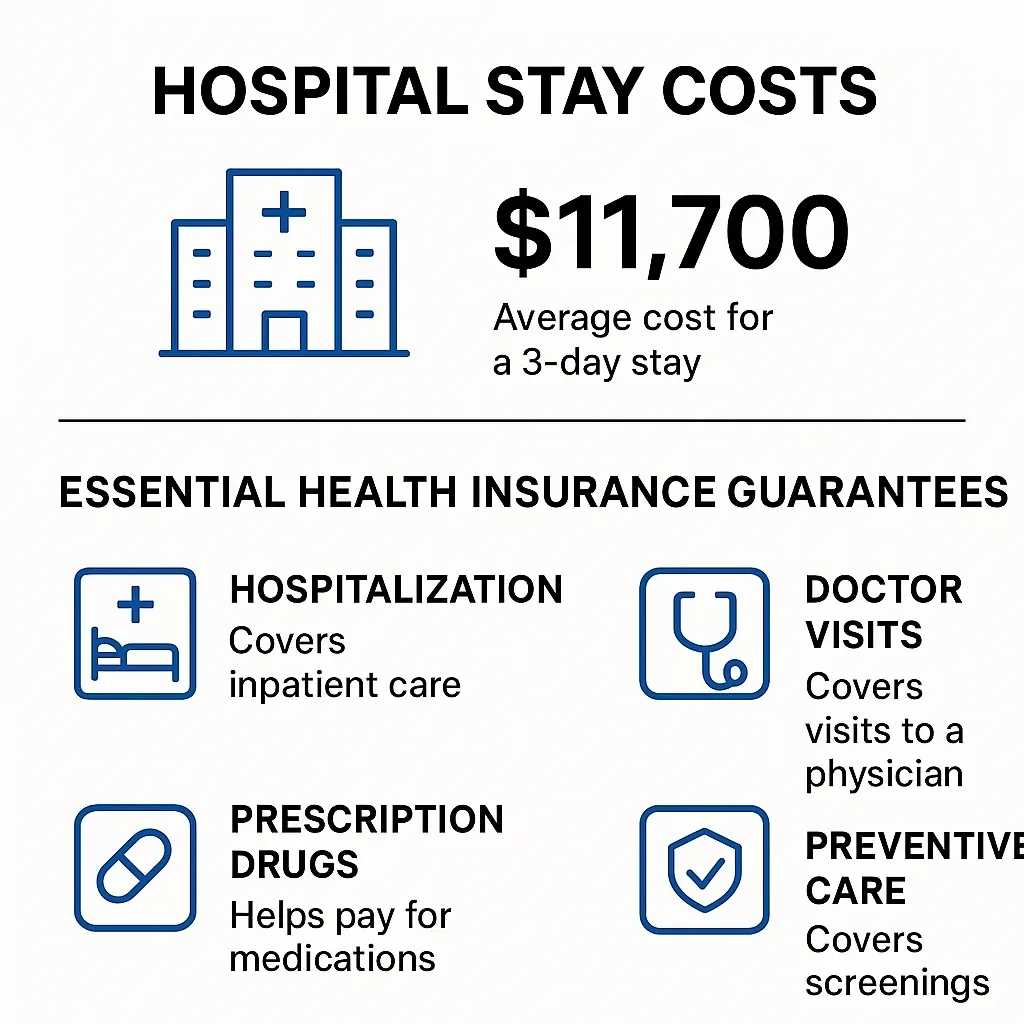
The essential guarantees of good hospitalization coverage generally revolve around five items:
- the daily hospital charge, which corresponds to the patient’s daily contribution to the stay;
- medical fees, especially when the surgeon or anesthetist charges excess fees;
- the private room, often billed separately, including in public hospitals;
- accompaniment costs, useful if a relative must stay with you;
- assistance, sometimes including home help, childcare, or transport.
It should be noted that some contracts refer to hospital guarantee or health mutual hospitalization to mean roughly the same thing, but the devil is in the details. A plan called “hospitalization only” focuses on the heavy costs, while a broader contract often adds optics, dental, and everyday consultations. In other words, the commercial name is never enough: you must read the actual reimbursement level.
What costs remain your responsibility at the hospital?
The real issue is not just what Social Security reimburses, but what it does not fully cover. And here, the bill items can stack up: daily flat rate, private room, excess fees, sometimes TV, accompanying bed, or comfort charges. It is precisely on these items that the mutual insurance makes a difference.
| Expense item | Out-of-pocket without good mutual insurance | Why it matters | Point to check |
|---|---|---|---|
| Daily flat rate | €20 per day, except exemption | It adds up for each night spent | Full coverage or annual cap |
| Private room | Often €40 to €100 per night, sometimes more | Comfort is billed separately | Amount reimbursed per night and maximum duration |
| Excess fees | Variable, from a few tens to several hundred euros | Common in private clinics or sector 2 | Reimbursement as a % of the agreed tariff or flat rate |
| Accompaniment | Often not covered without option | Can be costly over several days | Presence of an accompanying bed or logistical assistance |
| Additional expenses | TV, telephone, wifi, relative’s meals | Small amounts, but final bill can be steep | Precise list of included services |
According to DREES, which monitors health expenditures in France, the hospital remains a sensitive expense for households as soon as it goes beyond strictly reimbursed care. And in real life, this is seen on the ground: a family recently recounted that a short stay in a clinic left them with an unpleasant surprise at the final bill because the room alone and excess fees were only half covered.
The good reflex is therefore to ask for a hospitalization estimate when possible. This allows you to identify three critical lines: the practitioner’s fee, the room price, and comfort charges. A plan that reimburses 100% of the co-payment but excludes sector 2 fees may seem adequate on paper but can become quite mediocre at payment time.
For a verifiable reference framework, you can also consult Service-Public.fr on insured rights and DREES on health data. These are good starting points to distinguish what falls under general rules and what depends on your personal situation.
How to choose hospital mutual insurance without paying too much?
The right contract is chosen by comparing five criteria: reimbursement of fees, private room, daily flat rate, assistance, and waiting period. For a tight budget, it is better to have a targeted and clear plan than a contract inflated with little useful options. Price matters, but the actual out-of-pocket cost matters more.
The first reflex is to align coverage with your actual usage. If you rarely consult and mainly want to secure a possible hospital stay, a hospitalization-only mutual insurance may suffice. If, on the other hand, you also have regular needs in general medicine, dental, or optics, a more comprehensive contract will often be more coherent.
Next, you need to look at the guarantees in detail, not just the advertising slogan. Two contracts can both advertise “hospitalization reimbursed,” but one will reimburse the room up to €60 per night while the other will limit it to €20. In other words, the level of reimbursement is expressed either as a fixed amount or as a percentage, and these are not the same at all.
- Check the daily ceiling for the private room: this is often where the gap widens.
- Look at the excess fees: a percentage of 100% of the base rate does not necessarily cover everything.
- Control the waiting period: some guarantees only start after several weeks or months.
- Read the exclusions: psychiatry, non-urgent surgery, convalescence, or out-of-network facilities may be treated differently.
- Check the assistance: home help, childcare, return home, accommodation for a relative.
The right contract is not the one that promises everything, but the one that reimburses quickly and without unpleasant surprises what will actually cost you dearly on the day.
Another crucial point concerns the waiting period. This is the period during which you pay contributions without being able to use certain guarantees yet. If you subscribe to a hospitalization plan because an intervention is already planned, this point becomes central. It is always nice to pay less, but not at the cost of coverage that only starts after the operation.
Hospitalization-only mutual insurance or full health complementary insurance?
The choice between a hospitalization-only mutual insurance and a full complementary health insurance mainly depends on how you use healthcare services. If your goal is to protect against a one-off but costly risk, hospitalization-only is often the most economical solution. If you want comprehensive coverage, the full plan has the advantage over time.
| Criterion | Hospitalization-only mutual insurance | Full complementary health insurance |
|---|---|---|
| Main use | Hospital stay, surgery, clinic | Routine care, optics, dental, hospitalization |
| Budget | Often lower | Higher, but broader |
| Interest | Cut heavy risk without paying for the rest | Cover everyday life |
| Limit | Not very useful for repeated consultations | May be oversized if you consult little |
In some cases, the line is even finer: we then talk about hospital guarantee or super complementary when it complements an already mandatory company mutual insurance. It is observed in practice that employees already covered by their employer keep this additional option to secure the private room and excess fees in private clinics, especially in Marseille, Paris, or Lille.
You should also keep in mind that some plans display a very attractive entry price, for example around €10 to €15 per month, but with quite low ceilings. Conversely, a more expensive plan may seem less cost-effective until the day you spend three nights in a clinic. That is why you need to think in terms of annual out-of-pocket expenses, not just monthly contributions.
Which profiles benefit the most from subscribing?
The hospitalization mutual insurance is not equally beneficial for everyone. It is particularly relevant for people who want to limit their health budget while protecting themselves against a heavy event, but it can also serve as a safety net for those who already have good basic coverage. The right choice depends on age, usual level of care, and the presence of a collective mutual insurance.
A retiree settled in Toulouse who consults little may find clear interest in a hospitalization-only plan. Conversely, a self-employed person in Nantes who wants to keep flexibility on consultations, glasses, and dental care will often prefer a broader complementary plan. In other words, usage profile is as important as medical profile.
In the field, an anonymized brokerage agent observes that requests for quotes often increase after a first stay in a clinic or after the diagnosis of a scheduled operation. The trigger is not necessarily a serious illness: it is often the sudden discovery of the cost of a private room and fees.
Here are some profiles that benefit the most:
- Seniors: the risk of hospitalization increases with age, so securing this area becomes more strategic.
- Active individuals who rarely use healthcare: they pay less for more targeted coverage.
- Self-employed: they can finely adjust the level of protection according to their cash flow.
- Childless couples: a simple plan may suffice if daily needs are low.
- Families already covered by a company mutual insurance: a supplementary hospitalization plan can complement the mandatory base.
The public statistics from INSEE also remind us of a simple fact: the aging of the French population mechanically increases the need for intensive care. This is not a reason to over-insure everyone, but it is a good reminder to avoid “too short” contracts in coverage when the risk rises.
What mistakes should be avoided before signing?
The first mistake is to confuse low price with good coverage. An attractive premium can hide a private room coverage capped too low, insufficient reimbursement of fees, or exclusions that fall exactly on the most common situations. The second, more insidious mistake is to forget to check the waiting period.
- Do not choose based solely on price: compare the possible out-of-pocket expenses in case of an actual stay.
- Do not ignore the private room: it is often the first comfort item that inflates the bill.
- Do not assume all fees are covered: sector 2 and excess fees are not equivalent.
- Do not overlook exclusions: psychiatry, rehabilitation, scheduled surgery, or care abroad may be regulated differently.
- Do not subscribe too late if an operation is already planned: the waiting period can change everything.
You should also look at compatibility with a company mutual insurance. Many employees already pay for mandatory collective coverage, but this is not always optimal for private hospitalization or private rooms. In this case, the question is not “Do I already have mutual insurance?”, but rather “Does my current mutual insurance really cover what I want to secure?”.
Finally, beware of contracts that accumulate small attractive but little useful services for your situation. A brilliant telephone assistance on the brochure will never compensate for a ridiculous ceiling on the room or a rate too low on excess fees. In health as elsewhere, well-thought-out simplicity often outweighs marketing cosmetics.
FAQ — health mutual insurance and hospitalization
Does a hospitalization mutual insurance cover a private clinic?
Yes, in most cases, but the level of coverage depends on the contract and the type of establishment. In private clinics, excess fees are more frequent, so you must check the reimbursement ceiling and not just the existence of the guarantee.
Can one subscribe just before a scheduled operation?
Sometimes yes, but beware of the waiting period. Some guarantees only start after several weeks or even months. If the intervention is already planned, always ask for the exact activation date before signing.
Is the private room automatically reimbursed?
No. It is a very common option, but not automatic. Some contracts reimburse it up to a fixed amount per night, others impose a global ceiling or a limited number of days per year.
Are psychiatric care services covered in the same way?
Not always. The daily allowance is different, and contracts may apply specific rules. You must therefore check the mention of psychiatry in the general conditions, especially if you are looking for broad hospital protection.
If I have a company health insurance plan, do I need anything else?
Not necessarily, but sometimes yes. The collective health insurance covers the basics, while an additional supplementary plan can improve coverage for the room, extra charges, or support services. It all depends on your current contract and your priorities.
Does hospital insurance reimburse comfort expenses?
Often only partially, and never unlimited. TV, telephone, companion bed, or wifi may be covered in certain plans, but this is not the core of the contract. Be sure to carefully read the list of included services before forming an opinion.