
Complementary Solidarity Health Insurance: Conditions, Beneficiaries, and Procedures
The complementary solidarity health insurance is often the little boost that prevents giving up on care because the budget is too tight. Consultations, pharmacy, glasses, dental, hospitalization… when out-of-pocket expenses rise, the CSS can really make a difference. You just need to know who is eligible, what it covers, and how to apply without getting lost in administrative jargon.
The topic seems simple on paper. In practice, there are subtleties: household income, free coverage or modest contribution, renewal, special cases like RSA, and differences depending on your family situation. That’s why a clear guide is better than a page that’s too technical. Here, we get straight to the point, with the right reflexes and pitfalls to avoid.
Sommaire
In brief
🩺 The complementary solidarity health insurance replaces a mutual insurance when you have modest income. It can be free or require a small monthly contribution depending on your household.
📄 Eligibility is calculated based on income from the last 12 months, not just the current month’s salary. This is often where everything is decided, especially after a drop in activity or loss of rights.
🚫 With CSS, you generally avoid advance payments and limit excess fees. The icing on the cake: some situations allow for very simplified access, notably for RSA beneficiaries.
🔎 The official rules are detailed by the official complementary solidarity health insurance portal and by Health Insurance.
Who is eligible for complementary solidarity health insurance?
CSS targets people whose household income remains below a ceiling set by Health Insurance. In other words, it’s not just your individual income that matters: the household composition, presence of children, spouse, and the reference period are also considered. RSA beneficiaries can, in some cases, obtain CSS more easily.
In practice, the profiles most often concerned are job seekers, workers with irregular income, some retirees, single-parent families, and young adults leaving family coverage. The important point is not to limit yourself to a snapshot of the month: a recent income drop can open eligibility, whereas a previously stable salary no longer says much about the real situation.
Several common cases often arise in applications:
- RSA: access is frequently granted very simply, sometimes without complex procedures.
- AAH or ASPA: it’s not automatic in all cases, but the situation must be checked.
- Students: their own income and possible attachment to the household must be considered.
- Swiss cross-border workers or people who have changed their country of residence: affiliation with Health Insurance must be carefully examined.
To check without guessing, the best is to use the Service-Public fact sheet dedicated to CSS and the simulator offered on the official portal. This is the most reliable solution when the family situation is somewhat unstable, which happens more often than you might think.
What does the complementary health solidarity cover, and what does it not cover?
The CSS covers the complementary part of many common healthcare services and, in some cases, it also avoids expenses that hurt the wallet: consultations, medications, tests, hospitalization, glasses, dental prostheses, or hearing aids. However, it does not turn all care into total free service, especially outside regulated rates.
In practice, the CSS acts as a very useful safety net, but not as a universal pass. If the professional respects the applicable rates, the out-of-pocket cost decreases significantly. If there are extra charges outside the framework or if equipment is not included in the planned benefits, the coverage will not work miracles. Joking aside, this is where many people get it wrong.
- Medical consultations: the complementary part is covered as usual.
- Hospitalization: the daily fee is generally covered.
- Dental: the CSS strongly helps with prostheses and certain scheduled treatments.
- Optics: glasses and equipment included in the designated basket.
- Audio: some hearing aids can be covered according to applicable rules.
The CSS is interesting precisely because it is simple in its principle and very concrete in its effects. The real question is not “is it useful?”, but “does your situation fit well within the right framework?”.
It is also useful to check how it works with your complementary organization or your fund, especially if you are in Alsace-Moselle, Mayotte, or in a situation of changing funds. Administrative rules may seem twisted, but they follow a fairly clear logic: less income, more protection.
How to apply for complementary health solidarity?
The application is made with your Health Insurance fund, most often online, sometimes by paper form depending on your situation. The file must allow understanding who makes up the household, what income to consider, and if you fall under a special case. It is better to prepare the documents before starting, otherwise you quickly get scattered.
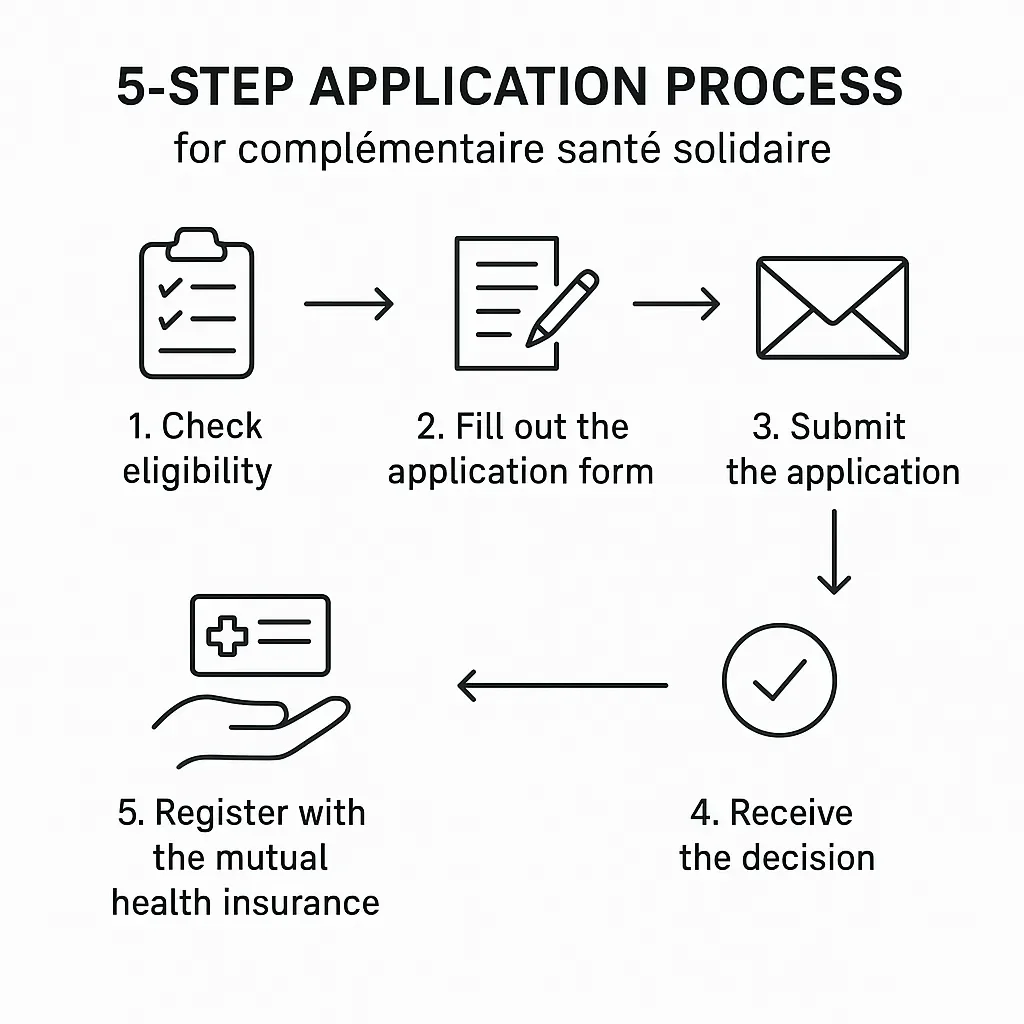
Here is the simplest path to follow, without complicating things:
- Check eligibility with the simulator or the official sheet.
- Gather supporting documents: income, household composition, identity, any recent changes.
- Submit the application online or at your fund.
- Wait for the decision and keep an eye on your messages or your Ameli account.
- Inform your organization if you already had private insurance, as unnecessary duplicates must be avoided.
If you go through a France Services advisor or the reception of your CPAM, do not hesitate to have the file reviewed. A missing document or a wrong income period, and the application goes off track. For the detailed procedure, the Health Insurance sheet on CSS remains the most practical reference.
What are the deadlines, renewal process, and what to do in case of refusal?
Once the application is submitted, the fund processes the file and makes its decision after verifying the submitted documents. In case of approval, the CSS is granted for a limited period and must be renewed before it expires. In case of refusal, you can request explanations and, if necessary, appeal within the prescribed time limits.
In real life, the best approach is to anticipate. Many people apply too late, especially when the financial situation changes from one month to another. However, renewal should not be handled at the last minute: you need to check the new income, see if the household has changed, and then submit a clean file again. Otherwise, you risk an unnecessary interruption.
In case of refusal, the most important thing is to understand why: income too high, incomplete file, incorrect household attachment, or information not taken into account. An appeal can sometimes correct a very simple error. On this point, the website of the Ministry in charge of Solidarity helps to stay on the right track.
CSS, traditional mutual insurance or out-of-pocket costs: how to choose?
The right choice mainly depends on your budget and your actual access to care. If you are eligible for the complementary health solidarity, it is often more advantageous than a basic paid mutual insurance because it greatly reduces out-of-pocket expenses. If you exceed the thresholds, then you need to compare the guarantees more carefully.
In other words, the CSS is not just social assistance: it is also a tool to protect against giving up care. At the moment when glasses, dental care, or hospitalization become too heavy for the budget, it can make a real difference. You still need to know if it is suitable for your profile, your household, and your current rights.
| Solution | Cost | Main advantage | Point of caution |
|---|---|---|---|
| Complementary health solidarity | €0 or nominal contribution | Strong protection for modest incomes | Thresholds to respect and renewal to monitor |
| Traditional mutual insurance | Monthly premium at your discretion | Wide choice of guarantees | Can be expensive for average coverage |
| Without complementary insurance | €0 contribution | No procedures | Sometimes very heavy out-of-pocket costs |
If you are unsure between CSS and company mutual insurance, check your professional situation carefully. A mandatory mutual insurance can sometimes coexist with certain rights, but you need to avoid unpleasant surprises at the time of joining or cancellation. Again, the basic rule remains simple: do not pay twice for the same protection.
Is the complementary health solidarity free for everyone?
No. It can be free for the most modest households, but a financial contribution may be requested depending on income and age. The idea is not to “make everyone pay a little,” but to adjust the cost to the household’s actual standard of living.
Can you apply for CSS without an Ameli account?
Yes, depending on your situation, the application can also be made via a paper form or with assistance at the fund. The Ameli account mainly facilitates follow-up, but it is not the only entry point. If your situation is complex, human assistance often remains the most effective.
Does the CSS automatically replace company mutual insurance?
Not always. If you benefit from mandatory mutual insurance through your job, you need to check how your rights and contractual obligations interact. Some people may be exempt or adjust their coverage, but it must be done properly to avoid a coverage gap or double contribution.
Can students benefit from the complementary health solidarity?
Yes, if their income and household situation allow it. A student who lives alone, works little, or is going through a period of instability can enter the scheme. However, attachment to the parental household and declared income can completely change the outcome.
What to do if my CSS application is denied?
Start by rereading the decision and the specific reasons for the refusal. An error in resources, a missing document, or an incorrect household composition may be enough. If the refusal seems unjustified to you, you can request an explanation and file an appeal within the deadlines indicated by your fund.
Is it necessary to renew the complementary health solidarity each year?
Yes, you need to monitor the expiration date and submit a new application on time. Renewal is a sensitive issue, especially when income has recently decreased or when the family composition has changed. Early renewal prevents the interruption of rights, and therefore the return of full out-of-pocket expenses.