
In brief
📌 The easiest to reduce are often the entry fees: aiming for 0% already makes a big difference if you contribute regularly.
📉 Management fees weigh more in the long term, as they apply every year on the assets. This is where returns get shaved off, slowly but surely.
🧾 Online contracts often show lighter fees than traditional bank offers, but you also need to look at the fees on the investment options and managed account fees.
🔍 Before signing, compare the fee schedule, the information notice, and the pre-contractual documents: the good clues are rarely hidden, but sometimes well concealed.
How are life insurance fees composed?
A life insurance contract adds several layers of fees, and they don’t all have the same impact. Entry fees are taken at the time of contribution, management fees recur every year, while arbitration fees appear when you change investment options. It is often this latter pair that weighs the most over time.
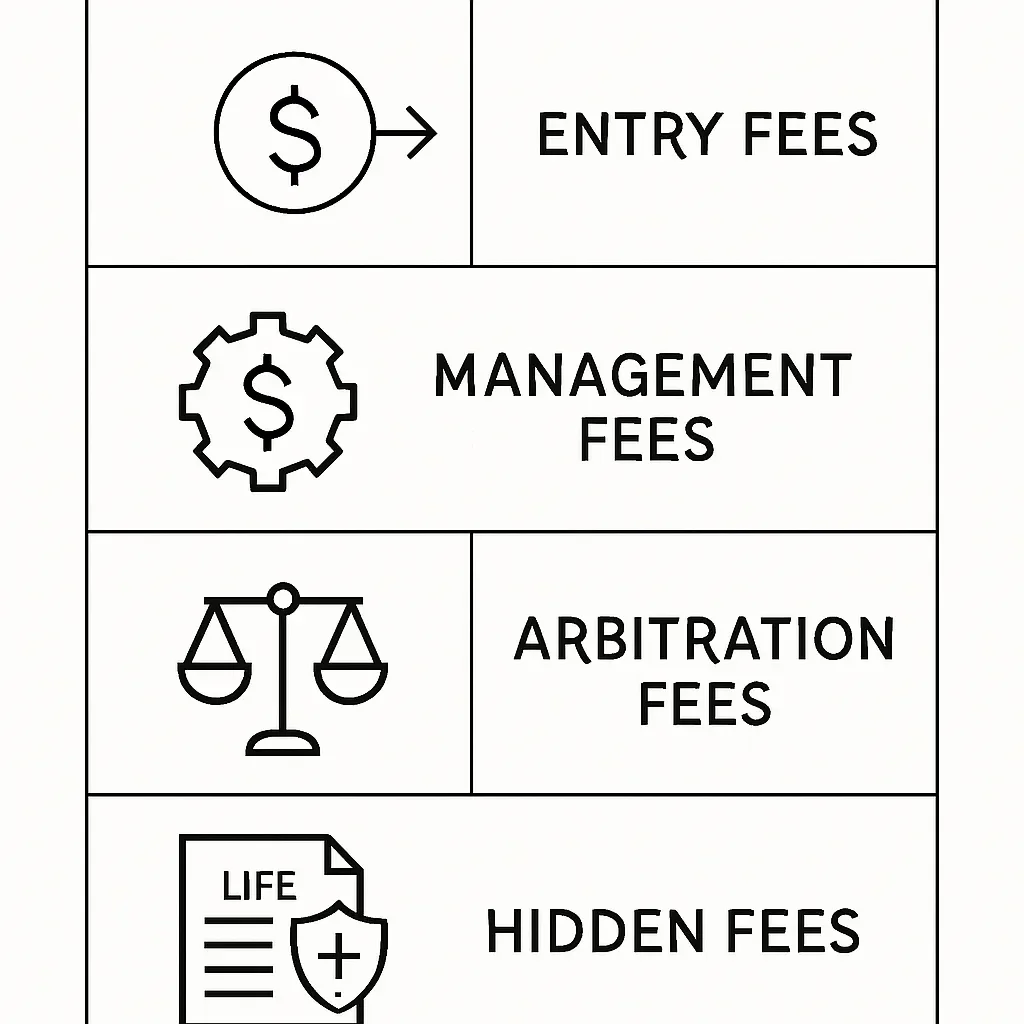
According to Service-Public, contract fees can be fixed or proportional, and they are charged at several points during the life of the contract. In other words, it is not enough to look at the gross return: you need to read the fee schedule, then check whether the fees apply to the contract itself or to the investment options held inside.
| Type of fee | When it applies | What to aim for |
|---|---|---|
| Entry fees | At each deposit | 0% if possible, especially for scheduled contributions |
| Management fees | Every year | The lowest level compatible with your strategy |
| Arbitration fees | When you change investment options | Free or capped, especially if you arbitrate often |
| Managed account fees | If you delegate decisions | Justified by a real service, not just a marketing label |
| Investment option fees | Inside the unit-linked funds | As low as possible, especially on ETFs |
The most often misunderstood point is the difference between contract fees and investment option fees. You can have a contract with 0% entry fees, but unit-linked funds that charge their own internal costs. This is also why two contracts showing a similar fee can produce very different performances.
Which fees can you really reduce before signing?
Before subscribing, you need to approach the subject like a smart buyer, not a spectator. Entry fees are not inevitable, especially on online contracts, often offered by players like Boursorama, Fortuneo, or Linxea. Banking networks sometimes keep heavier fees, but they can offer more comprehensive support. That’s why you need to compare the service provided, not just the “promo” line.
- Entry fees: ask if the contract can be set to 0%, especially if you contribute regularly.
- Management fees: check separately the euro fund and the unit-linked funds, as they do not have the same rate.
- Arbitration fees: look for at least a few free arbitrations per year, or even total free arbitration.
- Managed portfolio: accept the extra cost only if the strategy is clear, documented, and genuinely followed.
- Support fees: favor low-cost supports, especially if you invest for the long term.
The key point is not to confuse a “cheap” contract with a “good” contract. A low price is only interesting if it comes with a sound structure, serious supports, and genuinely useful service. Conversely, paying more for just a commercial facade is a bit like buying a car with chrome rims and a tired engine.
How to reduce fees on an already opened contract?
On an old contract, the classic mistake is to want to break everything at once. Bad plan. Life insurance taxation often rewards seniority, so you need to think strategically: keep what has already gained fiscal age, then optimize future flow. This is often smarter than doing a poorly calibrated big cleanup.
Start by looking at three very concrete points: the level of entry fees on your new contributions, the real cost of arbitrations, and the interest of delegated management. If your contract is loaded, a simple behavior change can already lower the bill:
- keep old contributions on the historical contract if it is fiscally advantageous;
- send new contributions to a leaner support, if your wealth strategy allows it;
- limit back-and-forth between supports, as some paid arbitrations eat up the sought gain;
- ask if an internal transfer is possible to a more recent contract from the same insurer.
Joking aside, the best contract is not the one that promises everything, it’s the one that leaves the most return in your pocket after fees.
It is also useful to reread the contractual documentation with a clear head. The Ministry of Economy reminds the importance of comparing fees before signing, while the AMF, for savers, emphasizes their direct impact on performance. In short, an average contract with low fees can outperform an attractive but too costly contract.
How much do these fees really cost you over time?
The real problem with life insurance fees is not their isolated amount: it is their repetition. An entry fee of 3% already hurts on the first payment, but an additional half-point management fee can cost more in the long run because it applies every year on a growing capital. It’s the famous snowball effect, but in the wrong direction.
| Scenario | Cost of fees | Practical interpretation |
|---|---|---|
| Payment of €1,000 with 3% fees | €30 deducted immediately | The invested capital starts lower from day one |
| Payments of €5,000 per year for 10 years with 2% fees | €1,000 lost at entry only | The bill remains visible, even before considering performance |
| Outstanding amount of €30,000 with an additional 0.5 point management fee | €150 per year, or €3,000 over 20 years excluding capitalization | The difference becomes very serious over a long period |
To grasp the scale of the issue, you also need to look at the fees of the investment options. A simple and lightly charged unit-linked fund can cost significantly less than a proprietary fund loaded with intermediate layers. In other words, two contracts with similar entry fees can diverge greatly over time simply because their investment options are not in the same league.
Which contract to choose to pay less without losing flexibility?
The right contract is not necessarily the cheapest on a single line, but the one that balances management fees, entry fees, quality of investment options, and ease of use. If you manage yourself, an online contract with 0% subscription fees and contained annual fees is often the most effective route. If you want support, you have to accept paying a bit more, but not just any way.
Here is the most useful sorting:
| Profile | Contract to favor | Point of vigilance |
|---|---|---|
| Independent saver | Online contract with reduced fees | Check the fees of the investment options and the quality of the interface |
| Scheduled payments | Contract with 0% entry fees | Small percentages become costly when repeated |
| Delegated management | Well-priced managed account | The extra cost must be justified by real added value |
| Old contract | Keep the fiscal seniority if it is useful | Do not sacrifice already acquired advantages for a mere cosmetic gain |
Practically speaking, the choice should not be made solely on the initial price. A slightly more expensive contract can be justified if it gives access to good investment options, free reallocations, and real follow-up. Conversely, a “budget” contract but poorly structured can cost more in the end. Careful reading of the terms is a bit like the whipped cream on the cherry: not essential at the start, but decisive in the end.
If you want to check the regulatory basics, rely on the Service-Public fact sheet on life insurance contracts, the guidelines from the Ministry of Economy, and the saver’s space of the AMF. These sources do not replace the comparison of a specific contract, but they provide a solid basis to avoid unpleasant surprises.
FAQ — Life insurance fees
Are life insurance fees negotiable?
Yes, especially the payment fees and sometimes the entry fees on a large initial contribution. For certain contracts, simply asking for a commercial discount is enough, particularly if you are contributing several thousand euros. However, management fees are harder to negotiate because they are part of the contract’s model.
Are the fees for managed accounts worth the extra cost?
Not always. Managed accounts can be justified if you lack time or interest in making adjustments, but they almost always add an extra layer of cost. The right approach is to check what the extra cost actually finances: allocation, rebalancing, reporting, or just a marketing label.
Can fees on an old contract be reduced without closing it?
Often yes, at least partially. Sometimes you can keep the tax seniority while stopping payments on the most expensive plan, or by requesting an internal transfer if the insurer allows it. Before making any decision, compare the fee difference with what you would lose in accrued benefits.
Do 0% entry fees mean the contract is free?
No, and this is a classic trap. A contract can show 0% payment fees while still having management fees, support fees, or fees related to delegated management. “Free” almost never exists in life insurance; you need to read the pricing as a whole.
Should you choose the euro fund to pay fewer fees?
Not necessarily. The euro fund is often easy to understand, but it is not automatically the least expensive, and its net return also depends on the contract fees. Unit-linked funds can be more costly, but some low-cost solutions, like ETFs, maintain a very reasonable fee level.